Department of Psychiatry, Massachusetts General Hospital and Harvard Medical School, Boston, MA, United States of America.
Department of Psychiatry, Massachusetts General Hospital and Harvard Medical School, Boston, MA, United States of America.
Gen Hosp Psychiatry. 2020 Jul-Aug;65:47-53. doi: 10.1016/j.genhosppsych.2020.05.008. Epub 2020 May 22.
Neuropsychiatric manifestations of the coronavirus disease 2019 (COVID-19) have been described, including anosmia, ageusia, headache, paresthesia, encephalitis and encephalopathy. Little is known about the mechanisms by which the virus causes central nervous system (CNS) symptoms, and therefore little guidance is available regarding potential workup or management options.
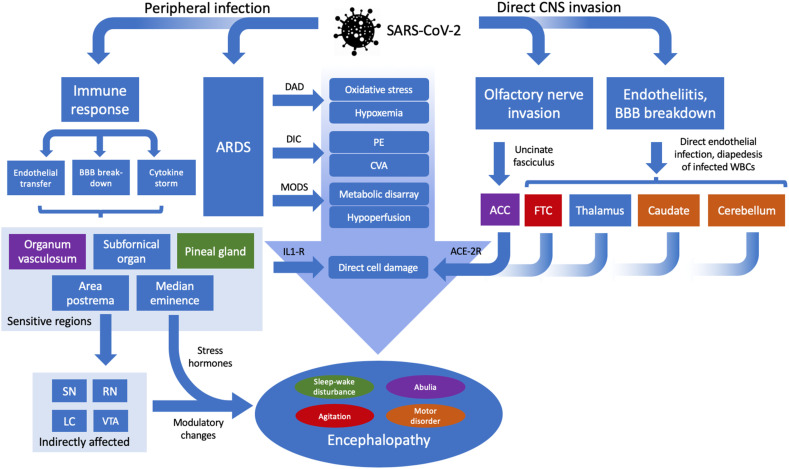
We present a series of four consecutive cases, seen by our psychiatry consultation service over a one-week period, each of which manifested delirium as a result of infection with severe acute respiratory syndrome coronavirus-2 (SARS-CoV-2).
The four cases highlighted here all occurred in older patients with premorbid evidence of cognitive decline. Unique features seen in multiple cases included rigidity, alogia, abulia, and elevated inflammatory markers. In all four cases, a change in mental status was the presenting symptom, and three of the four cases lacked significant respiratory symptoms. In addition to discussing unique features of the cases, we discuss possible pathophysiologic explanations for COVID-19 delirium.
Delirium should be recognized as a potential feature of infection with SARS-CoV-2 and may be the only presenting symptom. Based on the high rates of delirium demonstrated in prior studies, hospitals should consider adding mental status changes to the list of testing criteria. Further research is needed to determine if delirium in COVID-19 represents a primary encephalopathy heralding invasion of the CNS by the virus, or a secondary encephalopathy related to systemic inflammatory response or other factors.
已描述了 2019 年冠状病毒病(COVID-19)的神经精神表现,包括嗅觉丧失、味觉丧失、头痛、感觉异常、脑炎和脑病。人们对病毒引起中枢神经系统(CNS)症状的机制知之甚少,因此关于潜在的检查或治疗选择几乎没有指导。
我们提出了一系列连续的 4 个病例,在一周内由我们的精神病学咨询服务部门接诊,每个病例均因感染严重急性呼吸综合征冠状病毒 2(SARS-CoV-2)而表现出谵妄。
这里强调的四个病例均发生在有认知能力下降前期证据的老年患者中。在多个病例中可见到的独特特征包括僵硬、言语减少、意志缺失和炎症标志物升高。在所有四个病例中,精神状态的改变是首发症状,并且四个病例中有三个缺乏明显的呼吸道症状。除了讨论病例的独特特征外,我们还讨论了 COVID-19 谵妄的可能病理生理解释。
应将谵妄视为感染 SARS-CoV-2 的潜在特征,并且可能是唯一的首发症状。根据先前研究中显示的高谵妄发生率,医院应考虑将精神状态改变添加到检查标准列表中。需要进一步研究以确定 COVID-19 中的谵妄是否代表病毒对 CNS 的原发性脑病侵袭,或者是否与全身炎症反应或其他因素有关的继发性脑病。