Biochemistry Department, University of Geneva, 1211, Geneva, Switzerland.
LPTMS, CNRS, Université Paris-Sud, Université Paris-Saclay, 91405, Orsay, France.
Nat Commun. 2020 May 29;11(1):1516. doi: 10.1038/s41467-020-15327-4.
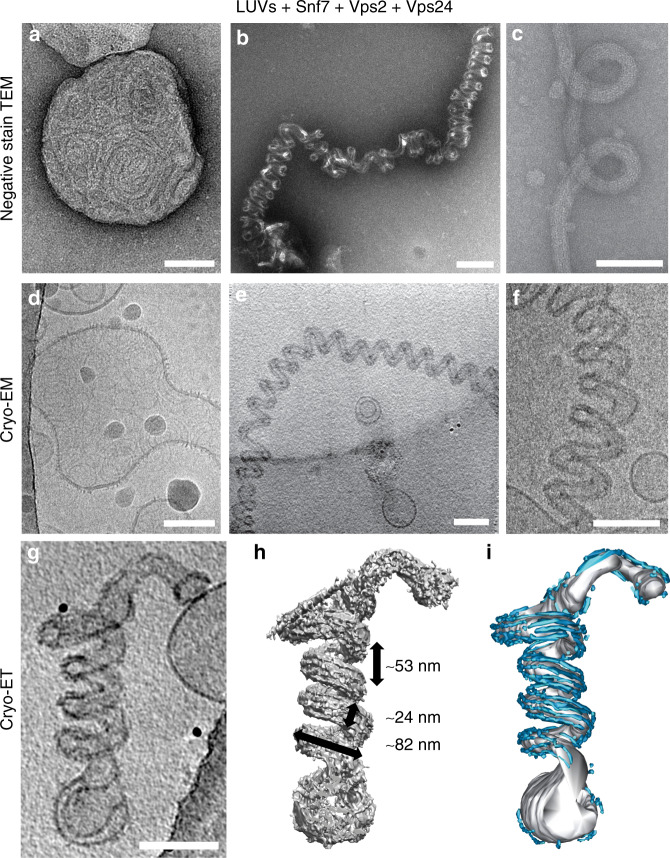
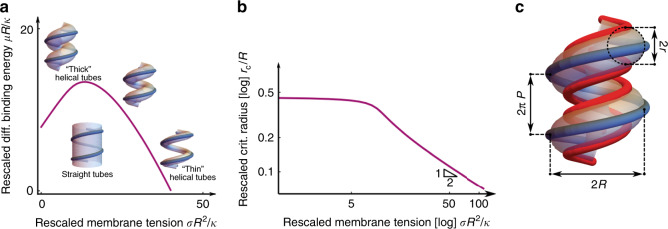
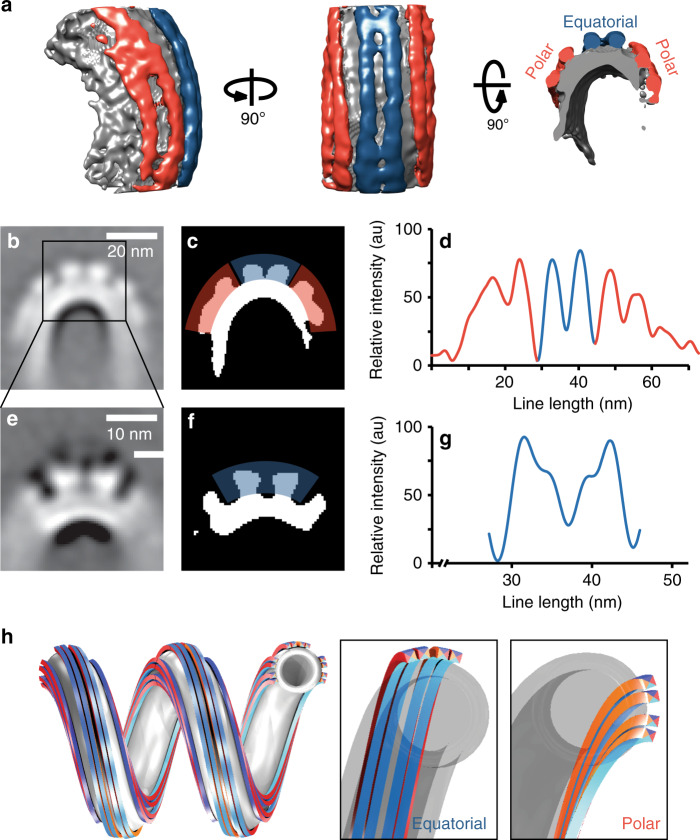
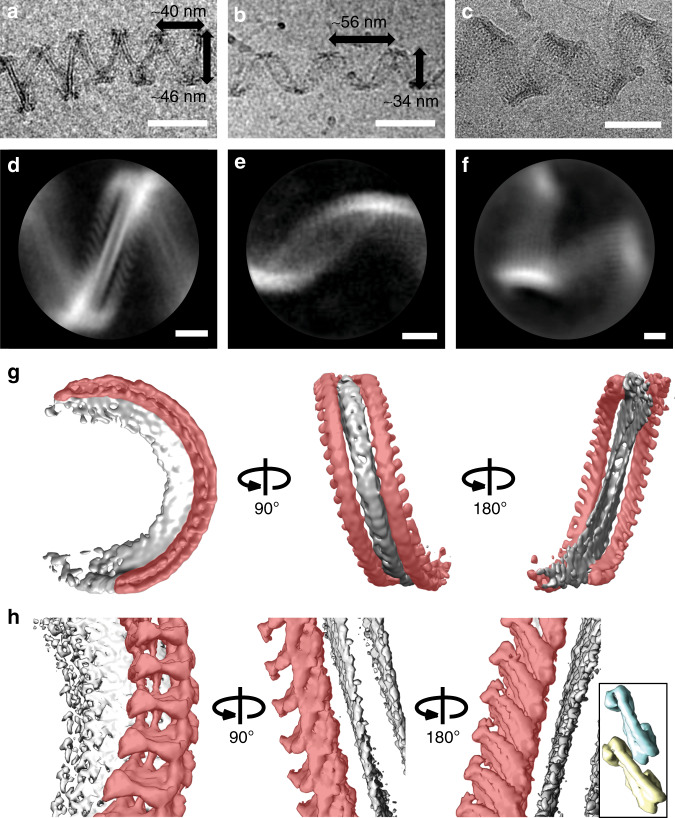
ESCRT-III proteins assemble into ubiquitous membrane-remodeling polymers during many cellular processes. Here we describe the structure of helical membrane tubes that are scaffolded by bundled ESCRT-III filaments. Cryo-ET reveals how the shape of the helical membrane tube arises from the assembly of two distinct bundles of helical filaments that have the same helical path but bind the membrane with different interfaces. Higher-resolution cryo-EM of filaments bound to helical bicelles confirms that ESCRT-III filaments can interact with the membrane through a previously undescribed interface. Mathematical modeling demonstrates that the interface described above is key to the mechanical stability of helical membrane tubes and helps infer the rigidity of the described protein filaments. Altogether, our results suggest that the interactions between ESCRT-III filaments and the membrane could proceed through multiple interfaces, to provide assembly on membranes with various shapes, or adapt the orientation of the filaments towards the membrane during membrane remodeling.
ESCRT-III 蛋白在许多细胞过程中组装成普遍存在的膜重塑聚合物。在这里,我们描述了由束状 ESCRT-III 丝组装而成的螺旋膜管的结构。冷冻电镜技术揭示了螺旋膜管的形状如何源于两种不同的螺旋丝束的组装,这两种螺旋丝束具有相同的螺旋路径,但与膜结合的界面不同。与螺旋双联体结合的丝的更高分辨率冷冻电镜证实,ESCRT-III 丝可以通过以前未描述的界面与膜相互作用。数学建模表明,上述界面是螺旋膜管机械稳定性的关键,并有助于推断所描述的蛋白丝的刚性。总之,我们的结果表明,ESCRT-III 丝和膜之间的相互作用可以通过多个界面进行,从而为具有各种形状的膜提供组装,或者在膜重塑过程中调整丝对膜的取向。