Zaragori Timothée, Ginet Merwan, Marie Pierre-Yves, Roch Véronique, Grignon Rachel, Gauchotte Guillaume, Rech Fabien, Blonski Marie, Lamiral Zohra, Taillandier Luc, Imbert Laëtitia, Verger Antoine
Department of Nuclear Medicine & Nancyclotep Imaging platform, Université de Lorraine, CHRU-Nancy, F-54000, Nancy, France.
IADI, INSERM, UMR 1254, Université de Lorraine, F-54000, Nancy, France.
EJNMMI Res. 2020 May 29;10(1):56. doi: 10.1186/s13550-020-00645-x.
Static [F]-F-DOPA PET images are currently used for identifying patients with glioma recurrence/progression after treatment, although the additional diagnostic value of dynamic parameters remains unknown in this setting. The aim of this study was to evaluate the performances of static and dynamic [F]-F-DOPA PET parameters for detecting patients with glioma recurrence/progression as well as assess further relationships with patient outcome.
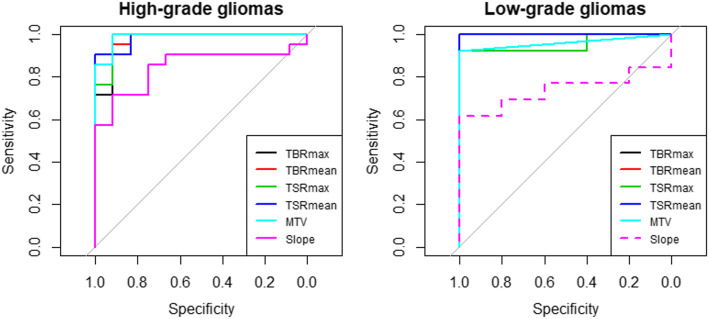
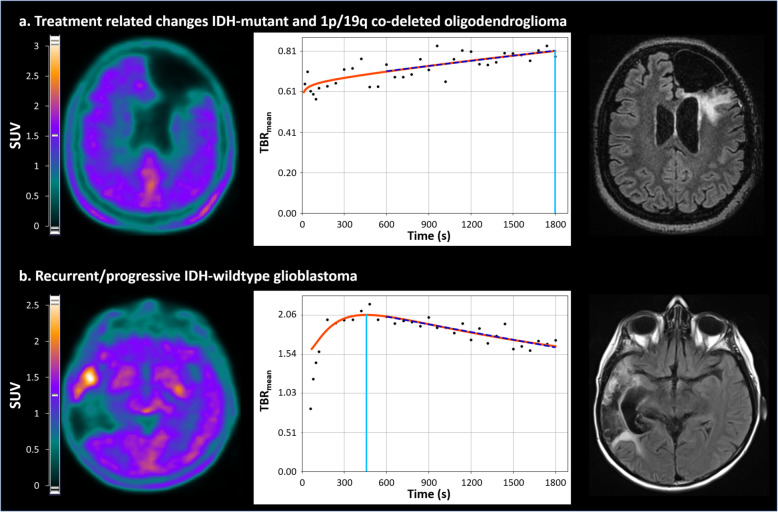
Fifty-one consecutive patients who underwent an [F]-F-DOPA PET for a suspected glioma recurrence/progression at post-resection MRI, were retrospectively included. Static parameters, including mean and maximum tumor-to-normal-brain (TBR) ratios, tumor-to-striatum (TSR) ratios, and metabolic tumor volume (MTV), as well as dynamic parameters with time-to-peak (TTP) values and curve slope, were tested for predicting the following: (1) glioma recurrence/progression at 6 months after the PET exam and (2) survival on longer follow-up.
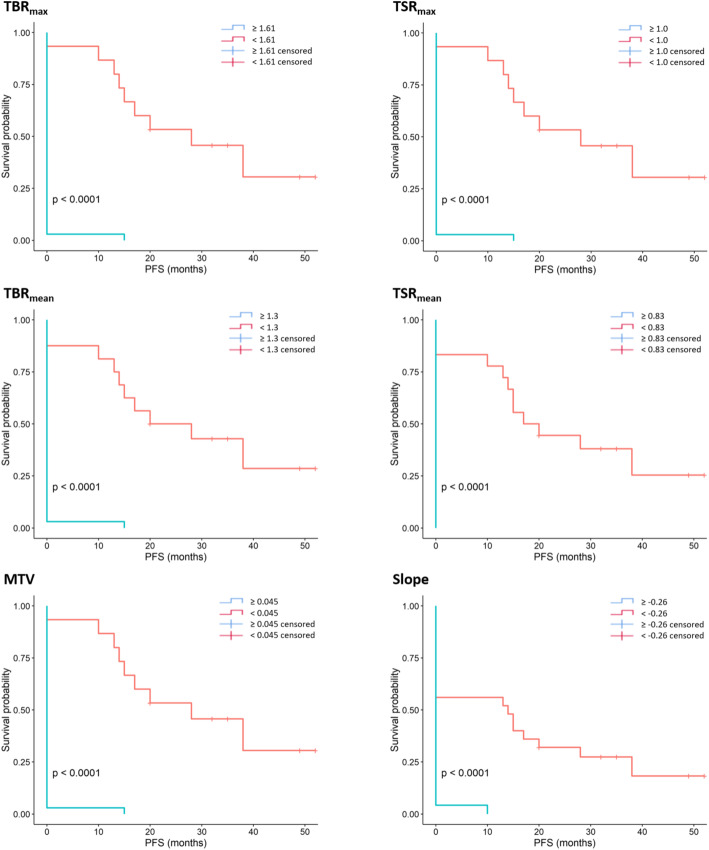
All static parameters were significant predictors of glioma recurrence/progression (accuracy ≥ 94%) with all parameters also associated with mean progression-free survival (PFS) in the overall population (all p < 0.001, 29.7 vs. 0.4 months for TBR, TSR, and MTV). The curve slope was the sole dynamic PET predictor of glioma recurrence/progression (accuracy = 76.5%) and was also associated with mean PFS (p < 0.001, 18.0 vs. 0.4 months). However, no additional information was provided relative to static parameters in multivariate analysis.
Although patients with glioma recurrence/progression can be detected by both static and dynamic [F]-F-DOPA PET parameters, most of this diagnostic information can be achieved by conventional static parameters.
目前,静态[F]-氟多巴正电子发射断层扫描(PET)图像用于识别治疗后胶质瘤复发/进展的患者,尽管在此情况下动态参数的附加诊断价值仍不清楚。本研究的目的是评估静态和动态[F]-氟多巴PET参数检测胶质瘤复发/进展患者的性能,并进一步评估与患者预后的关系。
回顾性纳入51例在切除术后MRI怀疑胶质瘤复发/进展而行[F]-氟多巴PET检查的连续患者。测试静态参数,包括平均和最大肿瘤与正常脑(TBR)比值、肿瘤与纹状体(TSR)比值和代谢肿瘤体积(MTV),以及具有达峰时间(TTP)值和曲线斜率的动态参数,以预测以下情况:(1)PET检查后6个月的胶质瘤复发/进展,以及(2)更长随访期的生存期。
所有静态参数都是胶质瘤复发/进展的显著预测指标(准确率≥94%),所有参数也与总体人群的平均无进展生存期(PFS)相关(所有p<0.001,TBR、TSR和MTV的PFS分别为29.7个月和0.4个月)。曲线斜率是胶质瘤复发/进展的唯一动态PET预测指标(准确率=76.5%),也与平均PFS相关(p<0.001,分别为18.0个月和0.4个月)。然而,在多变量分析中,相对于静态参数没有提供额外信息。
尽管静态和动态[F]-氟多巴PET参数均可检测胶质瘤复发/进展患者,但大多数诊断信息可通过传统静态参数获得。