National Institute of Biomedical Genomics, Kalyani, West Bengal, India.
Indian J Med Res. 2020 May;151(5):450-458. doi: 10.4103/ijmr.IJMR_1125_20.
BACKGROUND & OBJECTIVES: SARS-CoV-2 (Severe acute respiratory syndrome coronavirus-2) is evolving with the progression of the pandemic. This study was aimed to investigate the diversity and evolution of the coronavirus SARS-CoV-2 with progression of the pandemic over time and to identify similarities and differences of viral diversity and evolution across geographical regions (countries).
Publicly available data on type definitions based on whole-genome sequences of the SARS-CoV-2 sampled during December and March 2020 from 3636 infected patients spread over 55 countries were collected. Phylodynamic analyses were performed and the temporal and spatial evolution of the virus was examined.
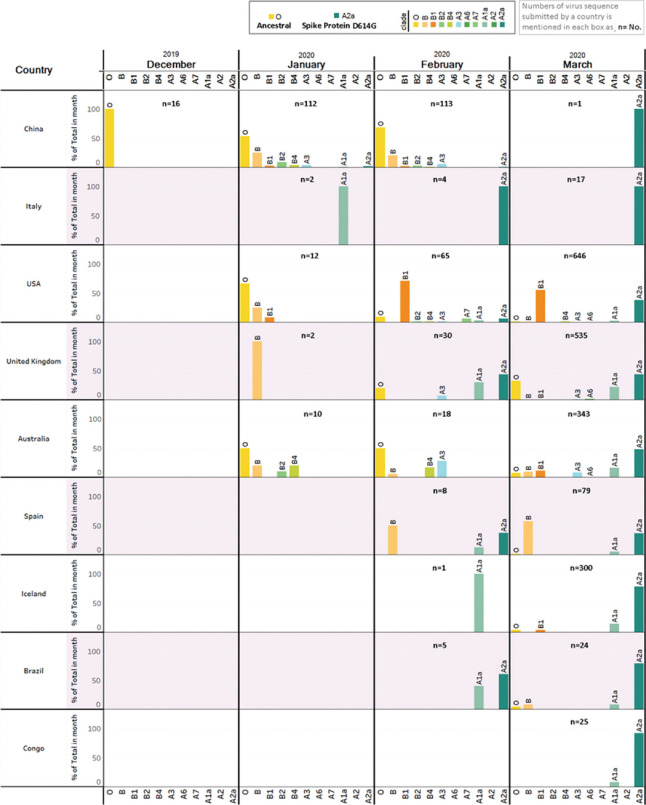
It was found that (i) temporal variation in frequencies of types of the coronavirus was significant; ancestral viruses of type O were replaced by evolved viruses belonging to type A2a; (ii) spatial variation was not significant; with the spread of SARS-CoV-2, the dominant virus was the A2a type virus in every geographical region; (iii) within a geographical region, there was significant micro-level variation in the frequencies of the different viral types, and (iv) the evolved coronavirus of type A2a swept rapidly across all continents.
INTERPRETATION & CONCLUSIONS: SARS-CoV-2 belonging to the A2a type possesses a non-synomymous variant (D614G) that possibly eases the entry of the virus into the lung cells of the host. This may be the reason why the A2a type has an advantage to infect and survive and as a result has rapidly swept all geographical regions. Therefore, large-scale sequencing of coronavirus genomes and, as required, of host genomes should be undertaken in India to identify regional and ethnic variation in viral composition and its interaction with host genomes. Further, careful collection of clinical and immunological data of the host can provide deep learning in relation to infection and transmission of the types of coronavirus genomes.
SARS-CoV-2(严重急性呼吸系统综合征冠状病毒-2)随着大流行的发展而不断演变。本研究旨在调查冠状病毒 SARS-CoV-2 的多样性和进化,以及随着时间的推移识别病毒多样性和进化在地理区域(国家)之间的异同。
收集了 2020 年 12 月至 3 月间来自 55 个国家的 3636 名感染患者的基于全基因组序列的 SARS-CoV-2 样本的基于类型定义的公开可用数据。进行了系统发育动力学分析,并检查了病毒的时间和空间进化。
发现(i)冠状病毒类型的频率随时间的变化具有重要意义;O 型病毒的祖先被属于 A2a 型的进化病毒所取代;(ii)空间变化不显著;随着 SARS-CoV-2 的传播,每个地理区域的主要病毒都是 A2a 型病毒;(iii)在一个地理区域内,不同病毒类型的频率存在显著的微观变化;(iv)A2a 型进化冠状病毒迅速席卷各大洲。
属于 A2a 型的 SARS-CoV-2 具有非同义突变(D614G),这可能使病毒更容易进入宿主的肺细胞。这可能是 A2a 型具有感染和生存优势并迅速席卷所有地理区域的原因。因此,应在印度大规模对冠状病毒基因组进行测序,并根据需要对宿主基因组进行测序,以确定病毒组成的区域和种族差异及其与宿主基因组的相互作用。此外,仔细收集宿主的临床和免疫学数据可以为感染和传播类型的冠状病毒基因组提供深度学习。