Koltzov Institute of Developmental Biology, Russian Academy of Sciences, Moscow, Russia.
Eur J Clin Invest. 2020 Sep;50(9):e13294. doi: 10.1111/eci.13294. Epub 2020 Jun 13.
Since the time of global SARS-CoV-2 spread across the earth in February 2020, most of countries faced the problem of massive stress of their healthcare systems. In many cases, the structural stress was a result of incorrect allocation of medical care resources. In turn, this misallocation resulted from fear and apprehensions that superseded thorough calculations. A key role in exacerbating the healthcare sector overburdening was played by misleading information on the virus and disease caused by it. In the current paper, we study the situation in Russian healthcare system and advance recommendations how to avoid further crises.
(a) Surveying the medical personnel (231 doctors, 317 nurses and 355 ambulance medical workers of lower levels) in five hospitals and six ambulance centres in Moscow. (b) Content analysis of 3164 accounts in Russian segment of social networks (VKontakte, Facebook, Instagram, Twitter, Odnoklassniki); official and unofficial media (TV, informational webpages).
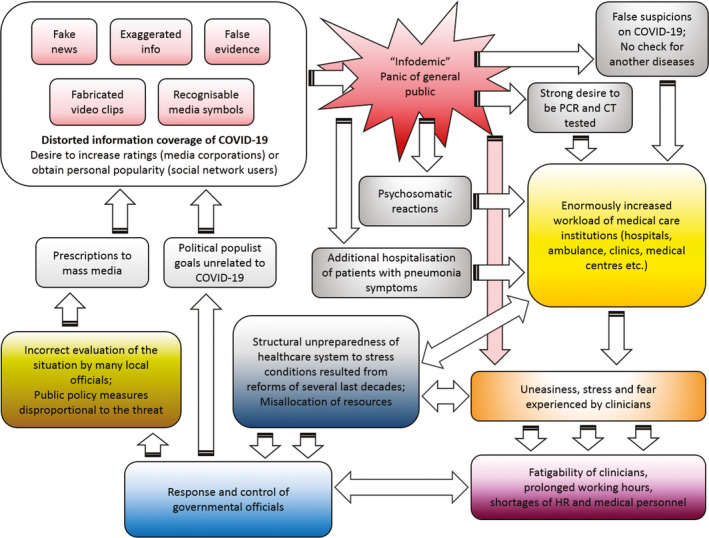
We revealed positive-feedback loop that threatened the sustainability of Russian care sector. The main knot was occupied by incorrect/exaggerated media coverage of COVID-19. General public scared by misinformation in media and social networks, started to panic. This negative social background undermined the productivity of a significant part of medical workers who were afraid of COVID-19 patients.
The most serious problems of Russian healthcare sector related to COVID-19 pandemic, were informational problems. The exaggerated information on COVID-19 had big negative influence upon Russian society and healthcare system, despite SARS-CoV-2 relatively low epidemiological hazard.
自 2020 年 2 月全球 SARS-CoV-2 扩散以来,大多数国家都面临着医疗系统巨大压力的问题。在许多情况下,结构性压力是医疗资源配置不当的结果。反过来,这种配置不当又源于恐惧和担忧,而这些恐惧和担忧又超越了深思熟虑的计算。导致医疗保健部门负担过重的一个关键因素是关于病毒及其引起的疾病的误导性信息。在当前的论文中,我们研究了俄罗斯医疗保健系统的情况,并提出了如何避免进一步危机的建议。
(a) 对莫斯科的五家医院和六家救护车中心的 231 名医生、317 名护士和 355 名救护车医护人员进行调查。(b) 对俄罗斯社交网络(VKontakte、Facebook、Instagram、Twitter、Odnoklassniki)部分的 3164 个账户和官方及非官方媒体(电视、信息网页)进行内容分析。
我们揭示了威胁俄罗斯护理部门可持续性的正反馈循环。主要的症结是 COVID-19 的媒体报道不正确/夸大。公众被媒体和社交网络中的错误信息吓到,开始恐慌。这种负面的社会背景削弱了相当一部分医疗工作者的生产力,他们害怕 COVID-19 患者。
与 COVID-19 大流行相关的俄罗斯医疗保健部门最严重的问题是信息问题。尽管 SARS-CoV-2 的流行病学危害相对较低,但对 COVID-19 的夸大信息对俄罗斯社会和医疗保健系统产生了巨大的负面影响。