Sun Bin, Chen Zhiyong, Duan Qing, Xue Yunjing, Chen Lianglong, Zhang Zhongshuai, An Jing
Department of Radiology, Union Hospital, Fujian Medical University, 29 Xin-Quan Road, Fuzhou, 350001, People's Republic of China.
Department of Cardiology, Union Hospital, Fujian Medical University, Fuzhou, China.
J Cardiovasc Magn Reson. 2020 Jun 1;22(1):40. doi: 10.1186/s12968-020-00630-2.
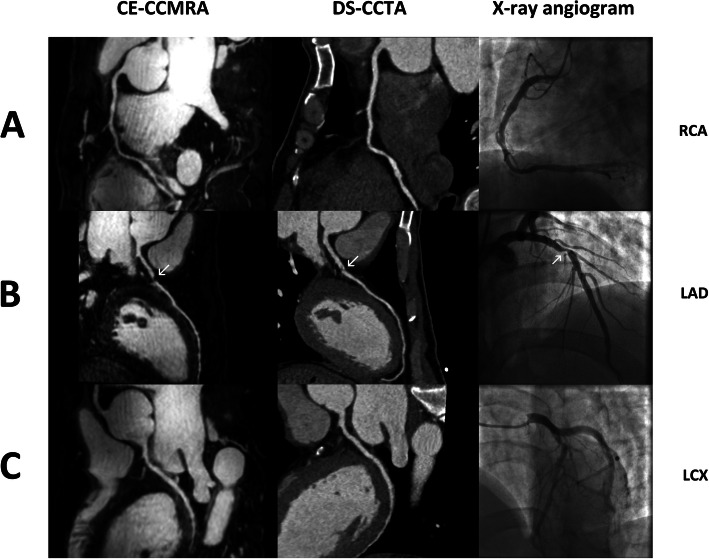
In recent years, substantial advances have been made in noninvasive cardiac imaging, including cardiac computed tomography (CT) and cardiovascular magnetic resonance (CMR). The purpose of this study was to prospectively compare the diagnostic performance of contrast-enhanced whole heart coronary CMR angiography (CCMRA) to dual-source coronary CT angiography (CCTA) for the diagnosis of significant coronary stenoses (≥50%) in patients with known or suspected coronary artery disease (CAD) referred for conventional x-ray coronary angiography.
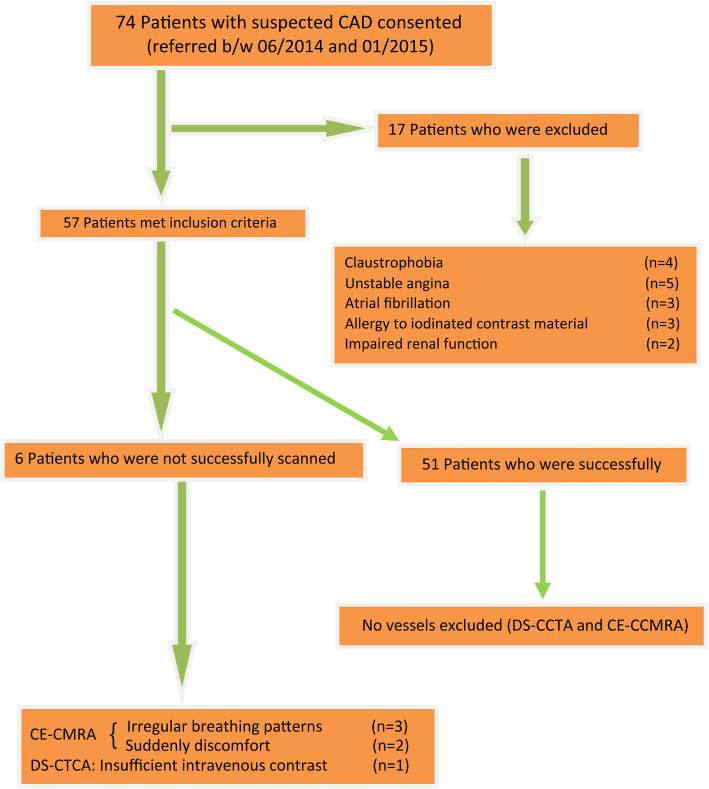
Our objective was to directly compare the diagnostic accuracy of contrast-enhanced whole-heart CCMRA (CE-CCMRA) to dual-source CCTA (DS-CCTA) for the detection of CAD. We prospectively studied 57 symptomatic patients with suspected or known CAD who were scheduled for conventional x-ray coronary angiography. Significant CAD was defined as an x-ray defined diameter reduction of ≥50% in a coronary artery with a reference diameter of ≥1.5 mm.
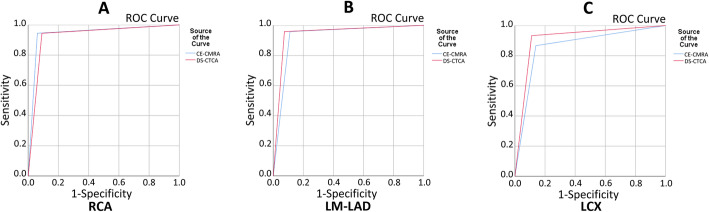
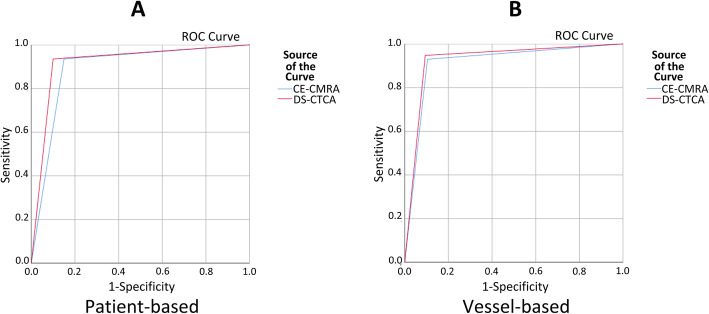
CE-CCMRA and DS-CCTA were completed in 51 (89%) of 57 patients without complications. The acquisition times of CE-CCMRA and DS-CCTA, respectively, were 9.5 ± 3.1 min and 8.3 ± 1.4 s. On patient-based analysis, the sensitivity, specificity, positive and negative predictive value of CE-CCMRA and DS-CCTA were 93.5% versus 93.5%(P > 0.05), 85% versus 90%(P > 0.05), 90.6% versus 93.5%(P > 0.05), and 89.4% versus 90%(P > 0.05), respectively. The area under the curve (AUC) was 0.89 (95% CI: 0.79 to 0.99) for CE-CCMRA and 0.92 (95% CI: 0.83 to 1.00) for DS-CCTA.
DS-CCTA was found to be superior to CE-CCMRA in the diagnosis of significant coronary stenoses (≥50%) in patients with suspected or known CAD scheduled for conventional x-ray coronary angiography, owing to shorter scanning times and higher spatial resolution. However, CE-CCMRA and DS-CCTA have similar diagnostic accuracies.
近年来,无创心脏成像技术取得了重大进展,包括心脏计算机断层扫描(CT)和心血管磁共振成像(CMR)。本研究的目的是前瞻性地比较对比增强全心冠状动脉磁共振血管造影(CCMRA)与双源冠状动脉CT血管造影(CCTA)对因常规X线冠状动脉造影而转诊的已知或疑似冠状动脉疾病(CAD)患者显著冠状动脉狭窄(≥50%)的诊断性能。
我们的目标是直接比较对比增强全心CCMRA(CE-CCMRA)与双源CCTA(DS-CCTA)对CAD的诊断准确性。我们前瞻性地研究了57例有症状的疑似或已知CAD患者,他们计划进行常规X线冠状动脉造影。显著CAD定义为在参考直径≥1.5 mm的冠状动脉中,X线显示直径减少≥50%。
57例患者中有51例(89%)完成了CE-CCMRA和DS-CCTA检查,无并发症发生。CE-CCMRA和DS-CCTA的采集时间分别为9.5±3.1分钟和8.3±1.4秒。基于患者的分析中,CE-CCMRA和DS-CCTA的敏感性、特异性、阳性和阴性预测值分别为93.5%对93.5%(P>0.05)、85%对90%(P>0.05)、90.6%对93.5%(P>0.05)和89.4%对90%(P>0.05)。CE-CCMRA的曲线下面积(AUC)为0.89(95%CI:0.79至0.99),DS-CCTA的曲线下面积为0.92(95%CI:0.83至1.00)。
对于计划进行常规X线冠状动脉造影的疑似或已知CAD患者,由于扫描时间较短和空间分辨率较高,发现DS-CCTA在诊断显著冠状动脉狭窄(≥50%)方面优于CE-CCMRA。然而,CE-CCMRA和DS-CCTA具有相似的诊断准确性。