Felzer-Kim Isabella Theresa, Hauck Janet Lynn
Department of Kinesiology, Michigan State University, East Lansing, MI, United States.
Front Integr Neurosci. 2020 May 12;14:24. doi: 10.3389/fnint.2020.00024. eCollection 2020.
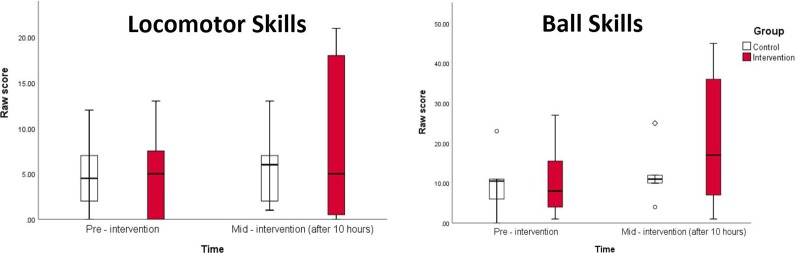
: The purpose of this study was to explore the question of the minimal amount of instructional time needed to still be effective by assessing the efficacy at mid-intervention of an early fundamental movement skill (FMS) intervention for preschoolers with Autism Spectrum Disorder (ASD). : Fourteen preschoolers participated in this randomized controlled trial daily over 10 weeks (10 h total at mid-intervention). A two-factor mixed MANOVA tested the significance of grouptime interactions for two dependent variables: object control and locomotor raw scores on the Test of Gross Motor Development-III. : Grouptime interactions approached significance with large effect sizes on the vector of both dependent variables and in a univariate fashion on object control scores, but not locomotor scores. : These findings hold relevance for physical educators working with young children with ASD, indicating that 10 h of FMS instruction, at least in this form, is not adequate to improve FMS.
本研究的目的是通过评估针对自闭症谱系障碍(ASD)学龄前儿童的早期基本运动技能(FMS)干预在干预中期的效果,来探讨达到有效所需的最少教学时间问题。14名学龄前儿童在10周内每天参与这项随机对照试验(干预中期共10小时)。双因素混合多元方差分析检验了组时间交互作用对两个因变量的显著性:粗大运动发展测试-III上的物体控制和移动原始分数。组时间交互作用在两个因变量的向量上以及在物体控制分数上以单变量方式接近显著性,但在移动分数上不显著。这些发现对与患有ASD的幼儿一起工作的体育教育工作者具有重要意义,表明至少以这种形式进行10小时的FMS教学不足以改善FMS。