Chance Frances S, Aimone James B, Musuvathy Srideep S, Smith Michael R, Vineyard Craig M, Wang Felix
Department of Cognitive and Emerging Computing, Sandia National Laboratories, Albuquerque, NM, United States.
All-Source Analytics Department, Sandia National Laboratories, Albuquerque, NM, United States.
Front Comput Neurosci. 2020 May 6;14:39. doi: 10.3389/fncom.2020.00039. eCollection 2020.
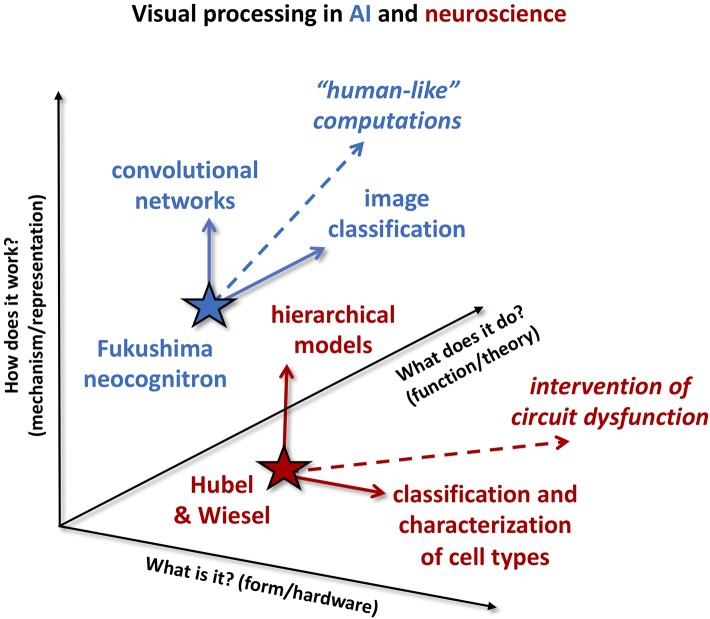
Historically, neuroscience principles have heavily influenced artificial intelligence (AI), for example the influence of the perceptron model, essentially a simple model of a biological neuron, on artificial neural networks. More recently, notable recent AI advances, for example the growing popularity of reinforcement learning, often appear more aligned with cognitive neuroscience or psychology, focusing on function at a relatively abstract level. At the same time, neuroscience stands poised to enter a new era of large-scale high-resolution data and appears more focused on underlying neural mechanisms or architectures that can, at times, seem rather removed from functional descriptions. While this might seem to foretell a new generation of AI approaches arising from a deeper exploration of neuroscience specifically for AI, the most direct path for achieving this is unclear. Here we discuss cultural differences between the two fields, including divergent priorities that should be considered when leveraging modern-day neuroscience for AI. For example, the two fields feed two very different applications that at times require potentially conflicting perspectives. We highlight small but significant cultural shifts that we feel would greatly facilitate increased synergy between the two fields.
从历史上看,神经科学原理对人工智能(AI)产生了重大影响,例如感知器模型(本质上是生物神经元的简单模型)对人工神经网络的影响。最近,人工智能取得了显著进展,例如强化学习越来越受欢迎,这些进展往往与认知神经科学或心理学更为契合,侧重于相对抽象层面的功能。与此同时,神经科学即将进入一个大规模高分辨率数据的新时代,似乎更专注于潜在的神经机制或架构,而这些有时可能与功能描述相去甚远。虽然这似乎预示着将通过对专门用于人工智能的神经科学进行更深入的探索而产生新一代的人工智能方法,但实现这一目标的最直接途径尚不明朗。在此,我们讨论这两个领域之间的文化差异,包括在将现代神经科学应用于人工智能时应考虑的不同优先事项。例如,这两个领域服务于两种截然不同的应用,有时需要可能相互冲突的观点。我们强调一些虽小但意义重大的文化转变,我们认为这些转变将极大地促进两个领域之间的协同增效。