Kutz Dieter F, Kolb Florian P, Glasauer Stefan, Straka Hans
Institute of Human Movement Sciences, Faculty of Behavioral and Social Sciences, Chemnitz University of Technology, Chemnitz, Germany.
Department of Physiological Genomics, Institute of Physiology, Ludwig-Maximilian-University Munich, Munich, Germany.
Front Neurol. 2020 May 14;11:332. doi: 10.3389/fneur.2020.00332. eCollection 2020.
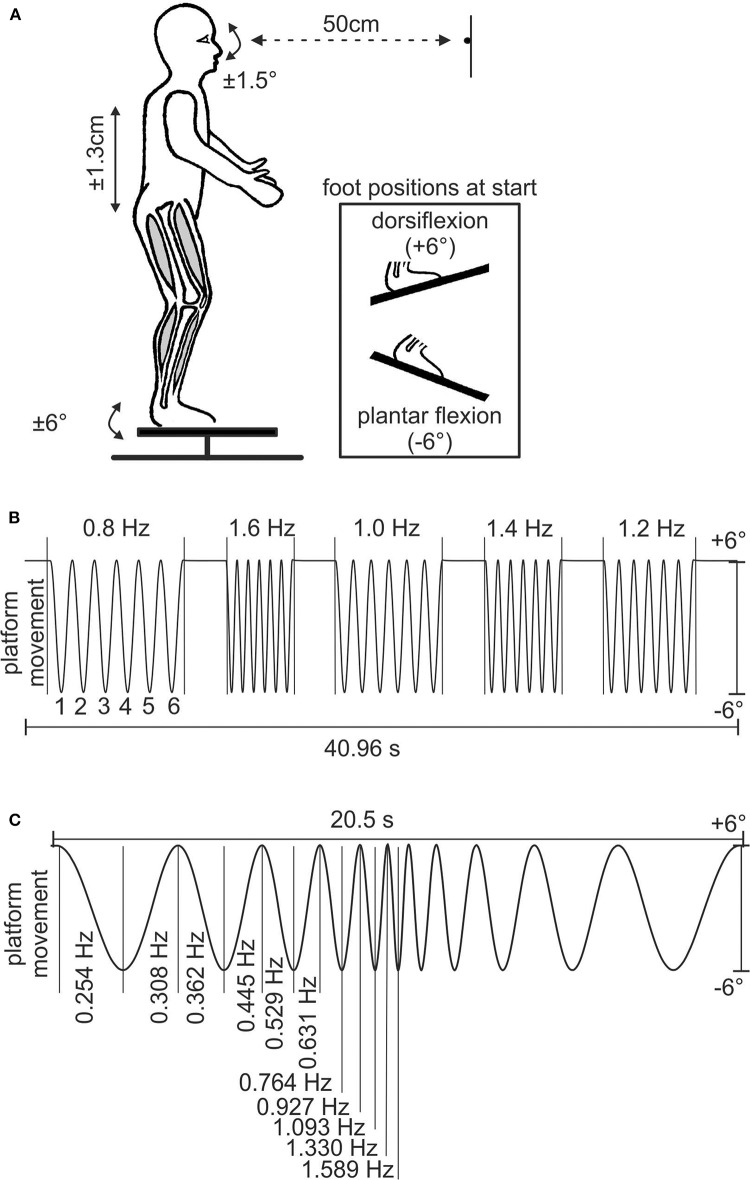
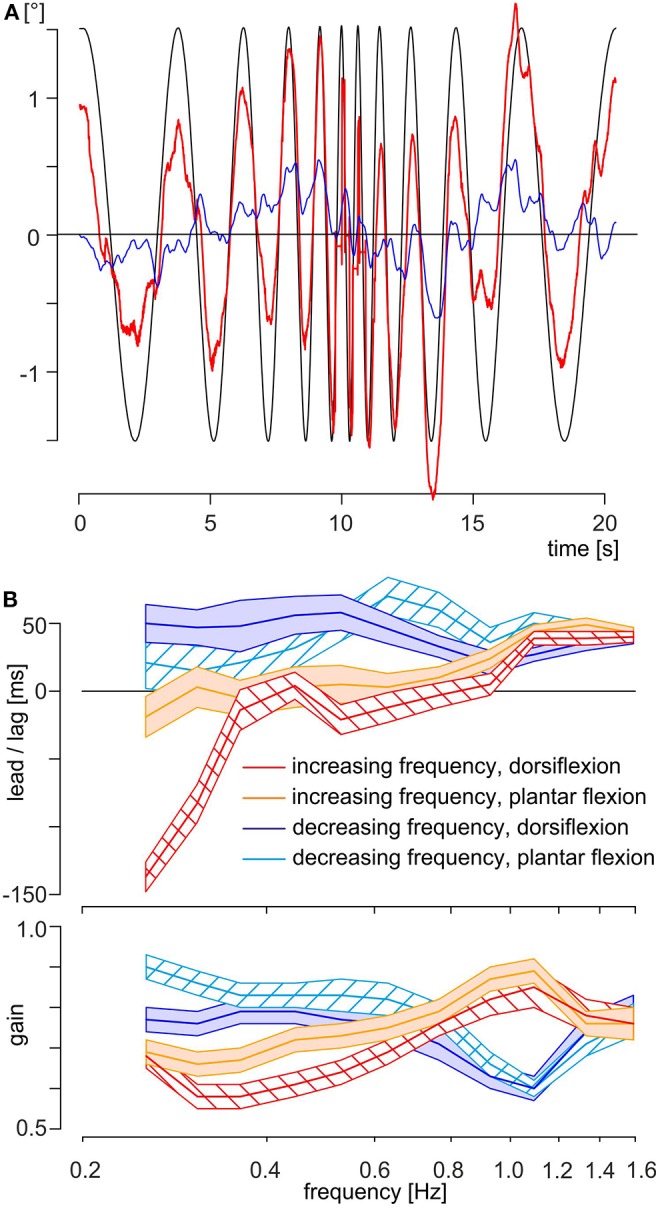
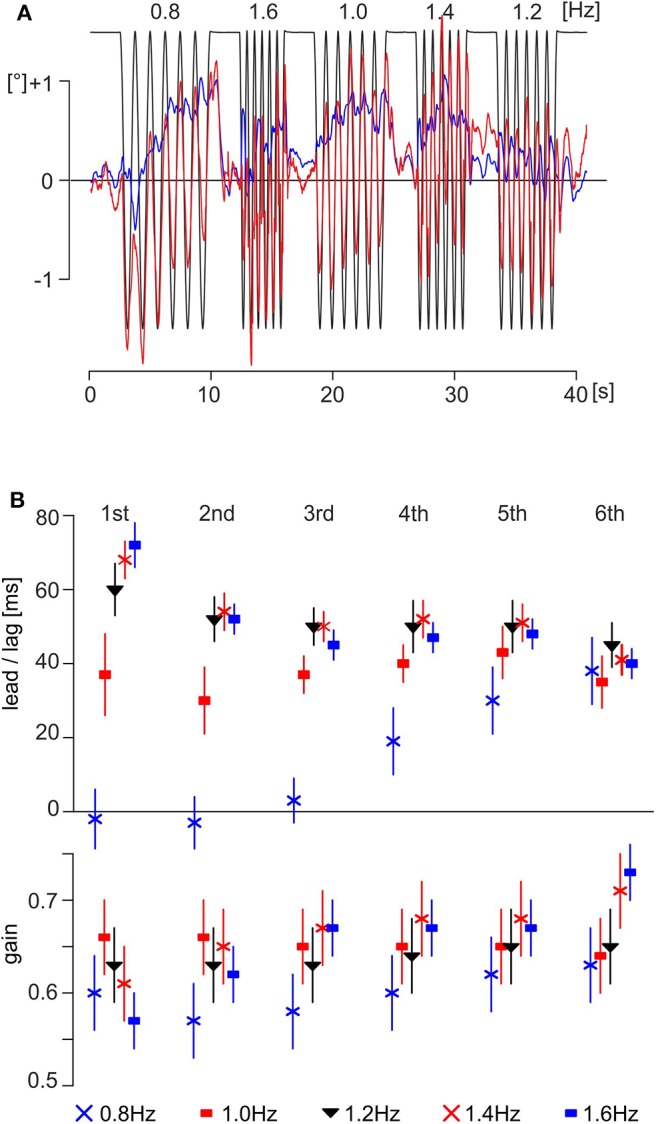
The vestibulo-ocular reflex (VOR) consists of two components, the rotational VOR (rVOR) elicited by semicircular canal signals and the translational VOR (tVOR) elicited by otolith signals. Given the relevant role of the vertical tVOR in human walking, this study aimed at measuring the time delay of eye movements in relation to whole-body vertical translations in natural standing position. Twenty (13 females and 7 males) healthy, young subjects (mean 25 years) stood upright on a motor-driven platform and were exposed to sinusoidal movements while fixating a LED, positioned at a distance of 50 cm in front of the eyes. The platform motion induced a vertical translation of 2.6 cm that provoked counteracting eye movements similar to self-paced walking. The time differences between platform and eye movements indicated that the subject's timing of the extraocular motor reaction depended on stimulus frequency and number of repetitions. At low stimulus frequencies (<0.8 Hz) and small numbers of repetitions (<3), eye movements were phase advanced or in synchrony with platform movements. At higher stimulus frequencies or continuous stimulation, eye movements were phase lagged by ~40 ms. Interestingly, the timing of eye movements depended on the initial platform inclination. Starting with both feet in dorsiflexion, eye movements preceded platform movements by 137 ms, whereas starting with both feet in plantar flexion eye movement precession was only 19 ms. This suggests a remarkable influence of foot proprioceptive signals on the timing of eye movements, indicating that the dynamics of the vertical tVOR is controlled by somatosensory signals.
前庭眼反射(VOR)由两个部分组成,即由半规管信号引发的旋转性VOR(rVOR)和由耳石信号引发的平移性VOR(tVOR)。鉴于垂直tVOR在人类行走中的相关作用,本研究旨在测量自然站立姿势下眼动相对于全身垂直平移的时间延迟。20名(13名女性和7名男性)健康的年轻受试者(平均年龄25岁)直立在一个电动平台上,在注视位于眼前50厘米处的发光二极管时,暴露于正弦运动中。平台运动引起了2.6厘米的垂直平移,引发了类似于自定步速行走的抵消性眼动。平台运动和眼动之间的时间差异表明,受试者眼外肌运动反应的时间取决于刺激频率和重复次数。在低刺激频率(<0.8赫兹)和少量重复次数(<3次)时,眼动相位超前或与平台运动同步。在较高刺激频率或持续刺激时,眼动相位滞后约40毫秒。有趣的是,眼动的时间取决于平台的初始倾斜度。双脚背屈开始时,眼动比平台运动提前137毫秒,而双脚跖屈开始时,眼动提前仅19毫秒。这表明足部本体感觉信号对眼动时间有显著影响,表明垂直tVOR的动态受躯体感觉信号控制。