Department of Internal Medicine and Gastroenterology, Università Cattolica del Sacro Cuore, Fondazione Policlinico Universitario A. Gemelli IRCCS, Rome, Italy.
Department of Pathology, Università Cattolica del Sacro Cuore, Fondazione Policlinico Universitario A. Gemelli IRCCS, Rome, Italy.
Front Immunol. 2020 May 13;11:889. doi: 10.3389/fimmu.2020.00889. eCollection 2020.
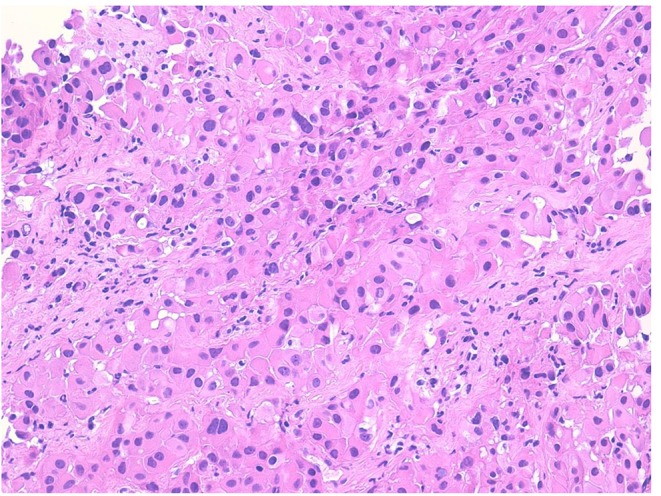
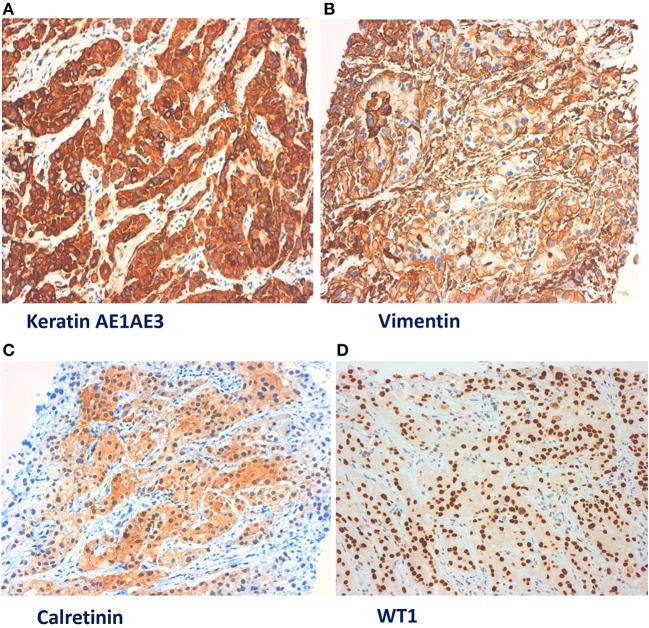
A 65-year-old Italian physician affected by Familial Mediterranean fever (FMF) was hospitalized due to progressive abdominal enlargement, which had begun 6 months before admission. Physical examination revealed ascites and bilateral leg edema. Abdominal CT scan showed ascitic fluid and extensive multiple peritoneal implants; peritoneal CT-guided biopsy revealed an epithelial-type malignant mesothelioma. The patient's past medical history revealed recurrent episodes of abdominal pain and fever from the age of 2. Clinical diagnosis of FMF was suspected at the age of 25, while genetic analysis, performed at the age of 50, confirmed homozygosity for the M694I mutation in the MEFV gene. Treatment with the first line FMF drug colchicine was started and stopped several times because of worsened leukopenia. The patient in fact had a history of asymptomatic leukopenia/lymphopenia from an early age; the intake of colchicine aggravated his pre-existing problem until the definitive suspension of the drug. As for second-line drugs, canakinumab was first prescribed, but due to prescription issues, it was not possible to be administered. When he was given anakinra, there was a worsening of leukopenia leading to septic fever. Systematic literature review indicates that, in most cases, recurrent peritoneal inflammation results in benign peritoneal fibrosis or less commonly in encapsulating peritonitis. There are only a few reported cases of recurrent peritoneal inflammation progressing from FMF to peritoneal mesothelioma (MST). In such cases, intolerance to colchicine or its erratic intake may lead to long-term recurrent inflammation, which usually precedes the development of the tumor, while pre-existing leukopenia, as in our patient, could also be a factor promoting or accelerating the tumor progression. In conclusion, we suggest that in the presence of intolerance or resistance to colchicine, interleukin (IL)-1 inhibition could suppress peritoneal inflammation and prevent MSTs.
一位 65 岁的意大利内科医生患有家族性地中海热(FMF),因进行性腹部增大而住院,该症状始于入院前 6 个月。体格检查显示腹水和双侧腿部水肿。腹部 CT 扫描显示腹水和广泛的多个腹膜种植物;腹膜 CT 引导下活检显示上皮型恶性间皮瘤。患者的既往病史显示,从 2 岁开始反复发作腹痛和发热。25 岁时怀疑 FMF 临床诊断,而 50 岁时进行的基因分析证实 MEFV 基因中 M694I 突变的纯合子。开始使用一线 FMF 药物秋水仙碱治疗,但由于白细胞减少恶化,多次停止治疗。实际上,该患者从早期开始就有无症状性白细胞减少/淋巴细胞减少症病史;秋水仙碱的摄入加重了他原有的问题,直到最终停止用药。二线药物方面,首先开了康纳单抗,但由于处方问题,无法给药。给予阿那白滞素时,白细胞减少恶化导致脓毒症发热。系统文献回顾表明,在大多数情况下,复发性腹膜炎症导致良性腹膜纤维化,或较少见的包裹性腹膜炎。仅有少数复发性腹膜炎症从 FMF 进展为腹膜间皮瘤(MST)的报道病例。在这种情况下,对秋水仙碱不耐受或不规则摄入可能导致长期复发性炎症,通常先于肿瘤发展,而像我们患者这样的预先存在的白细胞减少症也可能是促进或加速肿瘤进展的因素。总之,我们建议在对秋水仙碱不耐受或耐药的情况下,白细胞介素(IL)-1 抑制可能会抑制腹膜炎症并预防 MST。