Reedy Justin, Blanchard Jessica W, Lund Justin, Spicer Paul G, Byars Christie, Peercy Michael, Saunkeah Bobby, Blacksher Erika
Department of Communication and Center for Risk & Crisis Management, University of Oklahoma, Norman, OK, United States.
Department of Anthropology, University of Oklahoma, Norman, OK, United States.
Front Genet. 2020 May 14;11:466. doi: 10.3389/fgene.2020.00466. eCollection 2020.
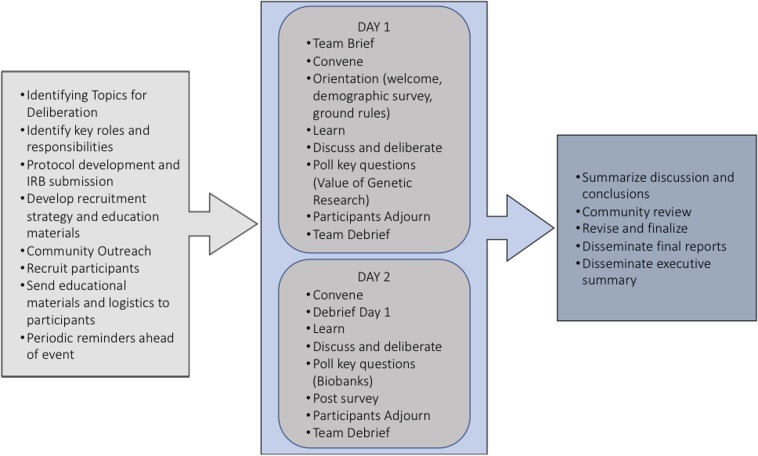
Amid the rapid growth of precision medicine and biobanking initiatives, there have been few efforts at cataloging the implications of these initiatives for Indigenous communities. A consortium involving a university and three American Indian/Alaska Native (AIAN) community partners is working to promote deliberation and dialog in AIAN communities about the potential benefits and risks of genomic research for those communities. The first of the consortium's three planned deliberations was held in September 2018 with citizens of the Chickasaw Nation, a federally recognized tribe in south-central Oklahoma with a full-service medical center and growing research capacity and oversight. Consortium members and the Chickasaw Nation Department of Health Administration designed a deliberative forum for Chickasaw citizens to consider the potential benefits and risks of participating in genomic research and biobanks. In this manuscript, we describe the deliberative method used in this event and report on the ideas discussed during the tribal citizens' deliberations. Chickasaw citizens identified many risks and benefits associated with genomic research and biobanks, including the potential for medical advancements that might benefit the Chickasaw community as well as the possibility of discrimination against the Chickasaw people. Although participants thought the potential benefits outweighed the potential risks, that moral calculation was contingent on whether control of the research and biobanks rested with Chickasaw leadership, researchers, and citizens.
在精准医学和生物样本库计划迅速发展的背景下,几乎没有人致力于梳理这些计划对原住民社区的影响。一个由一所大学和三个美国印第安/阿拉斯加原住民(AIAN)社区合作伙伴组成的联盟正在努力促进AIAN社区就基因组研究对这些社区的潜在益处和风险进行审议和对话。该联盟计划的三次审议中的第一次于2018年9月与奇克索族公民举行,奇克索族是俄克拉荷马州中南部一个获得联邦承认的部落,拥有一家提供全方位服务的医疗中心,研究能力和监督能力不断增强。联盟成员和奇克索族卫生部行政管理部门为奇克索族公民设计了一个审议论坛,以考虑参与基因组研究和生物样本库的潜在益处和风险。在本手稿中,我们描述了此次活动中使用的审议方法,并报告了部落公民审议期间讨论的想法。奇克索族公民确定了与基因组研究和生物样本库相关的许多风险和益处,包括可能使奇克索族社区受益的医学进步潜力以及对奇克索族人的歧视可能性。尽管参与者认为潜在益处大于潜在风险,但这种道德考量取决于研究和生物样本库的控制权是否掌握在奇克索族领导层、研究人员和公民手中。