Sindiani Amer, Rawashdeh Hasan, Obeidat Nail, Zayed Faheem, Alhowary Ala A A
Department of Obstetrics and Gynecology, Faculty of Medicine, Jordan University of Science and Technology, Irbid, 22110, Jordan.
Department of Anesthesiology and Intensive Care, Faculty of Medicine, Jordan University of Science and Technology, Irbid, 21110, Jordan.
Ann Med Surg (Lond). 2020 May 18;55:124-130. doi: 10.1016/j.amsu.2020.05.007. eCollection 2020 Jul.
During the last decades, the rate of caesarean section is increasing and this can increase the mortality and morbidity. Up to one third of the caesarean sections are attributed to the elective repeat caesarean section (ERCS). This study aims to evaluate attitudes and factors affecting the choice of pregnant women with one previous caesarean section regarding their mode of delivery in their second pregnancy. By assessing these attitudes, this study can help the efforts in developing strategies to increase the rates of vaginal delivery.
A cross-sectional design was conducted by a structured questionnaire on 166 pregnant women who had delivered once by caesarean section for their first pregnancy and were in the third trimester of their second pregnancy. Any women with an absolute indication for caesarean section was excluded. The study comprises women who attend the clinic at our center in Northern of Jordan. Proper statistical tests were performed to assess the association between the choice of delivery and selected demographic and clinical factors.
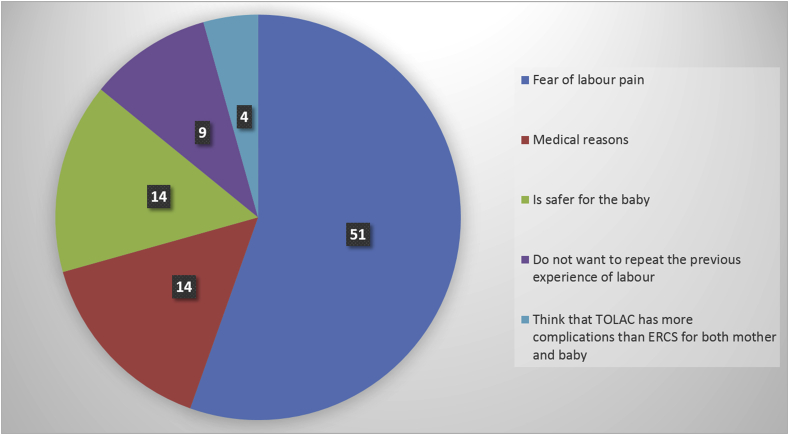
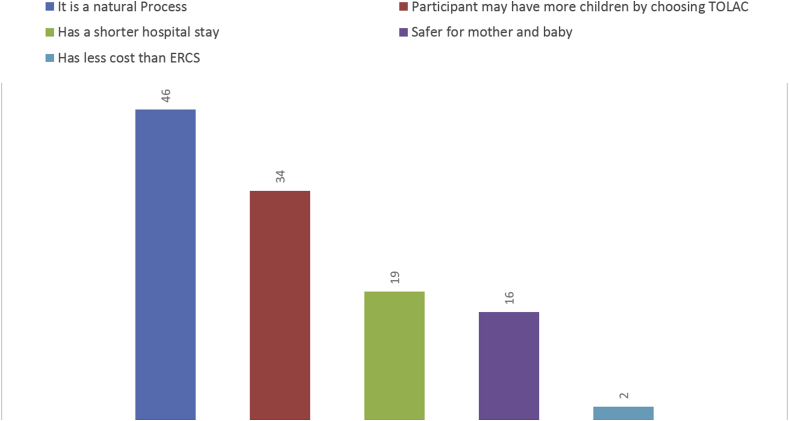
About 55.4% responded that they would choose ERCS (n = 92) and the remaining participants chose trial of labour after caesarean section (TOLAC) (n = 74). Fear of pain was the most common reason for choosing caesarean section, accounting for 55.4%. Interestingly, our study did not show a significant association between the mode of delivery and demographic factors, such as age, educational level and occupation. The single independent significant factor influencing patients' choice that our study revealed was "being informed about the complications of TOLAC". The choice of TOLAC was almost four times higher for those participants who had been informed about the complications, compared to those who had not been informed.
Proper counselling is a main factor that affected the patients' choice toward the mode of delivery. Proper pain management may encourage patients to choose TOLAC because fear of pain was a main reason that patients requested ERCS instead of TOLAC.
在过去几十年中,剖宫产率不断上升,这可能会增加死亡率和发病率。高达三分之一的剖宫产归因于选择性再次剖宫产(ERCS)。本研究旨在评估有过一次剖宫产史的孕妇在第二次妊娠时对分娩方式的选择态度及影响因素。通过评估这些态度,本研究有助于制定提高阴道分娩率的策略。
采用横断面设计,通过结构化问卷对166例首次剖宫产分娩且处于第二次妊娠晚期的孕妇进行调查。排除任何有剖宫产绝对指征的妇女。该研究纳入了约旦北部我们中心门诊的妇女。进行了适当的统计检验以评估分娩方式选择与选定的人口统计学和临床因素之间的关联。
约55.4%的人表示会选择ERCS(n = 92),其余参与者选择剖宫产术后试产(TOLAC)(n = 74)。害怕疼痛是选择剖宫产最常见的原因,占55.4%。有趣的是,我们的研究未显示分娩方式与年龄、教育水平和职业等人口统计学因素之间存在显著关联。我们的研究揭示,影响患者选择的唯一独立显著因素是“了解TOLAC的并发症”。与未被告知的参与者相比,被告知并发症的参与者选择TOLAC的可能性几乎高出四倍。
适当的咨询是影响患者分娩方式选择的主要因素。适当的疼痛管理可能会鼓励患者选择TOLAC,因为害怕疼痛是患者要求ERCS而非TOLAC的主要原因。