Doolen Suzanne, Keyes Gregory S, Ramsden Christopher E
Department of Physiology, University of Kentucky, 800 Rose Street, Lexington, KY 40536-0298, United States.
Lipid Peroxidation Unit, Laboratory of Clinical Investigation, National Institute on Aging, National Institutes of Health (NIH), Baltimore, MD 21224, USA.
Neurobiol Pain. 2020 Apr 30;7:100046. doi: 10.1016/j.ynpai.2020.100046. eCollection 2020 Jan-Jul.
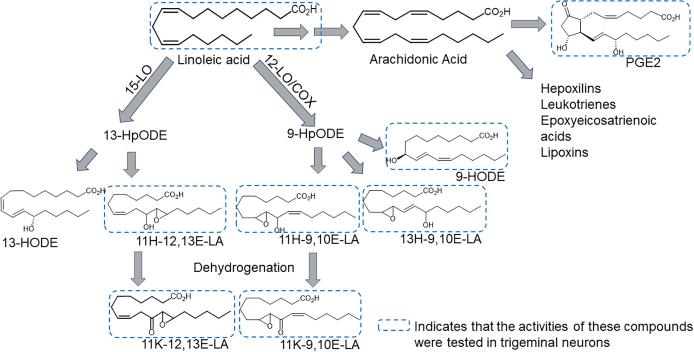
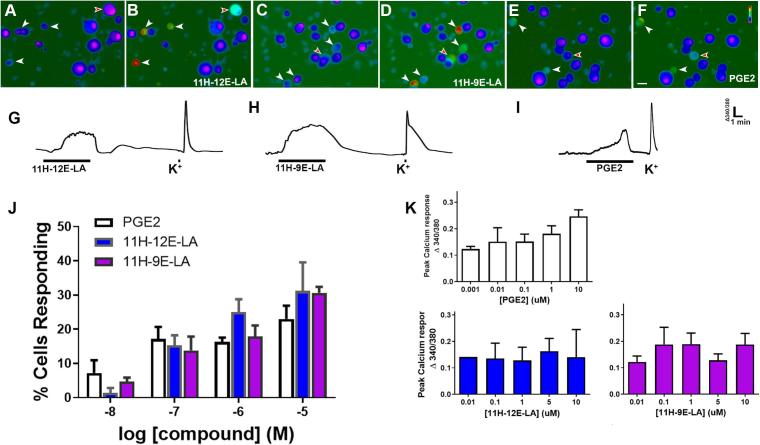
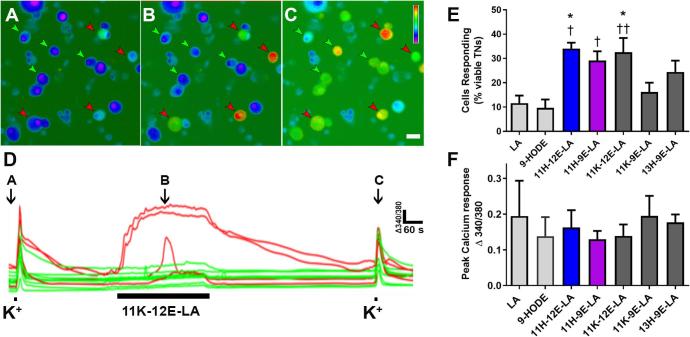
Endogenous lipid mediators are proposed to contribute to headache and facial pain by activating trigeminal neurons (TN). We recently identified 11-hydroxy-epoxide- and 11-keto-epoxide derivatives of linoleic acid (LA) that are present in human skin and plasma and potentially contribute to nociception. Here we expand upon initial findings by examining the effects of 11-hydroxy- and 11-keto-epoxide-LA derivatives on TN activation in comparison to LA, the LA derivative [9-hydroxy-octadecadienoic acid (9-HODE)] and prostaglandin E (PGE). 11-hydroxy- and 11-keto-epoxide-LA derivatives elicited Ca transients in TN subpopulations. The proportion of neurons responding to test compounds (5 μM, 5 min) ranged from 16.2 ± 3.8 cells (11 K-9,10E-LA) to 34.1 ± 2.4 cells (11H-12,13E-LA). LA and 9-HODE (5 μM, 5 min) elicited responses in 11.6 ± 3.1% and 9.7 ± 3.4% of neurons, respectively. 11H-12,13E-LA, 11K-12,13E-LA, and 11H-9,10E-LA produced Ca responses in significantly higher proportions of neurons compared to either LA or 9-HODE (F (6, 36) = 5.12, P = 0.0007). 11H-12,13E-LA and 11H-9,10E-LA increased proportions of responsive neurons in a concentration-dependent fashion, similar to PGE. Most sensitive neurons responded to additional algesic agents (32.9% to capsaicin, 40.1% to PGE, 58.0% to AITC), however 20.6% did not respond to any other agent. In summary, 11-hydroxy-epoxide derivatives of LA increase trigeminal neuron excitability, suggesting a potential role in headache or facial pain.
内源性脂质介质被认为通过激活三叉神经神经元(TN)导致头痛和面部疼痛。我们最近鉴定出了亚油酸(LA)的11-羟基环氧化物和11-酮基环氧化物衍生物,它们存在于人体皮肤和血浆中,并可能导致伤害感受。在这里,我们通过研究11-羟基环氧化物-LA衍生物和11-酮基环氧化物-LA衍生物与LA、LA衍生物[9-羟基十八碳二烯酸(9-HODE)]和前列腺素E(PGE)相比对TN激活的影响,扩展了最初的研究结果。11-羟基环氧化物-LA衍生物和11-酮基环氧化物-LA衍生物在TN亚群中引发了钙瞬变。对测试化合物(5μM,5分钟)有反应的神经元比例范围为16.2±3.8个细胞(11K-9,10E-LA)至34.1±2.4个细胞(11H-12,13E-LA)。LA和9-HODE(5μM,5分钟)分别在11.6±3.1%和9.7±3.4%的神经元中引发反应。与LA或9-HODE相比,11H-12,13E-LA、11K-12,13E-LA和11H-9,10E-LA在显著更高比例的神经元中产生了钙反应(F(6,36)=5.12,P=0.0007)。11H-12,13E-LA和11H-9,10E-LA以浓度依赖性方式增加了反应性神经元的比例,类似于PGE。大多数敏感神经元对其他镇痛剂有反应(对辣椒素有反应的占32.9%,对PGE有反应的占40.1%,对异硫氰酸烯丙酯有反应的占58.0%)但20.6%的神经元对任何其他药物均无反应。总之,LA的11-羟基环氧化物衍生物增加了三叉神经神经元的兴奋性,表明其在头痛或面部疼痛中可能发挥作用。