Child and Adolescent Studies, Utrecht University.
J Pediatr Psychol. 2020 Jul 1;45(6):685-694. doi: 10.1093/jpepsy/jsaa038.
Attention difficulties are commonly reported by caregivers in school-aged children born moderate-to-late preterm (MLPT; 32-36 weeks' gestation). We aimed to assess distinct aspects of attentional functioning (i.e. orienting, alerting and executive attention, processing speed and behavioral components) in children born MLPT and full term (FT), profiles of attentional functioning, and associated risk factors such as preterm birth.
Participants were 170 (87 MLPT and 83 FT) children, evaluated on cognitive and behavioral attention aspects at 6 years of age. We used a variable-centered approach to compare attentional functioning of children born MLPT and FT at group level, and a person-centered approach to identify profiles of attentional functioning. Neonatal and demographic characteristics of these profiles were compared.
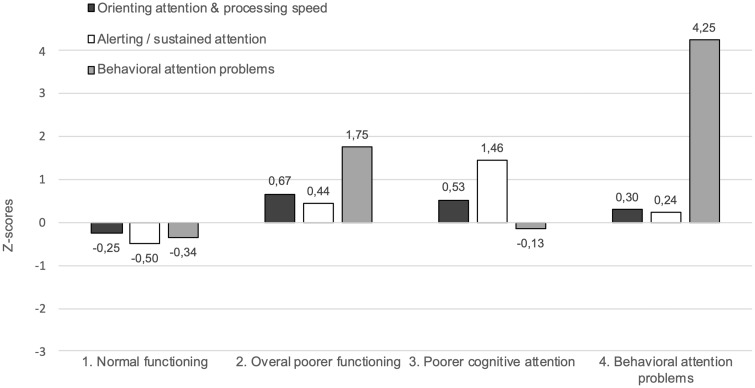
The variable-centered approach showed that at group level children born MLPT had poorer orienting attention and processing speed, and behavioral attention than children born FT. The person-centered approach revealed four profiles: (a) normal attentional functioning, (b) overall poorer attention, (c) poorer cognitive attention, and (d) behavioral attention problems. Children born MLPT were overrepresented in each of the suboptimal attention profiles, and were more dispersed across profiles than children born FT.
Children born MLPT are at increased risk of difficulties in some attention aspects, but at group level differences with children born FT are small. However, children born MLPT show considerable variation in the nature of attention difficulties and are twice as likely to show a suboptimal attention profile, indicating a cumulation of poorer attention scores.
注意力困难是中晚期早产儿(32-36 周妊娠)学龄期儿童的常见报告。我们旨在评估中晚期早产儿和足月产儿(FT)注意力功能的不同方面(即定向、警觉和执行注意力、处理速度和行为成分)、注意力功能的分布情况以及与早产相关的风险因素。
参与者为 170 名(87 名中晚期早产儿和 83 名 FT)儿童,在 6 岁时评估认知和行为注意力方面。我们使用变量中心方法在组水平上比较中晚期早产儿和 FT 儿童的注意力功能,并用个体中心方法识别注意力功能分布。比较这些分布的新生儿和人口统计学特征。
变量中心方法显示,在组水平上,中晚期早产儿的定向注意力、处理速度和行为注意力均较 FT 儿童差。个体中心方法揭示了四种注意力功能分布:(a)正常注意力功能,(b)整体注意力较差,(c)认知注意力较差,(d)行为注意力问题。中晚期早产儿在每个次优注意力分布中都占很大比例,而且比 FT 儿童更分散在各分布中。
中晚期早产儿在某些注意力方面存在更高的困难风险,但与 FT 儿童相比,组水平的差异很小。然而,中晚期早产儿在注意力困难的性质上表现出相当大的差异,出现次优注意力分布的可能性是 FT 儿童的两倍,这表明注意力得分较差的累积。