Department of Molecular Medicine, Aarhus University Hospital, 8200 Aarhus N, Denmark.
Department of Clinical Medicine, Aarhus University, 8200 Aarhus N, Denmark.
Cells. 2020 May 31;9(6):1362. doi: 10.3390/cells9061362.
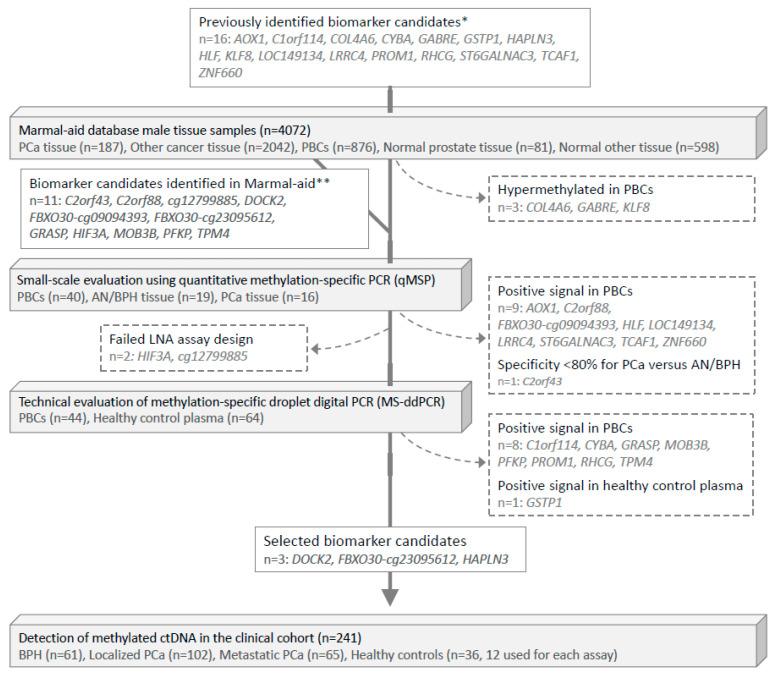
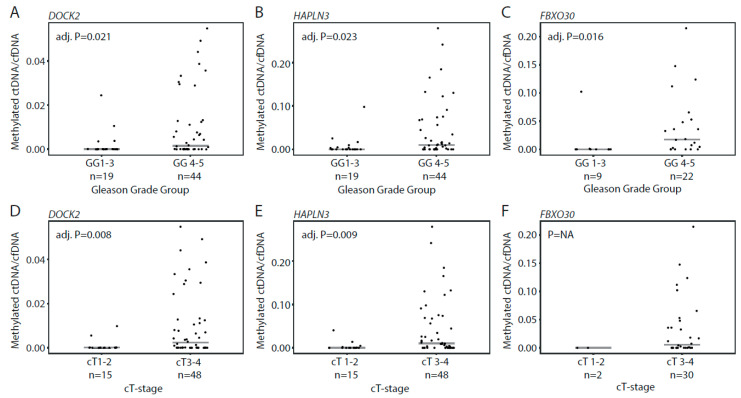
Novel and minimally-invasive prostate cancer (PCa)-specific biomarkers are needed to improve diagnosis and risk stratification. Here, we investigated the biomarker potential in localized and metastatic PCa (mPCa) of methylated circulating tumor DNA (ctDNA) in plasma. Using the Marmal-aid database and in-house datasets, we identified three top candidates specifically hypermethylated in PCa tissue: and (specificity/sensitivity: 80%-100%/75-94%). These candidates were further analyzed in plasma samples from 36 healthy controls, 61 benign prostatic hyperplasia (BPH), 102 localized PCa, and 65 mPCa patients using methylation-specific droplet digital PCR. Methylated ctDNA for was generally not detected in healthy controls, BPH patients, nor in patients with localized PCa despite a positive signal in 98%-100% of matched radical prostatectomy tissue samples. However, ctDNA methylation of and/or was detected in 61.5% (40/65) of mPCa patients and markedly increased in high- compared to low-volume mPCa (89.3% (25/28) vs. 32.1% (10/31), < 0.001). Moreover, detection of methylated ctDNA was associated with significantly shorter time to progression to metastatic castration resistant PCa, independent of tumor-volume. These results indicate that methylated ctDNA () may be potentially useful for identification of hormone-naïve mPCa patients who could benefit from intensified treatment.
需要新型的微创前列腺癌(PCa)特异性生物标志物来改善诊断和风险分层。在这里,我们研究了血浆中甲基化循环肿瘤 DNA(ctDNA)在局限性和转移性 PCa(mPCa)中的生物标志物潜力。使用 Marmal-aid 数据库和内部数据集,我们确定了三个在 PCa 组织中特异性高甲基化的顶级候选物:和(特异性/敏感性:80%-100%/75-94%)。在 36 名健康对照者、61 名良性前列腺增生(BPH)患者、102 名局限性 PCa 患者和 65 名 mPCa 患者的血浆样本中,使用甲基化特异性液滴数字 PCR 进一步分析了这些候选物。在健康对照组、BPH 患者和局限性 PCa 患者中,通常未检测到用于的循环 ctDNA 甲基化,尽管在 98%-100%的匹配根治性前列腺切除术组织样本中存在阳性信号。然而,在 61.5%(40/65)的 mPCa 患者中检测到和/或的 ctDNA 甲基化,并且在高体积与低体积 mPCa 相比明显增加(89.3%(25/28)比 32.1%(10/31),<0.001)。此外,检测到甲基化的 ctDNA 与转移性激素抵抗 PCa 进展到进展的时间显著相关,与肿瘤体积无关。这些结果表明,甲基化的 ctDNA()可能对识别可能受益于强化治疗的激素初治 mPCa 患者具有潜在的应用价值。