Center for Research Development and Scholarship Vanderbilt University, School of Nursing Nashville TN.
College of Nursing and Health Sciences University of Massachusetts Boston Boston MA.
J Am Heart Assoc. 2020 Jun 16;9(12):e016292. doi: 10.1161/JAHA.120.016292. Epub 2020 Jun 3.
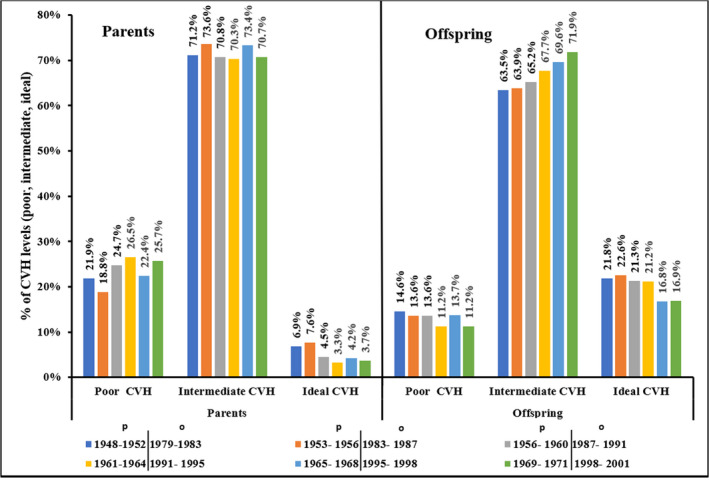
Background Evidence suggests familial aggregation and intergenerational associations for individual cardiovascular health (CVH) metrics. Over a 53-year life course, we examined trends and association of CVH between parents and their offspring at similar mean ages. Methods and Results We conducted a series of cross-sectional analyses of the FHS (Framingham Heart Study). Parent-offspring pairs were assessed at exams where their mean age distributions were similar. Ideal CVH was defined using 5 CVH metrics: blood pressure (<120/<80 mm Hg), fasting blood glucose (<100 mg/dL), blood cholesterol (<200 mg/dL), body mass index (<25 kg/m), and non-smoking. Joinpoint regression and Chi-squared test were used to assess linear trend; proportional-odds regression was used to examine the association between parents and offspring CVH. A total of 2637 parents were paired with 3119 biological offspring throughout 6 exam cycles. Similar patterns of declining ideal CVH with advancing age were observed in parents and offspring. Small proportions of parents (4%) and offspring (17%) achieved 5 CVH metrics at ideal levels (-trend <0.001). Offspring of parents with poor CVH had more than twice the odds of having poor CVH (pooled odds ratio, 2.59; 95% CI, 1.98-3.40). Over time, elevated glucose levels and obesity doubled among the offspring and were the main drivers for declining ideal CVH trends. Conclusions Parental CVH was positively associated with offspring CVH. However, intergenerational CVH gains from declining smoking rates, cholesterol, and blood pressure were offset by rising offspring obesity and elevated glucose levels. This suggests an intergenerational phenotypic shift of risk factors and the need for a family-centered approach to cardiovascular care.
背景 有证据表明,个体心血管健康 (CVH) 指标存在家族聚集和代际关联。在长达 53 年的生命历程中,我们研究了父母和同龄子女 CVH 的趋势和关联。
方法和结果 我们对 FHS(弗雷明汉心脏研究)进行了一系列横断面分析。在父母和子女的平均年龄分布相似的检查中评估了父母与子女之间的关系。使用 5 个 CVH 指标定义理想的 CVH:血压(<120/<80mmHg)、空腹血糖(<100mg/dL)、血胆固醇(<200mg/dL)、体重指数(<25kg/m)和不吸烟。采用 Joinpoint 回归和卡方检验评估线性趋势;采用比例优势回归检验父母与子女 CVH 之间的关联。在 6 个检查周期中,共有 2637 对父母与 3119 对生物学子女配对。在父母和子女中,随着年龄的增长,理想 CVH 呈下降趋势,模式相似。只有很少比例的父母(4%)和子女(17%)达到了 5 个 CVH 指标的理想水平(<趋势<0.001)。父母 CVH 不良的子女发生不良 CVH 的几率是父母 CVH 良好的子女的两倍以上(合并优势比,2.59;95%CI,1.98-3.40)。随着时间的推移,子女的葡萄糖水平升高和肥胖率翻了一番,是导致理想 CVH 趋势下降的主要因素。
结论 父母的 CVH 与子女的 CVH 呈正相关。然而,由于吸烟率、胆固醇和血压的下降,导致 CVH 代际改善的情况被子女肥胖率和葡萄糖水平升高所抵消。这表明存在代际风险因素表型转变,需要采取以家庭为中心的心血管保健方法。