Department of Biostatistics, Boston University School of Public Health, Boston, MA.
Department of Epidemiology, Boston University School of Public Health, Boston, MA.
J Am Heart Assoc. 2018 May 17;7(11):e008741. doi: 10.1161/JAHA.118.008741.
Data on the temporal trends in ideal cardiovascular health (CVH) as well as on their association with subclinical/overt cardiovascular disease (CVD) and death are limited.
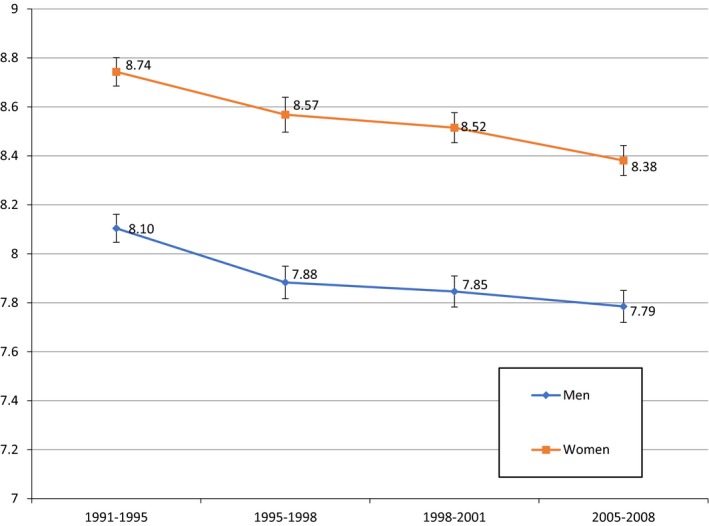
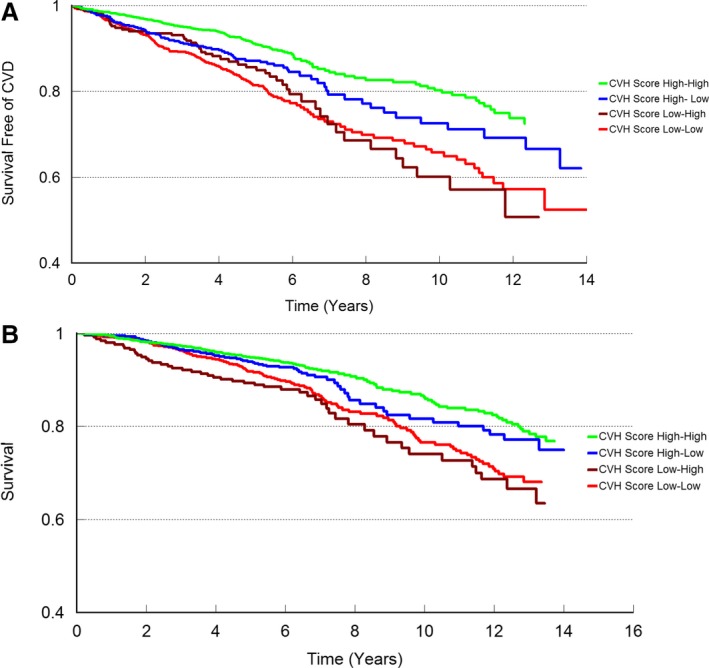
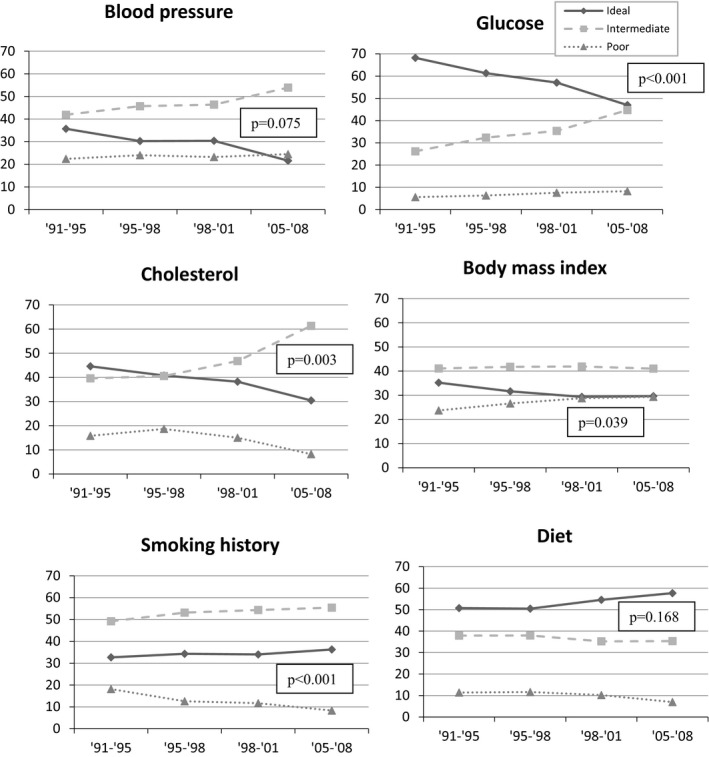
This study included 3460 participants attending ≥1 of 4 consecutive exams of the Framingham Heart Study (1991-2008, mean age 55.4 years, CVH score ranged 0-14). We created 4 groups describing changes in CVH score between examination cycles 5 and 8, using first and last exams attended (high-high: starting CVH score ≥8, last score of ≥8, referent; high-low: ≥8 start and ≤7 last; low-high: ≤7 start and ≥8 last; and low-low: ≤7 start and ≤7 last) and related them to subclinical CVD cross-sectionally, and incident CVD and death. Fewer people have ideal CVH scores over the past 20 years (8.5% for 1991-1995, 5.9% for 2005-2008, =0.002), because of decreases in those with ideal status of body mass index, blood glucose, and serum cholesterol levels (<0.05 for all). The odds of subclinical disease and risk of CVD and death were higher for all compared with the high-high group (428 CVD and 367 death events, median follow-up 5.1 years, hazard ratios for CVD: 1.39, 1.73, 1.9 and death: 1.12, 1.57, 1.4 and odds ratios for subclinical disease: 1.61, 1.98, 2.86 for high-low, low-high, and low-low, respectively).
The decreased presence of ideal CVH scores over the past 20 years resulted in increasing odds of subclinical disease and risk of CVD and death, emphasizing the importance of maintaining ideal CVH over the life course.
关于理想心血管健康(CVH)的时间趋势的数据,以及它们与亚临床/显性心血管疾病(CVD)和死亡的关系,数据有限。
这项研究包括参加弗雷明汉心脏研究(1991-2008 年,平均年龄 55.4 岁,CVH 评分范围 0-14)的 3460 名参与者中的 4 次连续检查。我们使用首次和最后一次参加的检查来描述 CVH 评分在检查周期 5 和 8 之间的变化,创建了 4 个组,分别描述 CVH 评分的变化(高-高:起始 CVH 评分≥8,最后评分≥8,参考;高-低:≥8 起始和≤7 最后;低-高:≤7 起始和≥8 最后;低-低:≤7 起始和≤7 最后),并将其与亚临床 CVD 进行横向比较,以及与 CVD 事件和死亡的关系。在过去的 20 年中,具有理想 CVH 评分的人数减少(1991-1995 年为 8.5%,2005-2008 年为 5.9%,=0.002),这是由于身体质量指数、血糖和血清胆固醇水平理想状态的下降所致(所有水平均<0.05)。与高-高组相比,所有组的亚临床疾病风险和 CVD 及死亡风险均较高(428 例 CVD 和 367 例死亡事件,中位随访 5.1 年,CVD 的风险比:1.39、1.73、1.9 和死亡:1.12、1.57、1.4,亚临床疾病的比值比:1.61、1.98、2.86 用于高-低、低-高和低-低)。
在过去的 20 年中,理想 CVH 评分的出现率下降,导致亚临床疾病和 CVD 及死亡风险增加,这强调了在整个生命过程中保持理想 CVH 的重要性。