Evolutionary Ecology, Lund University, SE-223 62, Sweden.
Biol Lett. 2020 Jun;16(6):20200133. doi: 10.1098/rsbl.2020.0133. Epub 2020 Jun 3.
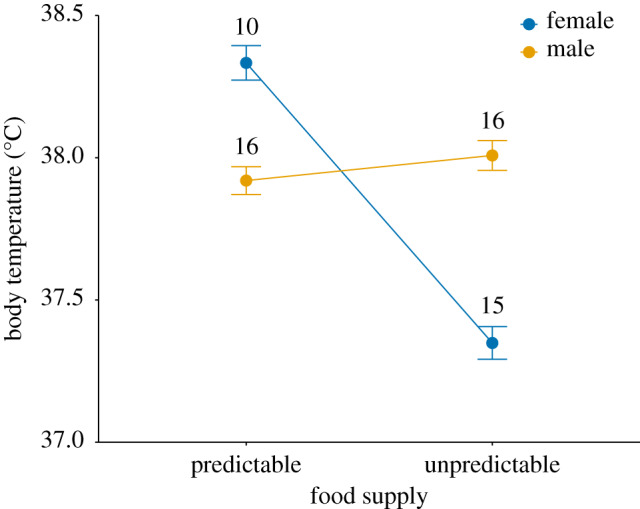
The combination of short days and long cold winter nights, in temperate regions, presents a major challenge for small diurnal birds. Small birds regularly employ heterothermy and enter rest-phase hypothermia during winter nights to conserve energy. However, we know little about how environmental conditions, such as food availability, shape these strategies. We experimentally manipulated food availability in winter to free-living great tits . A 'predictable' and constant food supply was provided to birds in one area of a forest, while birds in another area did not have access to a reliable supplementary food source. We found that predictability of food affected the extent of nocturnal hypothermia, but the response differed between the sexes. Whereas male nocturnal body temperature was similar regardless of food availability, females exposed to a naturally 'unpredictable' food supply entered deeper hypothermia at night, compared with females that had access to predictable food and compared with males in both treatment groups. We suggest that this response is likely a consequence of dominance, and subdominant females subject to unpredictable food resources cannot maintain sufficient energy intake, resulting in a higher demand for energy conservation at night.
在温带地区,短日照和漫长寒冷的冬夜相结合,给小型昼行鸟类带来了重大挑战。小型鸟类经常采用异温性,并在冬季夜间进入休眠期的体温降低,以节省能量。然而,我们对环境条件(如食物供应)如何影响这些策略知之甚少。我们通过实验在冬季控制自由生活的大山雀的食物供应。在森林的一个区域为鸟类提供“可预测”且恒定的食物供应,而在另一个区域,鸟类无法获得可靠的补充食物来源。我们发现,食物的可预测性影响了夜间体温降低的程度,但这种反应在性别之间存在差异。无论食物供应情况如何,雄性夜间的体温相似,而与可获得可预测食物的雌性相比,与两个处理组中的雄性相比,暴露于自然“不可预测”食物供应的雌性在夜间进入更深的体温降低。我们认为,这种反应可能是支配地位的结果,处于不可预测食物资源下的次级雌性无法维持足够的能量摄入,导致夜间对能量保存的需求更高。