Grupo de Ecología de Invasiones, INIBIOMA, CONICET, Universidad Nacional del Comahue, Pioneros 2350, San Carlos de Bariloche 8400, Argentina.
Laboratorio de Invasiones Biológicas, Facultad de Ciencias Forestales, Universidad de Concepción, Victoria 631, Concepción, Chile; Institute of Ecology and Biodiversity (IEB), Santiago, Chile.
Trends Ecol Evol. 2020 Aug;35(8):642-645. doi: 10.1016/j.tree.2020.05.004. Epub 2020 May 19.
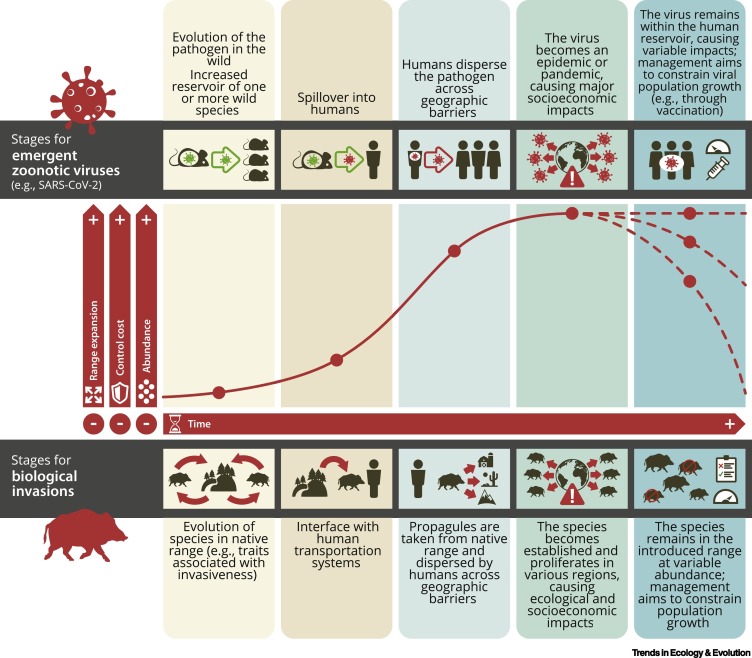
Emerging infectious diseases, such as coronavirus disease 2019 (COVID-19), are driven by ecological and socioeconomic factors, and their rapid spread and devastating impacts mirror those of invasive species. Collaborations between biomedical researchers and ecologists, heretofore rare, are vital to limiting future outbreaks. Enhancing the crossdisciplinary framework offered by invasion science could achieve this goal.
新发传染病,如 2019 年冠状病毒病(COVID-19),是由生态和社会经济因素驱动的,其快速传播和破坏性影响与入侵物种相似。生物医学研究人员和生态学家之间以前很少有合作,而这种合作对于限制未来的疫情爆发至关重要。加强入侵科学提供的跨学科框架可以实现这一目标。