Fuad Hossain Md, Ratnayake R R, Mahbub Shamim, Kumara K L Wasantha, Magana-Arachchi D N
Department of Biochemistry & Molecular Biology, Gono Bishwabidyalay, Savar, Dhaka 1344, Bangladesh.
National Institute of Fundamental Studies, Kandy, Sri Lanka.
Saudi J Biol Sci. 2020 Jun;27(6):1514-1520. doi: 10.1016/j.sjbs.2020.03.024. Epub 2020 Mar 30.
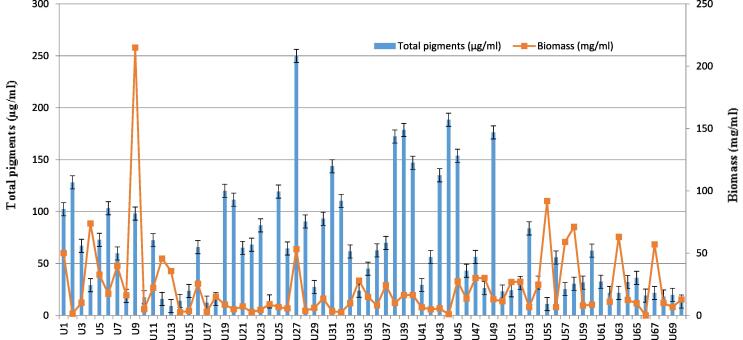
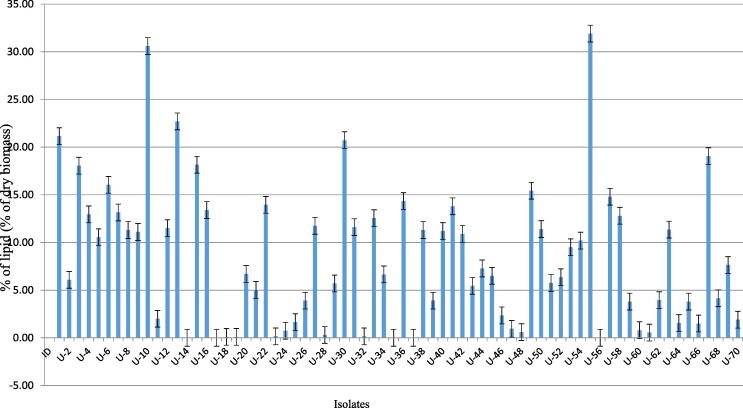
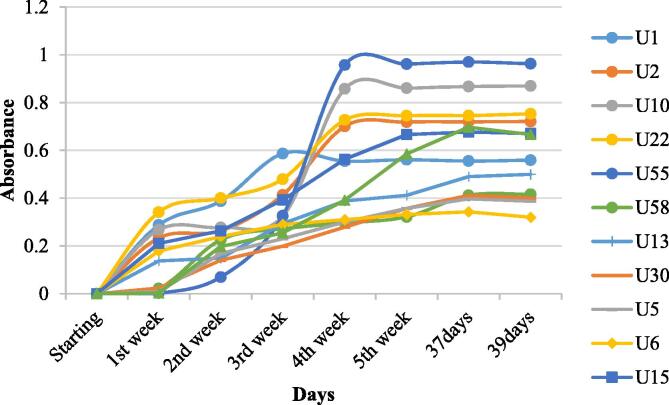
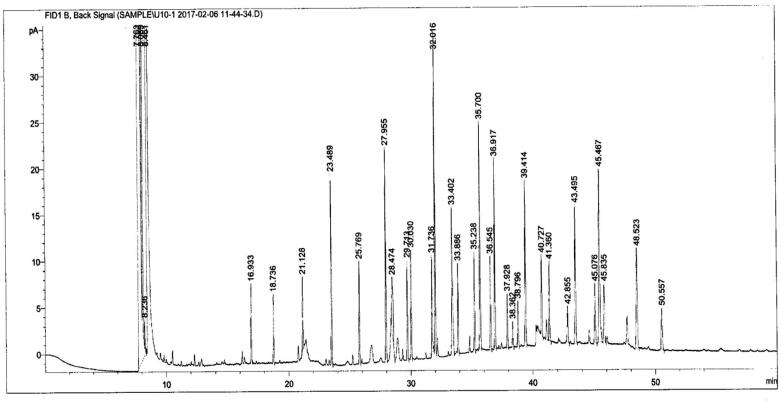
The present study was carried out to investigate cyanobacteria as a potential source for biodiesel production isolated from fresh water bodies of Sri Lanka. Semi mass culturing and mass culturing were carried out to obtain biomass for extracting total lipids. Fatty acid methyl ester (FAME) or biodiesel was produced from extracted lipid by -esterification reaction. FAME component was identified using gas chromatography (GC). Atotal of 74 uni-algal cultures were obtained from Biofuel and Bioenergy laboratory of the National Institute of Fundamental Studies (NIFS), Kandy, Sri Lanka. The total lipid content was recorded highest in sp. (31.9 ± 2.01% of dry biomass) followed by sp. (30.6 ± 2.87%), sp. (22.7 ± 1.36%), sp. (21.15 ± 1.99%), sp. (20.73 ± 3.26%), sp. (18.15 ± 4.11%) and sp. (15.43 ± 3.89%), sp. (13.95 ± 4.27%), (13.8 ± 3.56%) and (12.80 ± 1.97%). FAME analysis showed cyanobacteria contain Methyl palmitoleate, Linolelaidic acid methyl ester, Cis-8,11,14-eicosatrienoic acid methyl ester, Cis-10-heptadecanoic acid methyl ester, Methyl myristate, Methyl pentadecanoate, Methyl octanoate, Methyl decanoate, Methyl laurate, Methyl tridecanoate, Methyl palmitoleate, Methyl pentadeconoate, Methyl heptadeconoate, Linolaidic acid methyl ester, Methyl erucate, Methyl myristate, Myristoloeic acid, Methyl palmitate, Cis-9-oleic acid methyl ester, Methyl arachidate and Cis-8,11,14-ecosatrieconoic acid methyl ester. The present study revealed that cyanobacteria isolated from Sri Lanka are potential source for biodiesel industry because of their high fatty acid content. Further studies are required to optimize the mass culture conditions to increase thelipid content from cyanobacterial biomass along with the research in the value addition to the remaining biomass.
本研究旨在调查从斯里兰卡淡水水体中分离出的蓝藻作为生物柴油生产潜在来源的情况。进行了半批量培养和批量培养以获取用于提取总脂质的生物质。通过酯交换反应从提取的脂质中生产脂肪酸甲酯(FAME)或生物柴油。使用气相色谱(GC)鉴定FAME成分。总共从斯里兰卡康提国家基础研究机构(NIFS)的生物燃料和生物能源实验室获得了74种单藻培养物。总脂质含量在 种中记录最高(占干生物质的31.9±2.01%),其次是 种(30.6±2.87%)、 种(22.7±1.36%)、 种(21.15±1.99%)、 种(20.73±3.26%)、 种(18.15±4.11%)和 种(15.43±3.89%)、 种(13.95±4.27%)、 (13.8±3.56%)和 (12.80±1.97%)。FAME分析表明蓝藻含有棕榈油酸甲酯、亚油酸甲酯、顺式-8,11,14-二十碳三烯酸甲酯、顺式-10-十七烷酸甲酯、肉豆蔻酸甲酯、十五烷酸甲酯、辛酸甲酯、癸酸甲酯、月桂酸甲酯、十三烷酸甲酯、棕榈油酸甲酯、十五碳烯酸甲酯、十七碳烯酸甲酯、亚油酸甲酯、芥酸甲酯、肉豆蔻酸甲酯、肉豆蔻油酸、棕榈酸甲酯、顺式-9-油酸甲酯、花生酸甲酯和顺式-8,11,14-二十碳三烯酸甲酯。本研究表明,从斯里兰卡分离出的蓝藻因其高脂肪酸含量而成为生物柴油行业的潜在来源。需要进一步研究优化批量培养条件,以提高蓝藻生物质中的脂质含量,并对剩余生物质进行增值研究。