Hanson Petra, Weickert Martin O, Barber Thomas M
Clinical Sciences Research Laboratories, Warwick Medical School, University Hospitals Coventry and Warwickshire, Clifford Bridge Road, Coventry, CV2 2DX.
Ther Adv Endocrinol Metab. 2020 May 19;11:2042018820922018. doi: 10.1177/2042018820922018. eCollection 2020.
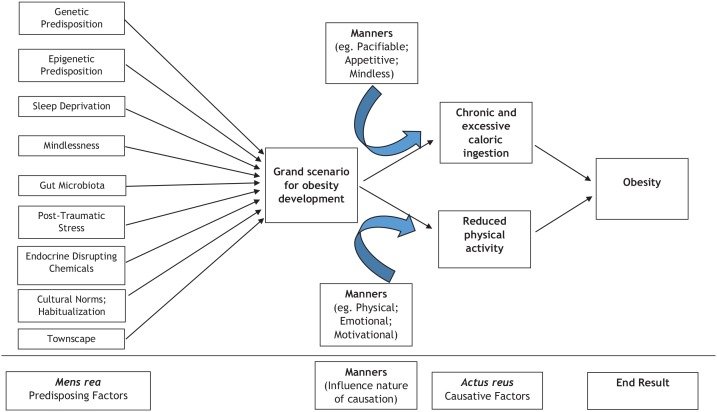
To tackle the complexity of the global obesity epidemic, it is important to consider the many predisposing factors that underlie progressive and sustained weight gain. Some of the biological drivers for weight gain following initial weight loss include persistent changes in appetite hormones [including ghrelin and postprandial plasma peptide YY (PYY)], and 'persistent metabolic adaptation'. However, many factors within our busy, stressful modern-day environment seem to conspire towards promotion of weight gain. These include the effects of sleep deprivation on appetite regulation, and the effects of modern-day technology on 'attention competition'. These factors, combined with cultural and societal factors can result in a 'mindless' attitude regarding eating-related behaviour that is likely to predispose to weight gain. In addition to the external environment, our internal environment within the gut has also changed radically within the last few decades, resulting from changes in fibre intake, and increased ingestion of highly refined, sterilised and processed foods. Although contentious, these dietary changes have implications for our gut microbiota, and possible downstream effects on control of appetite and metabolism. In this brief review, we consider some of the novel predisposing factors for weight gain within our modern-day 21st century environments (both external and internal), and explore how legal terminology can help to conceptualise the numerous factors that contribute towards weight gain, and, ultimately the global obesity epidemic.
为应对全球肥胖流行的复杂性,重要的是要考虑导致体重逐渐且持续增加的诸多诱发因素。初始体重减轻后体重增加的一些生物学驱动因素包括食欲激素(包括胃饥饿素和餐后血浆肽YY)的持续变化,以及“持续的代谢适应”。然而,在我们忙碌、充满压力的现代环境中,许多因素似乎共同促使体重增加。这些因素包括睡眠剥夺对食欲调节的影响,以及现代技术对“注意力竞争”的影响。这些因素与文化和社会因素相结合,可能导致对饮食相关行为持“无意识”态度,从而容易导致体重增加。除了外部环境,在过去几十年里,我们肠道内的内部环境也因纤维摄入量的变化以及高度精制、消毒和加工食品摄入量的增加而发生了根本性变化。尽管存在争议,但这些饮食变化对我们的肠道微生物群有影响,并可能对食欲和新陈代谢的控制产生下游效应。在这篇简短的综述中,我们考虑了21世纪现代环境(包括外部和内部)中一些导致体重增加的新的诱发因素,并探讨法律术语如何有助于将导致体重增加以及最终全球肥胖流行的众多因素概念化。