Van Nuland Michael E, Vincent John B, Ware Ian M, Mueller Liam O, Bayliss Shannon L J, Beals Kendall K, Schweitzer Jennifer A, Bailey Joseph K
Department of Biology Stanford University Stanford CA USA.
School of Environmental and Forest Sciences University of Washington Seattle WA USA.
Ecol Evol. 2020 Apr 17;10(9):3856-3867. doi: 10.1002/ece3.5969. eCollection 2020 May.
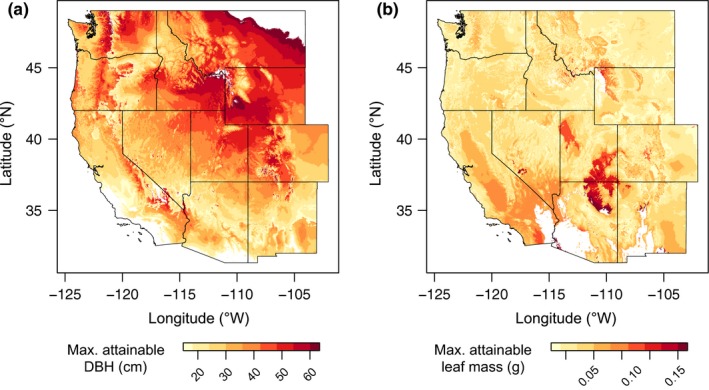
Global change is widely altering environmental conditions which makes accurately predicting species range limits across natural landscapes critical for conservation and management decisions. If climate pressures along elevation gradients influence the distribution of phenotypic and genetic variation of plant functional traits, then such trait variation may be informative of the selective mechanisms and adaptations that help define climatic niche limits. Using extensive field surveys along 16 elevation transects and a large common garden experiment, we tested whether functional trait variation could predict the climatic niche of a widespread tree species () with a double quantile regression approach. We show that intraspecific variation in plant size, growth, and leaf morphology corresponds with the species' total climate range and certain climatic limits related to temperature and moisture extremes. Moreover, we find evidence of genetic clines and phenotypic plasticity at environmental boundaries, which we use to create geographic predictions of trait variation and maximum values due to climatic constraints across the western US. Overall, our findings show the utility of double quantile regressions for connecting species distributions and climate gradients through trait-based mechanisms. We highlight how new approaches like ours that incorporate genetic variation in functional traits and their response to climate gradients will lead to a better understanding of plant distributions as well as identifying populations anticipated to be maladapted to future environments.
全球变化正在广泛改变环境条件,这使得准确预测自然景观中物种的分布范围极限对于保护和管理决策至关重要。如果沿海拔梯度的气候压力影响植物功能性状的表型和遗传变异分布,那么这种性状变异可能有助于了解有助于定义气候生态位极限的选择机制和适应性。通过沿16条海拔样带进行广泛的实地调查和一项大型共同花园实验,我们使用双分位数回归方法测试了功能性状变异是否能够预测一种广泛分布的树种()的气候生态位。我们发现,植物大小、生长和叶片形态的种内变异与该物种的总气候范围以及与极端温度和湿度相关的某些气候极限相对应。此外,我们在环境边界发现了遗传渐变和表型可塑性的证据,我们利用这些证据对美国西部因气候限制而产生的性状变异和最大值进行了地理预测。总体而言,我们的研究结果表明了双分位数回归在通过基于性状的机制连接物种分布和气候梯度方面的实用性。我们强调,像我们这样纳入功能性状遗传变异及其对气候梯度响应的新方法,将有助于更好地理解植物分布,并识别预计对未来环境适应不良的种群。