Duchowny Kate A, Hicken Margaret T, Cawthon Peggy M, Glymour M Maria, Clarke Philippa
Department of Epidemiology and Biostatistics, University of California, San Francisco, CA, USA.
Institute for Social Research, University of Michigan, Ann Arbor, MI, USA.
SSM Popul Health. 2020 May 7;11:100587. doi: 10.1016/j.ssmph.2020.100587. eCollection 2020 Aug.
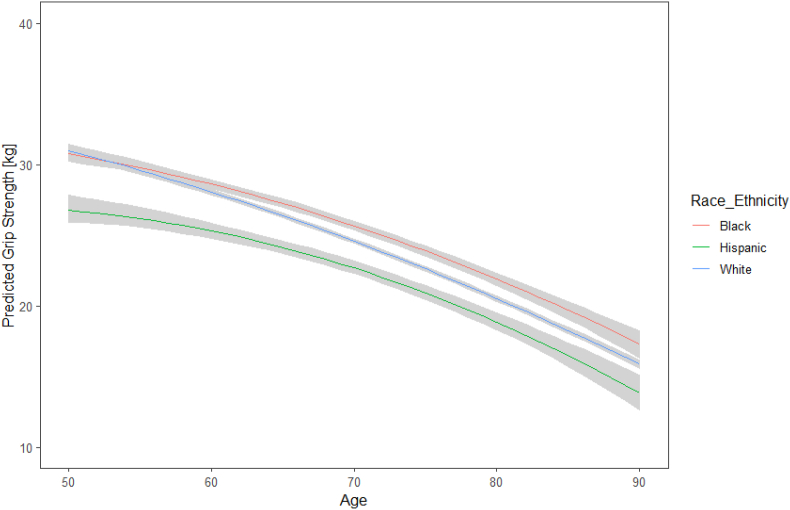
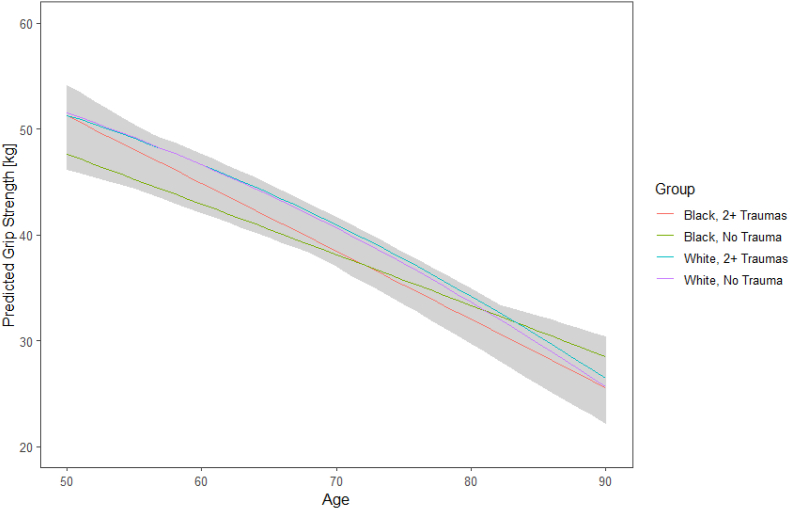
Muscle weakness, as measured by handgrip strength, is a primary determinant of physical functioning and disability. There is a high burden of muscle weakness in the United States with close to 50 percent of older Americans meeting criteria for clinical muscle weakness. While previous racial/ethnic disparities have been documented among older adults, the extent to which lifecourse trauma shapes muscle strength trajectories is unknown. Using U.S. Health and Retirement Study (N = 20,472, Mean Age = 63.8 years) data on grip strength (2006-2014, up to 3 assessments) and retrospectively reported traumatic events, we fit gender-stratified growth curve models to investigate whether traumatic events experienced across the lifecourse or at distinct sensitive periods (childhood, early/emerging adulthood or mid-life) predicted later-life trajectories of grip strength. There was no association between cumulative trauma and trajectories of grip strength and the main effects for the life stage models were largely null. However, among White women, our results suggest that traumatic events experienced during childhood (β = -0.012; 95% CI = -0.024, 0.0004) compared to middle adulthood are associated with faster declines in grip strength in later life. Traumatic events reported during childhood was related to a slower decline in grip strength over time among Hispanic women compared to that for White women (β = 0.086, 95% CI = 0.044, 0.128). Among Black men, the association between traumatic events during early/emerging adulthood and age-related declines in grip strength was stronger for Black men than for White men (interaction β = -0.070; 95% CI = -0.138, 0.001). Traumatic events experienced during distinct life stages may influence later life declines in grip strength and exacerbate racial inequalities in later life. This study addresses an important gap by investigating the life course social determinants of later life muscle strength, which is a key driver of physical functioning and mobility.
通过握力测量的肌肉无力是身体功能和残疾的主要决定因素。在美国,肌肉无力的负担很重,近50%的美国老年人符合临床肌肉无力的标准。虽然之前已记录了老年人中的种族/族裔差异,但生命历程创伤对肌肉力量轨迹的影响程度尚不清楚。利用美国健康与退休研究(N = 20472,平均年龄 = 63.8岁)中关于握力(2006 - 2014年,最多3次评估)的数据以及回顾性报告的创伤事件,我们拟合了按性别分层的生长曲线模型,以研究在整个生命历程或在不同敏感时期(童年、成年早期/青春期或中年)经历的创伤事件是否能预测晚年握力轨迹。累积创伤与握力轨迹之间没有关联,生命阶段模型的主要效应在很大程度上也不显著。然而,在白人女性中,我们的结果表明,与中年时期相比,童年时期经历的创伤事件(β = -0.012;95%置信区间 = -0.024,0.0004)与晚年握力更快下降有关。与白人女性相比,西班牙裔女性童年时期报告的创伤事件与握力随时间下降较慢有关(β = 0.086,95%置信区间 = 0.044,0.128)。在黑人男性中,成年早期/青春期的创伤事件与握力的年龄相关下降之间的关联,黑人男性比白人男性更强(交互作用β = -0.070;95%置信区间 = -0.138,0.001)。在不同生命阶段经历的创伤事件可能会影响晚年握力下降,并加剧晚年的种族不平等。本研究通过调查晚年肌肉力量的生命历程社会决定因素填补了一个重要空白,而肌肉力量是身体功能和活动能力的关键驱动因素。