Ye Huan, Zhang Ying, Yin Ya-Xia, Cao Fei-Fei, Guo Yu-Guo
CAS Key Laboratory of Molecular Nanostructure and Nanotechnology, CAS Research/Education Center for Excellence in Molecular Sciences, Beijing National Laboratory for Molecular Sciences (BNLMS), Institute of Chemistry, Chinese Academy of Sciences (CAS), Beijing 100190, China.
College of Science, Huazhong Agricultural University, Wuhan 430070, China.
ACS Cent Sci. 2020 May 27;6(5):661-671. doi: 10.1021/acscentsci.0c00351. Epub 2020 May 1.
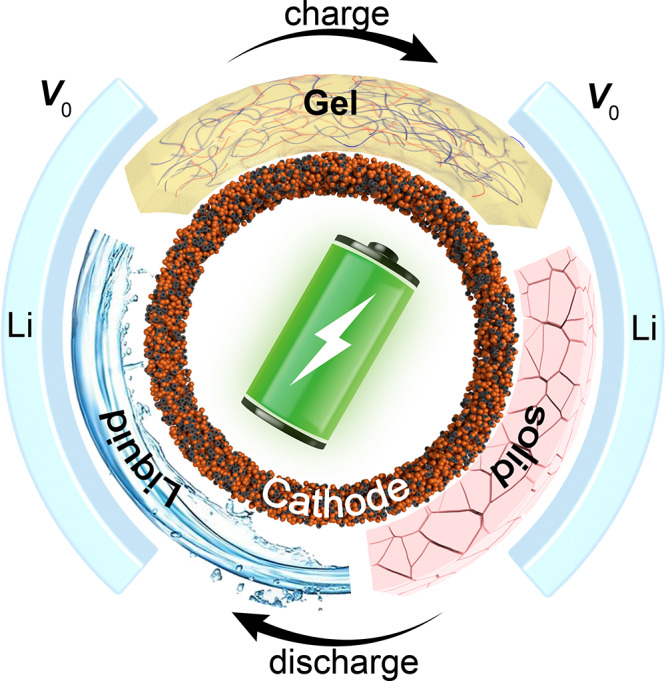
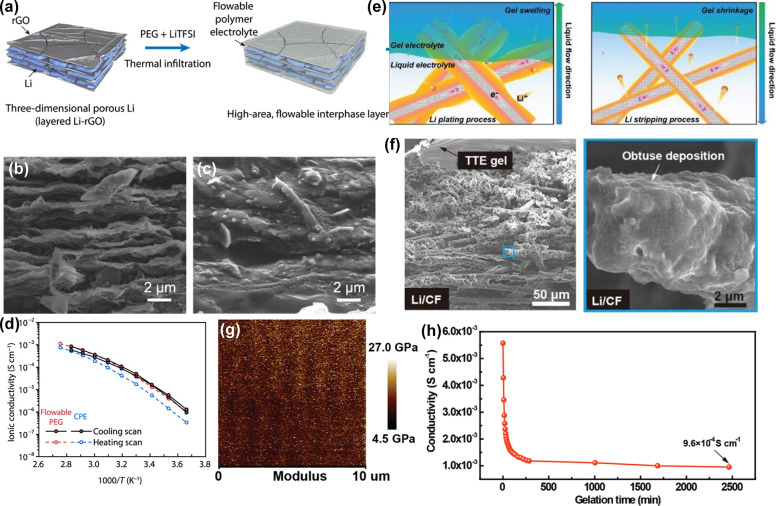
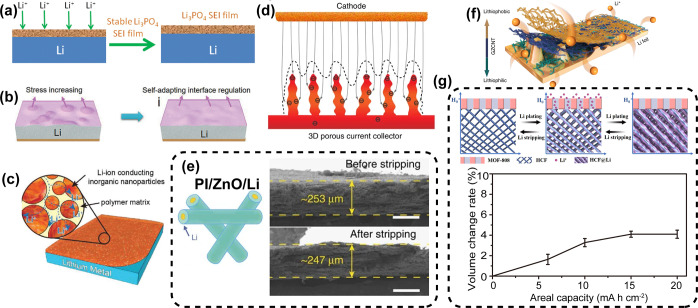
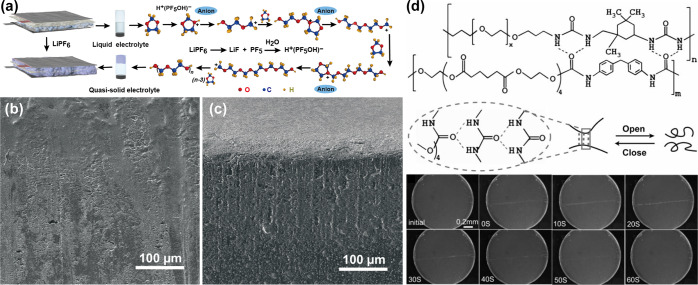
Rechargeable Li metal batteries are one of the most attractive energy storage systems due to their high energy density. However, the hostless nature of Li, the excessive dendritic growth, and the accumulation of nonactive Li induce severe volume variation of Li anodes. The volume variation can give rise to a fracture of solid electrolyte interphase, continuous consumption of Li and electrolytes, low Coulombic efficiency, fast performance degradation, and finally short cycle life. This Outlook provides a comprehensive understanding of the origin and consequences of Li volume variation. Recent strategies to address this challenge are reviewed from liquid to gel to solid-state electrolyte systems. In the end, guidelines for structural design and fabrication suggestions for future long-life Li composite anodes are presented.
可充电锂金属电池因其高能量密度而成为最具吸引力的储能系统之一。然而,锂的无宿主特性、过度的枝晶生长以及非活性锂的积累会导致锂负极发生严重的体积变化。这种体积变化会导致固体电解质界面破裂、锂和电解质的持续消耗、库仑效率低、性能快速退化,最终导致循环寿命短。本展望全面阐述了锂体积变化的起源和后果。从液体电解质系统到凝胶电解质系统再到固态电解质系统,综述了应对这一挑战的最新策略。最后,提出了未来长寿命锂复合负极的结构设计指南和制造建议。