Dörfler Susanne, Walus Sylwia, Locke Jacob, Fotouhi Abbas, Auger Daniel J, Shateri Neda, Abendroth Thomas, Härtel Paul, Althues Holger, Kaskel Stefan
Chemical Surface and Reaction Technology Fraunhofer IWS Dresden 01277 Germany.
OXIS Energy Ltd. Culham Science Center Abingdon UK.
Energy Technol (Weinh). 2021 Jan;9(1):2000694. doi: 10.1002/ente.202000694. Epub 2020 Nov 18.
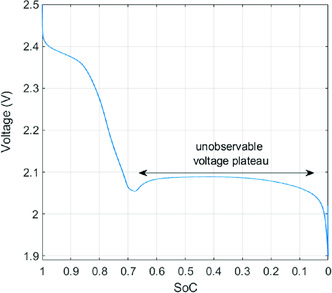
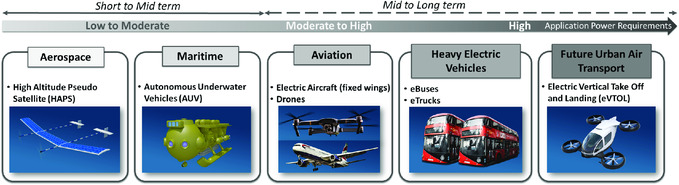
Electrification is progressing significantly within the present and future vehicle sectors such as large commercial vehicles (e.g., trucks and buses), high-altitude long endurance (HALE), high-altitude pseudosatellites (HAPS), and electric vertical take-off and landing (eVTOL). The battery systems' performance requirements differ across these applications in terms of power, cycle life, system cost, etc. However, the need for high gravimetric energy density, 400 Wh kg and beyond, is common across them all, as it enables vehicles to achieve extended range, a longer mission duration, lighter weight, or increased payload. The system-level requirements of these emerging applications are broken down into the component-level developments required to integrate Li-S technology as the power system of choice. To adapt batteries' properties, such as energy and power density, to the respective application, the academic research community has a key role to play in component-level development. However, materials and component research must be conducted within the context of a viable Li-S cell system. Herein, the key performance benefits, limitations, modeling, and recent progress of the Li-S battery technology and its adaption toward real-world application are discussed.
在当前和未来的车辆领域,如大型商用车(如卡车和公交车)、高空长航时(HALE)飞行器、高空伪卫星(HAPS)以及电动垂直起降(eVTOL)飞行器等,电气化进程正在显著推进。在功率、循环寿命、系统成本等方面,这些应用对电池系统的性能要求各不相同。然而,它们都普遍需要高重量能量密度,即400 Wh/kg及以上,因为这能使车辆实现更长的续航里程、更长的任务持续时间、更轻的重量或更大的payload。这些新兴应用的系统级要求被分解为将锂硫(Li-S)技术作为首选动力系统所需的组件级开发。为使电池的性能,如能量和功率密度,适应各自的应用,学术研究界在组件级开发中起着关键作用。然而,材料和组件研究必须在可行的锂硫电池系统背景下进行。本文讨论了锂硫电池技术的关键性能优势、局限性、建模以及最近在向实际应用转化方面的进展。