Department of Microbiology, Immunology and Inflammation, Center for Neurovirology and Gene Editing, Temple University Lewis Katz School of Medicine, Philadelphia, PA, 19140, USA.
J Neurovirol. 2023 Apr;29(2):121-134. doi: 10.1007/s13365-023-01133-3. Epub 2023 Apr 25.
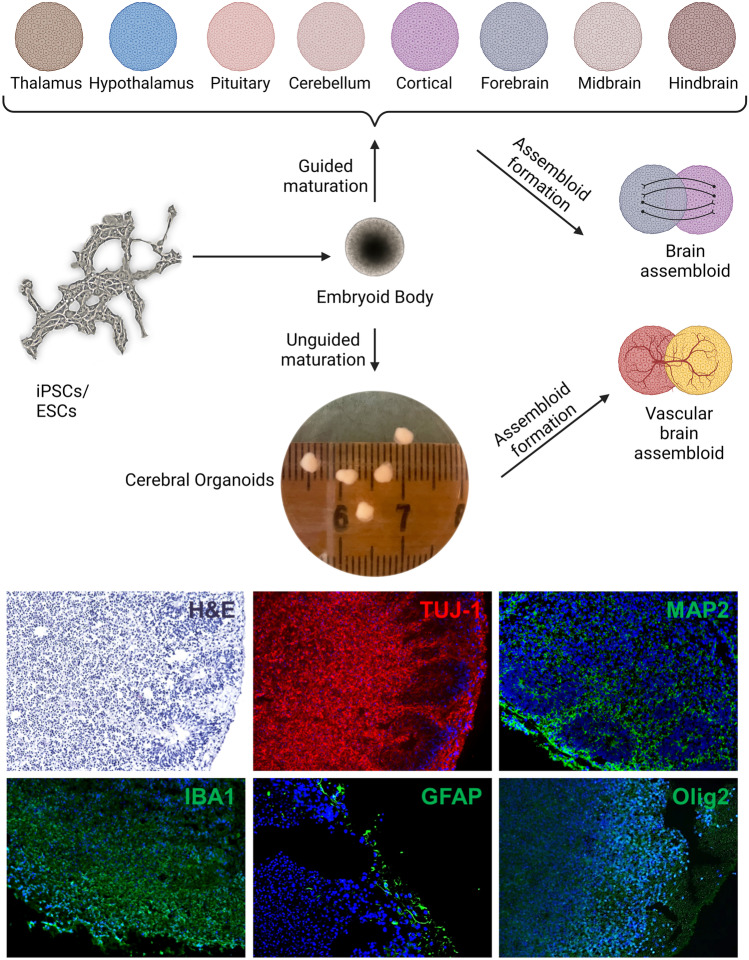
Progress in stem cell research has revolutionized the medical field for more than two decades. More recently, the discovery of induced pluripotent stem cells (iPSCs) has allowed for the development of advanced disease modeling and tissue engineering platforms. iPSCs are generated from adult somatic cells by reprogramming them into an embryonic-like state via the expression of transcription factors required for establishing pluripotency. In the context of the central nervous system (CNS), iPSCs have the potential to differentiate into a wide variety of brain cell types including neurons, astrocytes, microglial cells, endothelial cells, and oligodendrocytes. iPSCs can be used to generate brain organoids by using a constructive approach in three-dimensional (3D) culture in vitro. Recent advances in 3D brain organoid modeling have provided access to a better understanding of cell-to-cell interactions in disease progression, particularly with neurotropic viral infections. Neurotropic viral infections have been difficult to study in two-dimensional culture systems in vitro due to the lack of a multicellular composition of CNS cell networks. In recent years, 3D brain organoids have been preferred for modeling neurotropic viral diseases and have provided invaluable information for better understanding the molecular regulation of viral infection and cellular responses. Here we provide a comprehensive review of the literature on recent advances in iPSC-derived 3D brain organoid culturing and their utilization in modeling major neurotropic viral infections including HIV-1, HSV-1, JCV, ZIKV, CMV, and SARS-CoV2.
干细胞研究的进展在过去二十多年中彻底改变了医学领域。最近,诱导多能干细胞(iPSC)的发现使得高级疾病建模和组织工程平台得以发展。iPSC 是通过表达建立多能性所需的转录因子,将成人体细胞重编程为类似胚胎的状态而产生的。在中枢神经系统(CNS)中,iPSC 有可能分化为多种脑细胞类型,包括神经元、星形胶质细胞、小胶质细胞、内皮细胞和少突胶质细胞。iPSC 可以通过在体外三维(3D)培养中使用构建方法生成脑类器官。3D 脑类器官建模的最新进展使得人们能够更好地了解疾病进展中的细胞间相互作用,特别是神经嗜性病毒感染。由于缺乏中枢神经系统细胞网络的多细胞组成,神经嗜性病毒感染在体外二维培养系统中难以研究。近年来,3D 脑类器官已被用于模拟神经嗜性病毒疾病,并为更好地了解病毒感染和细胞反应的分子调控提供了宝贵的信息。本文全面综述了 iPSC 衍生的 3D 脑类器官培养的最新进展及其在模拟主要神经嗜性病毒感染(包括 HIV-1、HSV-1、JCV、ZIKV、CMV 和 SARS-CoV2)中的应用。