State Key Laboratory of Biochemical Engineering, Institute of Process Engineering Chinese Academy of Sciences, Beijing 100190, P. R. China.
University of Chinese Academy of Sciences, Beijing 100049, P. R. China.
Sci Adv. 2020 May 22;6(21):eaay7735. doi: 10.1126/sciadv.aay7735. eCollection 2020 May.
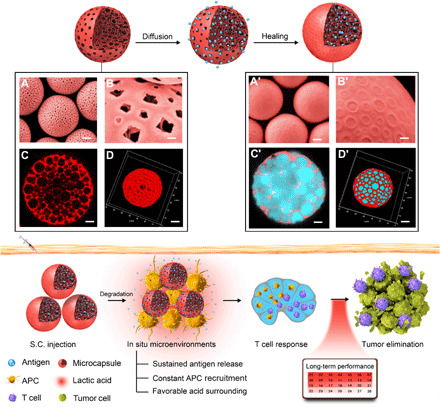
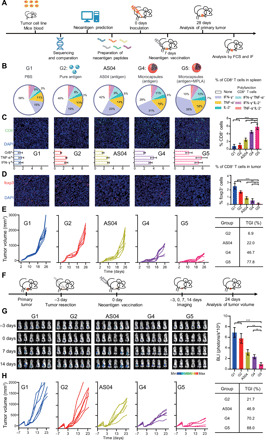
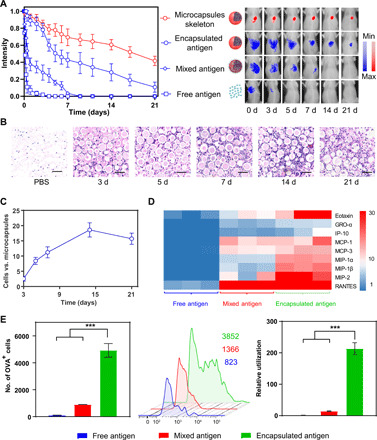
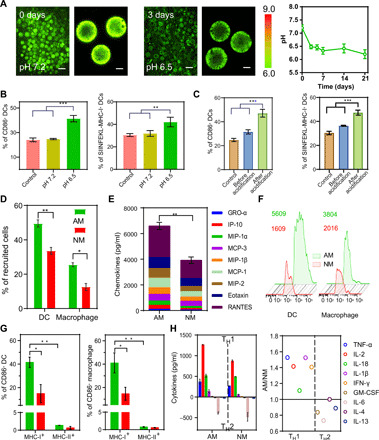
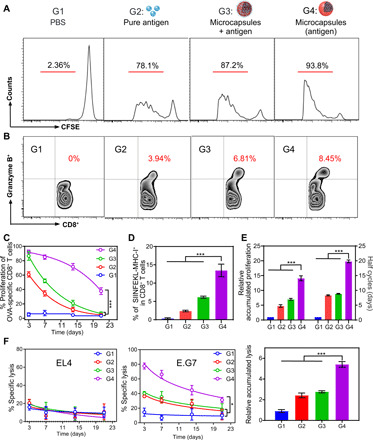
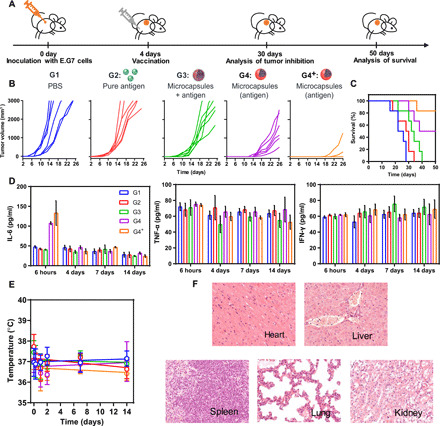
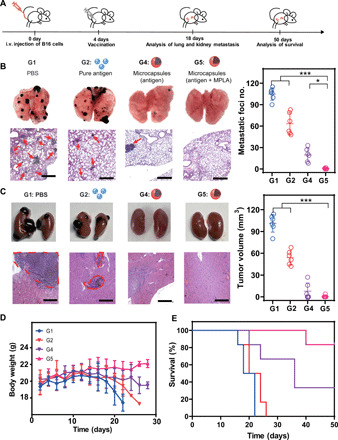
Therapeutic cancer vaccines that harness the immune system to reject cancer cells have shown great promise for cancer treatment. Although a wave of efforts have spurred to improve the therapeutic effect, unfavorable immunization microenvironment along with a complicated preparation process and frequent vaccinations substantially compromise the performance. Here, we report a novel microcapsule-based formulation for high-performance cancer vaccinations. The special self-healing feature provides a mild and efficient paradigm for antigen microencapsulation. After vaccination, these microcapsules create a favorable immunization microenvironment in situ, wherein antigen release kinetics, recruited cell behavior, and acid surrounding work in a synergetic manner. In this case, we can effectively increase the antigen utilization, improve the antigen presentation, and activate antigen presenting cells. As a result, effective T cell response, potent tumor inhibition, antimetastatic effects, and prevention of postsurgical recurrence are achieved with various types of antigens, while neoantigen was encapsuled and evaluated in different tumor models.
利用免疫系统排斥癌细胞的治疗性癌症疫苗在癌症治疗方面显示出巨大的前景。尽管已经有一系列的努力来提高治疗效果,但不利的免疫微环境以及复杂的制备过程和频繁的接种大大降低了其性能。在这里,我们报告了一种用于高性能癌症疫苗接种的新型基于微胶囊的制剂。特殊的自修复特性为抗原微囊化提供了一种温和高效的范例。接种疫苗后,这些微胶囊在原位创造了一个有利的免疫微环境,其中抗原释放动力学、募集细胞行为和酸性环境协同作用。在这种情况下,我们可以有效地增加抗原的利用,改善抗原呈递,并激活抗原呈递细胞。结果,各种类型的抗原都能产生有效的 T 细胞反应、强烈的肿瘤抑制、抗转移作用和预防术后复发,同时新抗原在不同的肿瘤模型中进行了包封和评估。