Tapia-Rojo Rafael, Alonso-Caballero Alvaro, Fernandez Julio M
Department of Biological Sciences, Columbia University, New York, NY 10027, USA.
Sci Adv. 2020 May 22;6(21):eaaz4707. doi: 10.1126/sciadv.aaz4707. eCollection 2020 May.
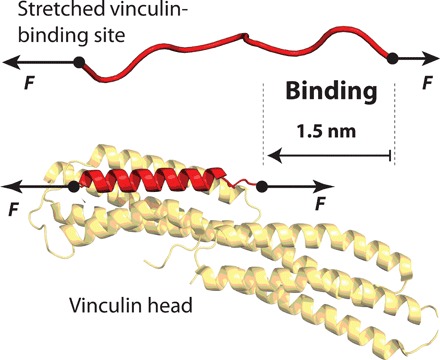
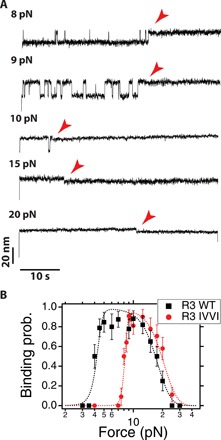
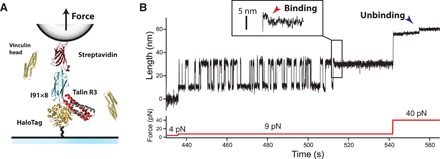
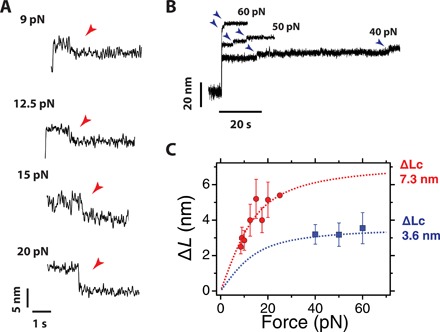
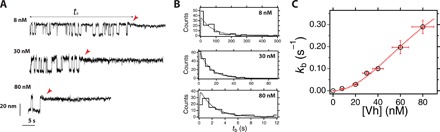
Vinculin binds unfolded talin domains in focal adhesions, which recruits actin filaments to reinforce the mechanical coupling of this organelle. However, it remains unknown how this interaction is regulated and its impact on the force transmission properties of this mechanotransduction pathway. Here, we use magnetic tweezers to measure the interaction between vinculin head and the talin R3 domain under physiological forces. For the first time, we resolve individual binding events as a short contraction of the unfolded talin polypeptide caused by the reformation of the vinculin-binding site helices, which dictates a biphasic mechanism that regulates this interaction. Force favors vinculin binding by unfolding talin and exposing the vinculin-binding sites; however, the coil-to-helix contraction introduces an energy penalty that increases with force, defining an optimal binding regime. This mechanism implies that the talin-vinculin-actin association could operate as a negative feedback mechanism to stabilize force on focal adhesions.
纽蛋白在黏着斑中与伸展的踝蛋白结构域结合,该结构域招募肌动蛋白丝以加强这个细胞器的机械偶联。然而,这种相互作用是如何被调控的以及它对这个机械转导途径的力传递特性有何影响,仍然未知。在这里,我们使用磁镊在生理力作用下测量纽蛋白头部与踝蛋白R3结构域之间的相互作用。首次,我们将单个结合事件解析为由纽蛋白结合位点螺旋的重新形成导致的伸展踝蛋白多肽的短暂收缩,这表明一种双相机制调控这种相互作用。力通过展开踝蛋白并暴露纽蛋白结合位点来促进纽蛋白结合;然而,从卷曲到螺旋的收缩会引入随着力增加的能量消耗,从而定义了一个最佳结合状态。这种机制意味着踝蛋白 - 纽蛋白 - 肌动蛋白关联可以作为一种负反馈机制来稳定黏着斑上的力。