Ho Wei-Chin, Li Diyan, Zhu Qing, Zhang Jianzhi
Department of Ecology and Evolutionary Biology, University of Michigan, Ann Arbor, MI 48109, USA.
Institute of Animal Genetics and Breeding, College of Animal Science and Technology, Sichuan Agricultural University, Chengdu 611130, China.
Sci Adv. 2020 May 22;6(21):eaba3388. doi: 10.1126/sciadv.aba3388. eCollection 2020 May.
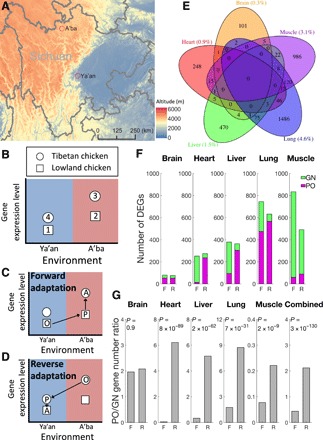
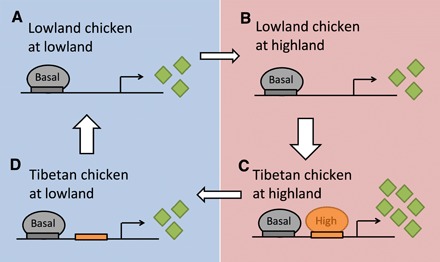
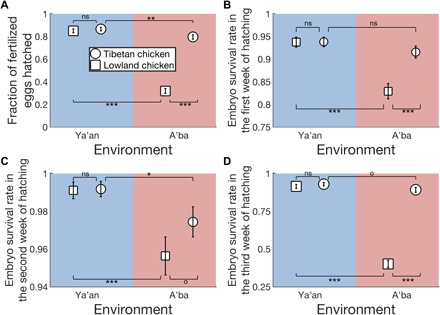
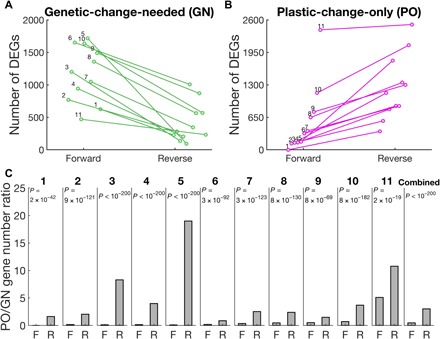
Phenotypic plasticity refers to environment-induced phenotypic changes without mutation and is present in all organisms. The role of phenotypic plasticity in organismal adaptations to novel environments has attracted much attention, but its role in readaptations to ancestral environments is understudied. To address this question, we use the reciprocal transplant approach to investigate the multitissue transcriptomes of chickens adapted to the Tibetan Plateau and adjacent lowland. While many genetic transcriptomic changes had occurred in the forward adaptation to the highland, plastic changes largely transform the transcriptomes to the preferred state when Tibetan chickens are brought back to the lowland. The same trend holds for egg hatchability, a key component of the chicken fitness. These findings, along with highly similar patterns in comparable experiments of guppies and , demonstrate that organisms generally "remember" their ancestral environments via phenotypic plasticity and reveal a mechanism by which past experience affects future evolution.
表型可塑性是指在无突变情况下由环境诱导的表型变化,存在于所有生物体中。表型可塑性在生物体适应新环境中的作用已备受关注,但其在重新适应祖先环境中的作用却研究不足。为解决这个问题,我们采用 reciprocal transplant 方法来研究适应青藏高原及邻近低地的鸡的多组织转录组。虽然在正向适应高地的过程中发生了许多基因转录组变化,但当藏鸡回到低地时,可塑性变化在很大程度上会将转录组转变为优选状态。鸡的适应性的关键组成部分——卵孵化率也呈现相同趋势。这些发现,连同孔雀鱼等类似实验中的高度相似模式,表明生物体通常通过表型可塑性“记住”它们的祖先环境,并揭示了一种过去的经历影响未来进化的机制。