American Dental Association Science and Research Institute, Hagerstown, MD 21742, U.S.A.
Biosci Rep. 2020 Jun 26;40(6). doi: 10.1042/BSR20200210.
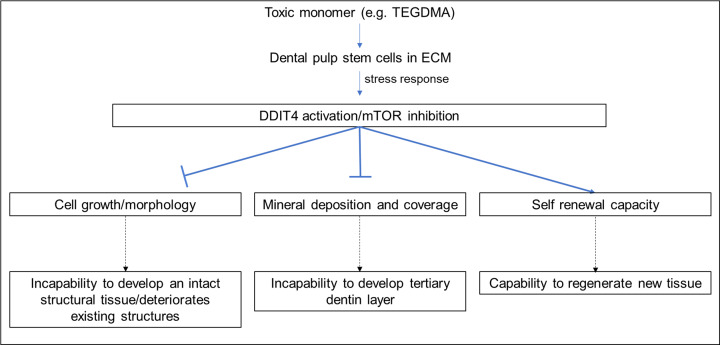
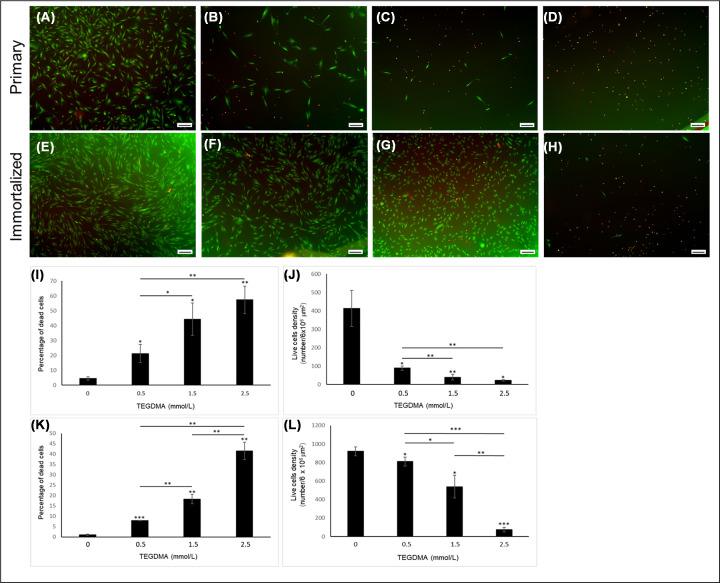
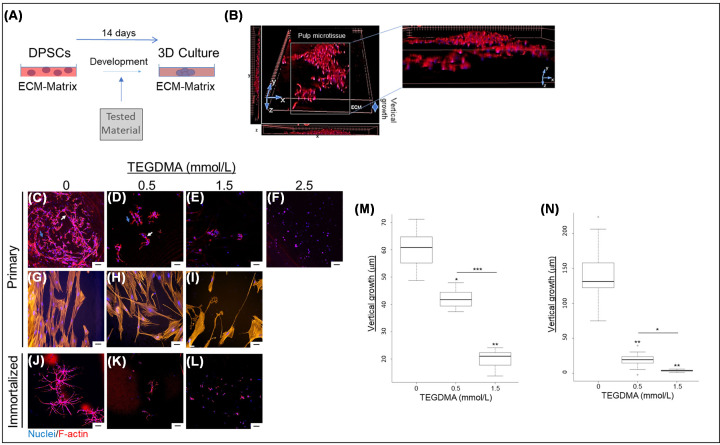
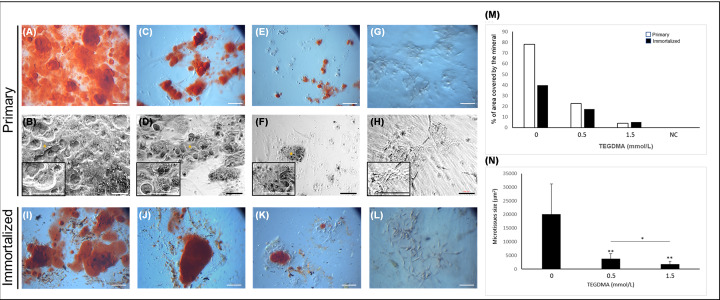
Dental pulp stem cells (DPSCs) regenerate injured/diseased pulp tissue and deposit tertiary dentin. DPSCs stress response can be activated by exposing cells to the monomer triethyleneglycol dimethacrylate (TEGDMA) and inducing the DNA-damage inducible transcript 4 (DDIT4) protein expression. The goal of the present study was to determine the impact of TEGDMA on the ability of DPSCs to maintain their self-renewal capabilities, develop and preserve their 3D structures and deposit the mineral. Human primary and immortalized DPSCs were cultured in extracellular matrix/basement membrane (ECM/BM) to support stemness and to create multicellular interacting layers (microtissues). The microtissues were exposed to the toxic concentrations of TEGDMA (0.5 and 1.5 mmol/l). The DPSCs spatial architecture was assessed by confocal microscopy. Mineral deposition was detected by alizarin red staining and visualized by stereoscopy. Cellular self-renewal transcription factor SOX2 was determined by immunocytochemistry. The microtissue thicknesses/vertical growth, surface area of the mineralizing microtissues, the percentage of area covered by the deposited mineral, and the fluorescence intensity of the immunostained cells were quantified ImageJ. DDIT4 expression was determined by a single molecule RNA-FISH technique and the cell phenotype was determined morphologically. DDIT4 expression was correlated with the cytotoxic phenotype. TEGDMA affected the structures of developing and mature microtissues. It inhibited the deposition of the mineral in the matrix while not affecting the SOX2 expression. Our data demonstrate that DPSCs retained their self-renewal capacity although their other functions were impeded. Since the DPSCs pool remained preserved, properties effected by the irritant should be restored by a proper rescue therapy.
牙髓干细胞(DPSCs)可再生受损/病变的牙髓组织并分泌第三期牙本质。DPSCs 的应激反应可通过使细胞暴露于单体三甘醇二甲基丙烯酸酯(TEGDMA)并诱导 DNA 损伤诱导转录物 4(DDIT4)蛋白表达来激活。本研究的目的是确定 TEGDMA 对 DPSCs 维持其自我更新能力、发育和维持其 3D 结构以及沉积矿物质的能力的影响。将人原代和永生化 DPSCs 培养在细胞外基质/基底膜(ECM/BM)中,以支持干细胞特性并形成多细胞相互作用层(微组织)。将微组织暴露于有毒浓度的 TEGDMA(0.5 和 1.5mmol/L)中。通过共聚焦显微镜评估 DPSCs 的空间结构。通过茜素红染色检测矿物质沉积,并通过立体学可视化。通过免疫细胞化学测定细胞自我更新转录因子 SOX2。用 ImageJ 量化微组织厚度/垂直生长、矿化微组织的表面积、被沉积矿物质覆盖的面积百分比以及免疫染色细胞的荧光强度。通过单分子 RNA-FISH 技术确定 DDIT4 的表达,并通过形态学确定细胞表型。DDIT4 的表达与细胞毒性表型相关。TEGDMA 影响发育中和成熟的微组织的结构。它抑制基质中矿物质的沉积,而不影响 SOX2 的表达。我们的数据表明,尽管 DPSCs 的其他功能受到抑制,但它们仍保留了自我更新的能力。由于 DPSCs 池得以保留,受刺激影响的特性应该可以通过适当的挽救治疗来恢复。