Chemical Biological and Radiological Division, Defence Science and Technology Laboratory (Dstl), Wiltshire, UK.
Emerg Microbes Infect. 2020 Dec;9(1):1415-1417. doi: 10.1080/22221751.2020.1777906.
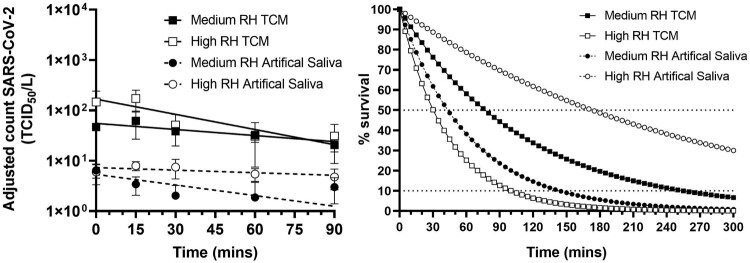
SARS-CoV-2, the causative agent of the COVID-19 pandemic, may be transmitted via airborne droplets or contact with surfaces onto which droplets have deposited. In this study, the ability of SARS-CoV-2 to survive in the dark, at two different relative humidity values and within artificial saliva, a clinically relevant matrix, was investigated. SARS-CoV-2 was found to be stable, in the dark, in a dynamic small particle aerosol under the four experimental conditions we tested and viable virus could still be detected after 90 minutes. The decay rate and half-life was determined and decay rates ranged from 0.4 to 2.27 % per minute and the half lives ranged from 30 to 177 minutes for the different conditions. This information can be used for advice and modelling and potential mitigation strategies.
SARS-CoV-2,COVID-19 大流行的病原体,可能通过空气飞沫传播或接触到有飞沫沉积的表面。在这项研究中,研究了 SARS-CoV-2 在黑暗中、两种不同相对湿度值下以及在临床相关基质人工唾液中的存活能力。研究发现,SARS-CoV-2 在我们测试的四种实验条件下,在动态小颗粒气溶胶中黑暗稳定,90 分钟后仍可检测到存活病毒。确定了衰减率和半衰期,不同条件下的衰减率范围为每分钟 0.4%至 2.27%,半衰期范围为 30 分钟至 177 分钟。这些信息可用于提供建议和建模以及潜在的缓解策略。