Judson Seth D, Munster Vincent J
Department of Medicine, University of Washington, Seattle, WA 98195, USA.
Laboratory of Virology, Division of Intramural Research, National Institute of Allergy and Infectious Diseases, National Institutes of Health, Hamilton, MT 59840, USA.
Viruses. 2019 Oct 12;11(10):940. doi: 10.3390/v11100940.
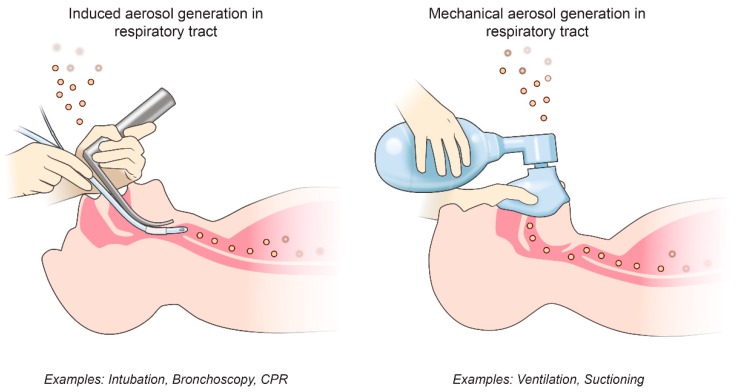
Recent nosocomial transmission events of emerging and re-emerging viruses, including Ebola virus, Middle East respiratory syndrome coronavirus, Nipah virus, and Crimean-Congo hemorrhagic fever orthonairovirus, have highlighted the risk of nosocomial transmission of emerging viruses in health-care settings. In particular, concerns and precautions have increased regarding the use of aerosol-generating medical procedures when treating patients with such viral infections. In spite of increasing associations between aerosol-generating medical procedures and the nosocomial transmission of viruses, we still have a poor understanding of the risks of specific procedures and viruses. In order to identify which aerosol-generating medical procedures and emerging viruses pose a high risk to health-care workers, we explore the mechanisms of aerosol-generating medical procedures, as well as the transmission pathways and characteristics of highly pathogenic viruses associated with nosocomial transmission. We then propose how research, both in clinical and experimental settings, could advance current infection control guidelines.
近期,包括埃博拉病毒、中东呼吸综合征冠状病毒、尼帕病毒和克里米亚-刚果出血热正布尼亚病毒在内的新发和再发病毒的医院内传播事件,凸显了医疗环境中新型病毒发生医院内传播的风险。特别是,在治疗此类病毒感染患者时,使用产生气溶胶的医疗操作引发的担忧和预防措施不断增加。尽管产生气溶胶的医疗操作与病毒的医院内传播之间的关联日益增多,但我们对特定操作和病毒的风险仍知之甚少。为了确定哪些产生气溶胶的医疗操作和新发病毒对医护人员构成高风险,我们探讨了产生气溶胶的医疗操作机制,以及与医院内传播相关的高致病性病毒的传播途径和特征。然后,我们提出临床和实验研究如何能够推进当前的感染控制指南。