• 文献检索
  • 文档翻译
  • 深度研究
  • 学术资讯
  • Suppr Zotero 插件Zotero 插件
  • 邀请有礼
  • 套餐&价格
  • 历史记录
应用&插件
Suppr Zotero 插件Zotero 插件浏览器插件Mac 客户端Windows 客户端微信小程序
定价
高级版会员购买积分包购买API积分包
服务
文献检索文档翻译深度研究API 文档MCP 服务
关于我们
关于 Suppr公司介绍联系我们用户协议隐私条款
关注我们

Suppr 超能文献

核心技术专利:CN118964589B侵权必究
粤ICP备2023148730 号-1Suppr @ 2026

文献检索

告别复杂PubMed语法,用中文像聊天一样搜索,搜遍4000万医学文献。AI智能推荐,让科研检索更轻松。

立即免费搜索

文件翻译

保留排版,准确专业,支持PDF/Word/PPT等文件格式,支持 12+语言互译。

免费翻译文档

深度研究

AI帮你快速写综述,25分钟生成高质量综述,智能提取关键信息,辅助科研写作。

立即免费体验

比较基于临床和基于社区的暴发调查的见解:孟加拉国基孔肯雅热的案例研究。

Comparing insights from clinic-based versus community-based outbreak investigations: a case study of chikungunya in Bangladesh.

机构信息

Infectious Diseases Division, International Centre for Diarrhoeal Disease Research, Bangladesh (icddr,b), Dhaka, Bangladesh; The Kirby Institute, University of New South Wales, Sydney, Australia.

Mathematical Modeling of Infectious Diseases Unit, Institut Pasteur, Paris, France.

出版信息

Int J Infect Dis. 2020 Aug;97:306-312. doi: 10.1016/j.ijid.2020.05.111. Epub 2020 Jun 2.

DOI:10.1016/j.ijid.2020.05.111
PMID:32497797
原文链接:https://pmc.ncbi.nlm.nih.gov/articles/PMC7264925/
Abstract

BACKGROUND

Outbreak investigations typically focus their efforts on identifying cases that present at healthcare facilities. However, these cases rarely represent all cases in the wider community. In this context, community-based investigations may provide additional insight into key risk factors for infection, however, the benefits of these more laborious data collection strategies remains unclear.

METHODS

We used different subsets of the data from a comprehensive outbreak investigation to compare the inferences we make in alternative investigation strategies.

RESULTS

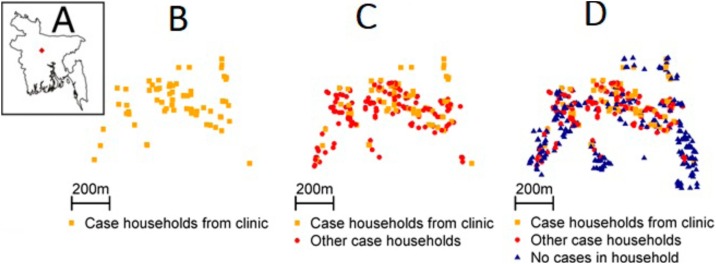
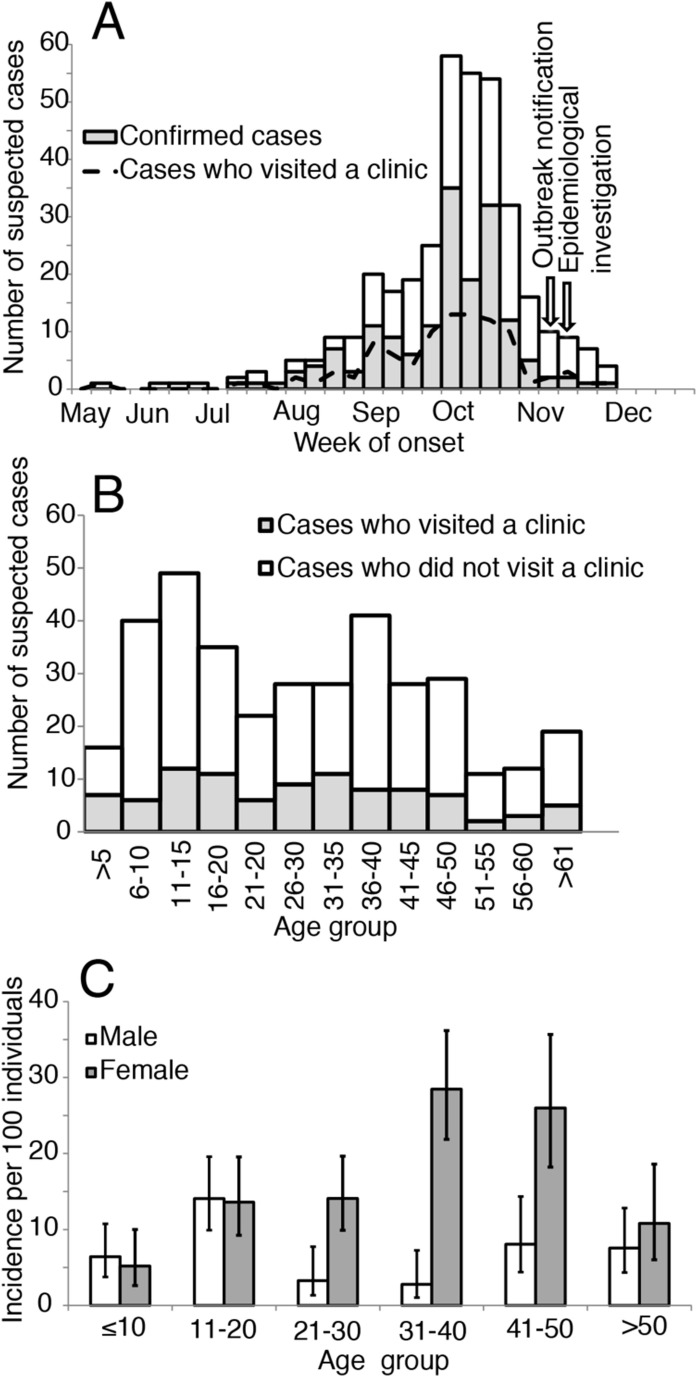
The outbreak investigation team interviewed 1,933 individuals from 460 homes. 364 (18%) of individuals had symptoms consistent with chikungunya. A theoretical clinic-based study would have identified 26% of the cases. Adding in community-based cases provided an overall estimate of the attack rate in the community. Comparison with controls from the same household revealed that those with at least secondary education had a reduced risk. Finally, enrolling residents from households across the community allowed us to characterize spatial heterogeneity of risk and identify the type of clothing usually worn and travel history as risk factors. This also revealed that household-level use of mosquito control was not associated with infection.

CONCLUSIONS

These findings highlight that while clinic-based studies may be easier to conduct, they only provide limited insight into the burden and risk factors for disease. Enrolling people who escaped from infection, both in the household and in the community allows a step change in our understanding of the spread of a pathogen and maximizes opportunities for control.

摘要

背景

暴发调查通常集中精力识别在医疗机构就诊的病例。然而,这些病例很少代表社区中所有的病例。在这种情况下,基于社区的调查可能会提供有关感染关键风险因素的更多见解,然而,这些更费力的数据收集策略的好处尚不清楚。

方法

我们使用全面暴发调查的不同数据子集来比较替代调查策略中的推断。

结果

暴发调查小组对来自 460 户家庭的 1933 人进行了访谈。460 户家庭中有 364 人(18%)出现符合基孔肯雅热症状。理论上的以诊所为基础的研究将确定 26%的病例。加入基于社区的病例提供了社区中总体发病率的估计。与同一家庭的对照进行比较表明,至少受过中等教育的人患病风险降低。最后,招募来自整个社区家庭的居民使我们能够描述风险的空间异质性,并确定通常穿着的衣服类型和旅行史作为风险因素。这也表明家庭层面使用蚊虫控制与感染无关。

结论

这些发现强调,虽然以诊所为基础的研究可能更容易进行,但它们仅提供了对疾病负担和风险因素的有限了解。招募那些从家庭和社区中逃脱感染的人,可以让我们对病原体的传播有一个更深入的理解,并最大限度地提高控制的机会。
https://cdn.ncbi.nlm.nih.gov/pmc/blobs/1f79/7264925/5a0cbc7cf89f/gr2_lrg.jpg
https://cdn.ncbi.nlm.nih.gov/pmc/blobs/1f79/7264925/cc5a4940fb4a/gr1_lrg.jpg
https://cdn.ncbi.nlm.nih.gov/pmc/blobs/1f79/7264925/5a0cbc7cf89f/gr2_lrg.jpg
https://cdn.ncbi.nlm.nih.gov/pmc/blobs/1f79/7264925/cc5a4940fb4a/gr1_lrg.jpg
https://cdn.ncbi.nlm.nih.gov/pmc/blobs/1f79/7264925/5a0cbc7cf89f/gr2_lrg.jpg

相似文献

1
Comparing insights from clinic-based versus community-based outbreak investigations: a case study of chikungunya in Bangladesh.比较基于临床和基于社区的暴发调查的见解:孟加拉国基孔肯雅热的案例研究。
Int J Infect Dis. 2020 Aug;97:306-312. doi: 10.1016/j.ijid.2020.05.111. Epub 2020 Jun 2.
2
An Outbreak of Chikungunya in Rural Bangladesh, 2011.2011年孟加拉国农村基孔肯雅热疫情
PLoS Negl Trop Dis. 2015 Jul 10;9(7):e0003907. doi: 10.1371/journal.pntd.0003907. eCollection 2015.
3
Megacities as drivers of national outbreaks: The 2017 chikungunya outbreak in Dhaka, Bangladesh.特大城市推动国家疫情爆发:2017 年孟加拉国达卡基孔古尼雅热疫情。
PLoS Negl Trop Dis. 2021 Feb 2;15(2):e0009106. doi: 10.1371/journal.pntd.0009106. eCollection 2021 Feb.
4
Chikungunya outbreak (2017) in Bangladesh: Clinical profile, economic impact and quality of life during the acute phase of the disease.2017 年孟加拉国基孔肯雅热疫情:疾病急性期的临床特征、经济影响和生活质量。
PLoS Negl Trop Dis. 2018 Jun 6;12(6):e0006561. doi: 10.1371/journal.pntd.0006561. eCollection 2018 Jun.
5
Seroprevalence and Symptomatic Attack Rate of Chikungunya Virus Infection, United States Virgin Islands, 2014-2015.2014-2015 年美国维尔京群岛基孔肯雅病毒感染的血清阳性率和症状发病率。
Am J Trop Med Hyg. 2018 Nov;99(5):1321-1326. doi: 10.4269/ajtmh.18-0437.
6
Chikungunya outbreak in Bangladesh (2017): Clinical and hematological findings.孟加拉国(2017 年)基孔肯雅热疫情:临床和血液学发现。
PLoS Negl Trop Dis. 2020 Feb 24;14(2):e0007466. doi: 10.1371/journal.pntd.0007466. eCollection 2020 Feb.
7
Manifestations of Atypical Symptoms of Chikungunya during the Dhaka Outbreak (2017) in Bangladesh.孟加拉国达卡疫情(2017 年)中基孔肯雅热非典型症状表现。
Am J Trop Med Hyg. 2019 Jun;100(6):1545-1548. doi: 10.4269/ajtmh.19-0122.
8
Chikungunya virus disease outbreak in Yap State, Federated States of Micronesia.密克罗尼西亚联邦雅浦州基孔肯雅病毒病疫情。
PLoS Negl Trop Dis. 2017 Mar 1;11(3):e0005410. doi: 10.1371/journal.pntd.0005410. eCollection 2017 Mar.
9
How social structures, space, and behaviors shape the spread of infectious diseases using chikungunya as a case study.以基孔肯雅热为例,探讨社会结构、空间和行为如何影响传染病的传播。
Proc Natl Acad Sci U S A. 2016 Nov 22;113(47):13420-13425. doi: 10.1073/pnas.1611391113. Epub 2016 Nov 7.
10
Experience of Chikungunya in a Chikungunya Clinic at Tertiary Medical College Hospital in Bangladesh.孟加拉国三级医学院医院基孔肯雅热诊所的基孔肯雅热诊疗经验
Mymensingh Med J. 2020 Apr;29(2):431-437.

引用本文的文献

1
Seroprevalence of Chikungunya Virus, Jamaica, and New Tools for Surveillance (Response).牙买加基孔肯雅病毒血清流行率及新的监测工具(回应)
Emerg Infect Dis. 2022 Aug;28(8):1737-1738. doi: 10.3201/eid2808.221006.

本文引用的文献

1
Evaluating Hospital-Based Surveillance for Outbreak Detection in Bangladesh: Analysis of Healthcare Utilization Data.评估孟加拉国基于医院的疫情监测以进行疫情检测:医疗利用数据分析
PLoS Med. 2017 Jan 17;14(1):e1002218. doi: 10.1371/journal.pmed.1002218. eCollection 2017 Jan.
2
Laboratory Diagnosis of Chikungunya Virus Infections and Commercial Sources for Diagnostic Assays.基孔肯雅病毒感染的实验室诊断及诊断检测的商业来源
J Infect Dis. 2016 Dec 15;214(suppl 5):S471-S474. doi: 10.1093/infdis/jiw274.
3
How social structures, space, and behaviors shape the spread of infectious diseases using chikungunya as a case study.
以基孔肯雅热为例,探讨社会结构、空间和行为如何影响传染病的传播。
Proc Natl Acad Sci U S A. 2016 Nov 22;113(47):13420-13425. doi: 10.1073/pnas.1611391113. Epub 2016 Nov 7.
4
Is Dengue Vector Control Deficient in Effectiveness or Evidence?: Systematic Review and Meta-analysis.登革热病媒控制在有效性还是证据方面存在不足?系统评价与荟萃分析
PLoS Negl Trop Dis. 2016 Mar 17;10(3):e0004551. doi: 10.1371/journal.pntd.0004551. eCollection 2016 Mar.
5
The Epidemic of Zika Virus-Related Microcephaly in Brazil: Detection, Control, Etiology, and Future Scenarios.巴西寨卡病毒相关小头畸形疫情:检测、防控、病因及未来情形
Am J Public Health. 2016 Apr;106(4):601-5. doi: 10.2105/AJPH.2016.303113.
6
Investigation of chikungunya fever outbreak in Laguna, Philippines, 2012.2012年菲律宾拉古纳基孔肯雅热疫情调查
Western Pac Surveill Response J. 2015 Aug 10;6(3):8-11. doi: 10.5365/WPSAR.2015.6.1.006. eCollection 2015 Jul-Sep.
7
Ebola Virus Outbreak Investigation, Sierra Leone, September 28-November 11, 2014.2014年9月28日至11月11日,塞拉利昂埃博拉病毒疫情调查
Emerg Infect Dis. 2015 Nov;21(11):1921-7. doi: 10.3201/eid2111.150582.
8
Reconstruction of 60 Years of Chikungunya Epidemiology in the Philippines Demonstrates Episodic and Focal Transmission.菲律宾60年基孔肯雅热流行病学重建显示其呈间歇性和局部性传播。
J Infect Dis. 2016 Feb 15;213(4):604-10. doi: 10.1093/infdis/jiv470. Epub 2015 Sep 25.
9
An Outbreak of Chikungunya in Rural Bangladesh, 2011.2011年孟加拉国农村基孔肯雅热疫情
PLoS Negl Trop Dis. 2015 Jul 10;9(7):e0003907. doi: 10.1371/journal.pntd.0003907. eCollection 2015.
10
Chikungunya virus outbreak, Dominica, 2014.2014年,多米尼克基孔肯雅病毒疫情
Emerg Infect Dis. 2015 May;21(5):909-11. doi: 10.3201/eid2105.141813.