Department of Pathology, Microbiology and Immunology, Division of Molecular Pathogenesis, Nashville, TN, USA.
Department of Urology, Nashville, TN, USA.
Nat Commun. 2020 Jun 4;11(1):2803. doi: 10.1038/s41467-020-16627-5.
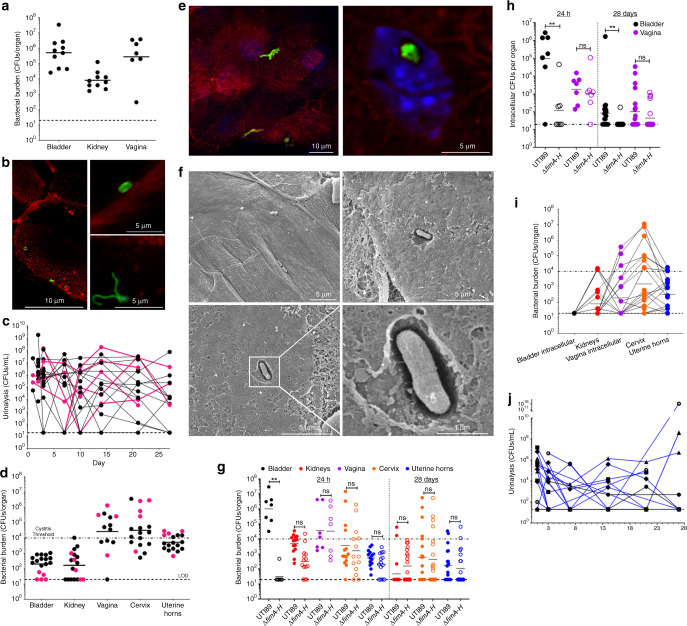
Host-associated reservoirs account for the majority of recurrent and oftentimes recalcitrant infections. Previous studies established that uropathogenic E. coli - the primary cause of urinary tract infections (UTIs) - can adhere to vaginal epithelial cells preceding UTI. Here, we demonstrate that diverse urinary E. coli isolates not only adhere to, but also invade vaginal cells. Intracellular colonization of the vaginal epithelium is detected in acute and chronic murine UTI models indicating the ability of E. coli to reside in the vagina following UTI. Conversely, in a vaginal colonization model, E. coli are detected inside vaginal cells and the urinary tract, indicating that vaginal colonization can seed the bladder. More critically, bacteria are identified inside vaginal cells from clinical samples from women with a history of recurrent UTI. These findings suggest that E. coli can establish a vaginal intracellular reservoir, where it may reside safely from extracellular stressors prior to causing an ascending infection.
宿主相关的储层是大多数反复发生且常常难以治愈的感染的原因。先前的研究表明,尿路致病性大肠杆菌是尿路感染(UTI)的主要原因,它可以在 UTI 之前附着在阴道上皮细胞上。在这里,我们证明了不同的尿大肠杆菌分离株不仅可以附着,还可以侵入阴道细胞。在急性和慢性小鼠 UTI 模型中检测到阴道上皮细胞的细胞内定植,表明大肠杆菌在 UTI 后有能力在阴道中存活。相反,在阴道定植模型中,大肠杆菌在阴道细胞和泌尿道中被检测到,表明阴道定植可以将细菌播种到膀胱中。更重要的是,从有反复尿路感染史的女性的临床样本中的阴道细胞中鉴定出了细菌。这些发现表明,大肠杆菌可以建立一个阴道细胞内储层,在那里它可以安全地躲避细胞外应激源,然后再引起上行感染。