Neonatal Unit, C2 VN, Hospital University La Conception, APHM, AMU, Marseille, France.
Public Health and Medical Information Department, APHM, Marseille, France.
PLoS One. 2020 Jun 5;15(6):e0233416. doi: 10.1371/journal.pone.0233416. eCollection 2020.
To determine whether neighbourhood socioeconomic status (SES) was associated with large for gestational age (LGA) while considering key sociodemographic and clinical confounding factors.
All singleton infants whose parents were living in the city of Marseilles, France, between 2013 and 2016.
Population-based study based on new-born hospital birth admission charts from the French National Uniform Hospital Discharge Data Set Database. LGA infants were compared to appropriate-for-gestational-age (AGA) infants. Multiple generalized logistic model analysis was used to examine factors associated with LGA.
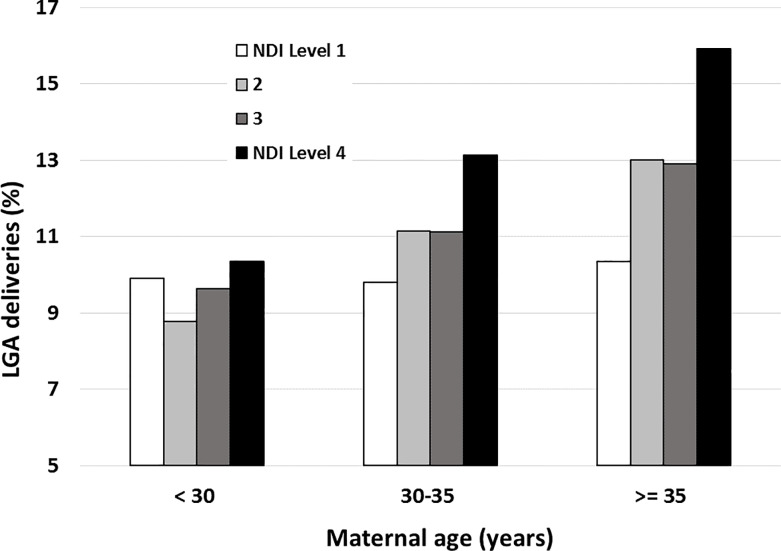
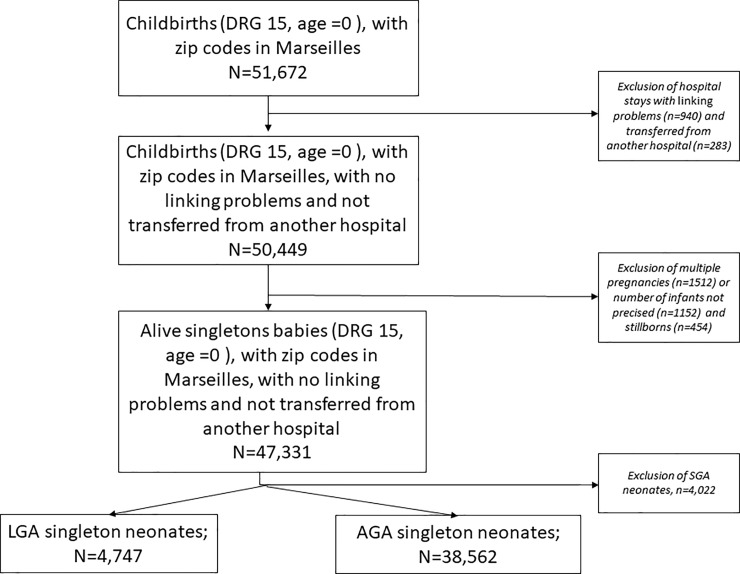
A total of 43,309 singleton infants were included, and 4,747 (11%) were born LGA. LGA infants were more likely to have metabolic and respiratory diseases and to be admitted to the neonatal intensive care unit. Multiparity, advanced maternal age, obesity and diabetes were associated with an increased risk of LGA. Lower neighbourhood SES was associated with LGA (aOR = 1.24, 95% CI: 1.14; 1.36; p<0.0001) independent of age, diabetes, obesity, maternal smoking and multiparity. The strength of this association increased with maternal age, reaching an aOR of 1.50 (95% CI: 1.26; 1.78; p<0.0001) for women > 35 years old.
Neighbourhood SES could be considered an important factor for clinicians to better identify mothers at risk of having LGA births in addition to well-known risk factors such as maternal diabetes, obesity and age. The intensification of the association between SES and LGA with increasing maternal age suggests that neighbourhood disadvantage may act on LGA cumulatively over time.
在考虑关键社会人口学和临床混杂因素的情况下,确定邻里社会经济地位(SES)是否与巨大儿(LGA)有关。
2013 年至 2016 年间,法国马赛市所有父母居住在该市的单胎婴儿。
基于法国国家统一医院出院数据数据库中新生儿住院入院图表的基于人群的研究。将 LGA 婴儿与适合胎龄(AGA)婴儿进行比较。使用多广义逻辑模型分析来检查与 LGA 相关的因素。
共纳入 43309 名单胎婴儿,其中 4747 名(11%)出生时为 LGA。LGA 婴儿更有可能患有代谢和呼吸系统疾病,并需要入住新生儿重症监护病房。多胎、高龄、肥胖和糖尿病与 LGA 的风险增加有关。较低的邻里 SES 与 LGA 相关(aOR=1.24,95%CI:1.14;1.36;p<0.0001),与年龄、糖尿病、肥胖、母亲吸烟和多胎无关。随着母亲年龄的增加,这种关联的强度增加,对于年龄大于 35 岁的女性,aOR 达到 1.50(95%CI:1.26;1.78;p<0.0001)。
除了众所周知的危险因素(如母亲糖尿病、肥胖和年龄)外,邻里 SES 可以被认为是临床医生更好地识别有巨大儿分娩风险的母亲的一个重要因素。SES 与 LGA 之间的关联随着母亲年龄的增加而增强,这表明邻里劣势可能随着时间的推移对 LGA 产生累积影响。