Instituto de Enfermedades Crónico-Degenerativas, Departamento de Biología Molecular y Genómica, CUCS, Universidad de Guadalajara, Guadalajara, Jalisco, Mexico.
Centro de Física Aplicada y Tecnología Avanzada, Universidad Nacional Autonoma de México (UNAM), Apartado Postal 1-1010, Queretaro, Queretaro 76000, Mexico.
Life Sci. 2020 Sep 1;256:117905. doi: 10.1016/j.lfs.2020.117905. Epub 2020 Jun 3.
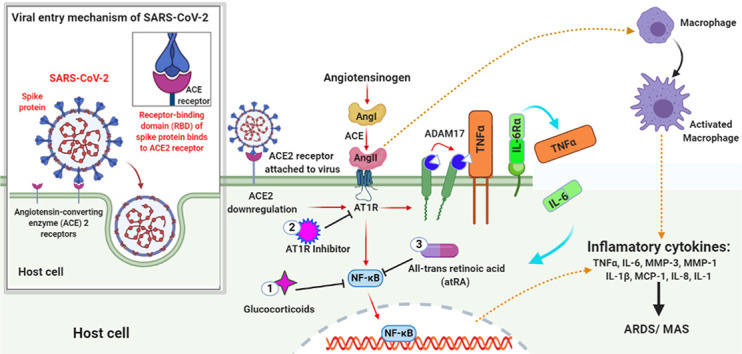
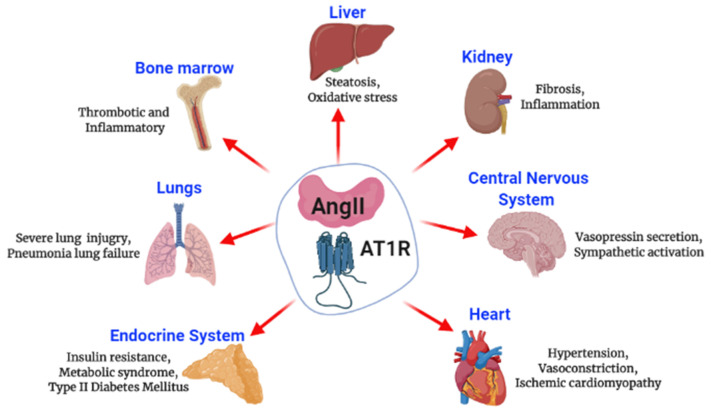
In light of the outbreak of the 2019 novel coronavirus disease (COVID-19), the international scientific community has joined forces to develop effective treatment strategies. The Angiotensin-Converting Enzyme (ACE) 2, is an essential receptor for cell fusion and engulfs the SARS coronavirus infections. ACE2 plays an important physiological role, practically in all the organs and systems. Also, ACE2 exerts protective functions in various models of pathologies with acute and chronic inflammation. While ACE2 downregulation by SARS-CoV-2 spike protein leads to an overactivation of Angiotensin (Ang) II/AT1R axis and the deleterious effects of Ang II may explain the multiorgan dysfunction seen in patients. Specifically, the role of Ang II leading to the appearance of Macrophage Activation Syndrome (MAS) and the cytokine storm in COVID-19 is discussed below. In this review, we summarized the latest research progress in the strategies of treatments that mainly focus on reducing the Ang II-induced deleterious effects rather than attenuating the virus replication.
鉴于 2019 年新型冠状病毒病(COVID-19)的爆发,国际科学界已经联合起来制定有效的治疗策略。血管紧张素转换酶(ACE)2 是细胞融合的必需受体,并吞噬 SARS 冠状病毒感染。ACE2 在所有器官和系统中都具有重要的生理作用。此外,ACE2 在各种急慢性炎症的病理模型中发挥着保护作用。而 SARS-CoV-2 刺突蛋白下调 ACE2 会导致血管紧张素(Ang)II/AT1R 轴过度激活,Ang II 的有害作用可能解释了 COVID-19 患者多器官功能障碍的原因。具体来说,讨论了 Ang II 导致 COVID-19 中巨噬细胞活化综合征(MAS)和细胞因子风暴出现的作用。在这篇综述中,我们总结了主要关注减轻 Ang II 诱导的有害作用而不是减弱病毒复制的治疗策略的最新研究进展。