Department of Clinical Research, London School of Hygiene & Tropical Medicine, London, UK.
London Centre for Neglected Tropical Disease Research, London, UK.
Parasit Vectors. 2020 Jun 6;13(1):289. doi: 10.1186/s13071-020-04168-1.
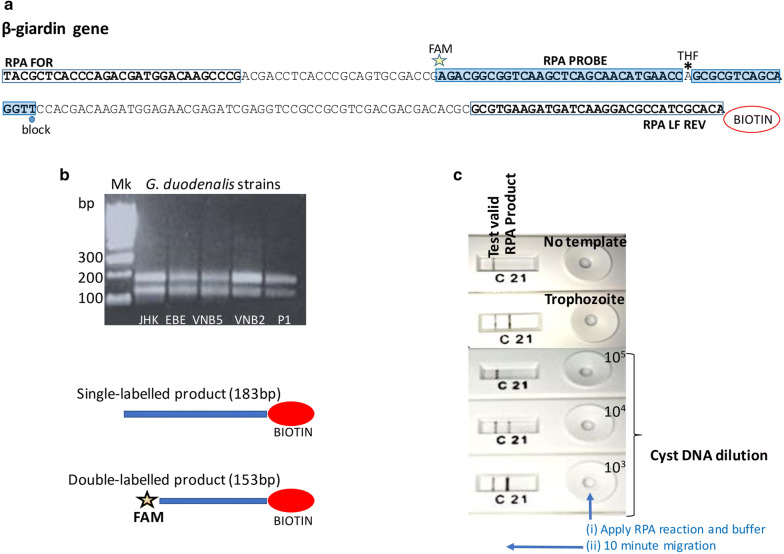
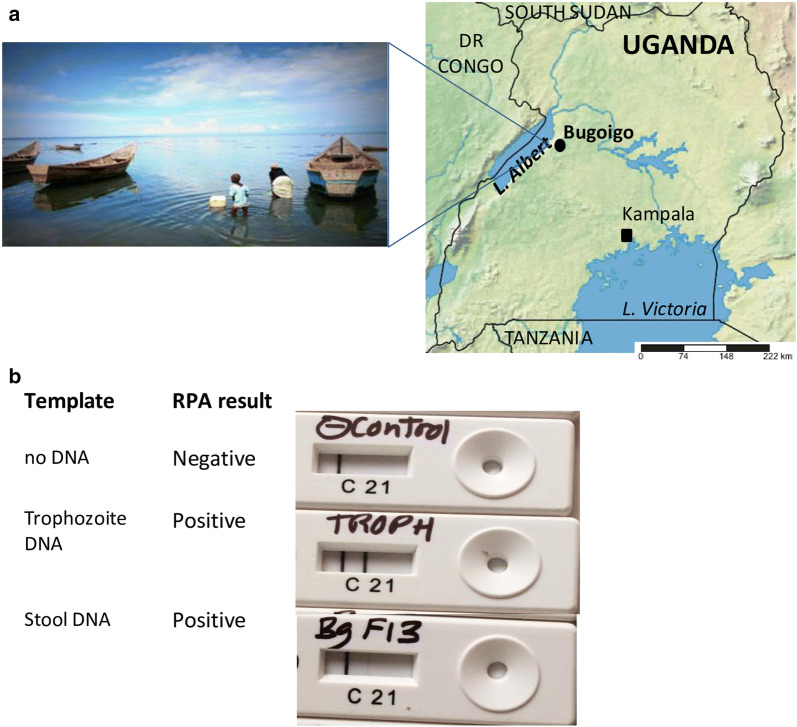
Giardia duodenalis is a gastrointestinal protozoan causing 184 million cases of giardiasis worldwide annually. Detection is by microscopy or coproantigen assays, although sensitivity is often compromised by intermittent shedding of cysts or trophozoites, or operator expertise. Therefore, for enhanced surveillance field-applicable, point-of-care (POC), molecular assays are needed. Our aims were to: (i) optimise the recombinase polymerase amplification (RPA) assay for the isothermal amplification of the G. duodenalis β-giardin gene from trophozoites and cysts, using published primer and probes; and (ii) perform a pilot field validation of RPA at a field station in a resource-poor setting, on DNA extracted from stool samples from schoolchildren in villages around Lake Albert, Uganda. Results were compared to an established laboratory small subunit ribosomal RNA (SSU rDNA) qPCR assay with additional testing using a qPCR targeting the triose phosphate isomerase (tpi) DNA regions that can distinguish G. duodenalis of two different assemblages (A and B), which are human-specific.
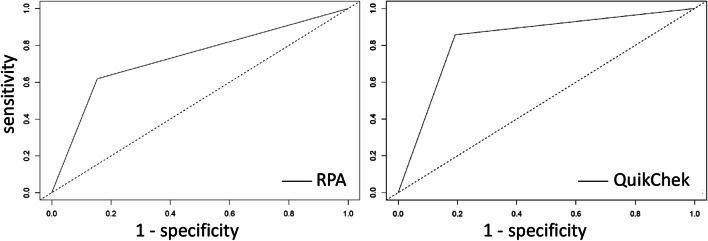
Initial optimisation resulted in the successful amplification of predicted RPA products from G. duodenalis-purified gDNA, producing a double-labelled amplicon detected using lateral flow strips. In the field setting, of 129 stool samples, 49 (37.9%) were positive using the Giardia/Cryptosporidium QuikChek coproantigen test; however, the RPA assay when conducted in the field was positive for a single stool sample. Subsequent molecular screening in the laboratory on a subset (n = 73) of the samples demonstrated better results with 21 (28.8%) RPA positive. The SSU rDNA qPCR assay resulted in 30/129 (23.3%) positive samples; 18 out of 73 (24.7%) were assemblage typed (9 assemblage A; 5 assemblage B; and 4 mixed A+B). Compared with the SSU rDNA qPCR, QuikChek was more sensitive than RPA (85.7 vs 61.9%), but with similar specificities (80.8 vs 84.6%). In comparison to QuikChek, RPA had 46.4% sensitivity and 82.2% specificity.
To the best of our knowledge, this is the first in-field and comparative laboratory validation of RPA for giardiasis in low resource settings. Further refinement and technology transfer, specifically in relation to stool sample preparation, will be needed to implement this assay in the field, which could assist better detection of asymptomatic Giardia infections.
十二指肠贾第鞭毛虫是一种胃肠道原生动物,每年在全球范围内导致 1.84 亿例贾第虫病。检测方法是通过显微镜检查或粪便抗原检测,但由于囊肿或滋养体间歇性排出,或操作人员的专业知识,敏感性往往受到影响。因此,需要增强适合现场应用的、即时的(POC)分子检测方法。我们的目的是:(i)优化重组酶聚合酶扩增(RPA)检测方法,用于从滋养体和囊肿中对十二指肠贾第鞭毛虫的β-微管蛋白基因进行等温扩增,使用已发表的引物和探针;(ii)在乌干达阿尔伯特湖周围村庄的小学生粪便样本中,在资源匮乏的现场工作站上对 RPA 进行初步现场验证。结果与建立的实验室小亚基核糖体 RNA(SSU rDNA)qPCR 检测方法进行了比较,并使用靶向三磷酸甘油醛异构酶(tpi)DNA 区域的 qPCR 进行了额外的检测,该区域可以区分两种不同集合体(A 和 B)的十二指肠贾第鞭毛虫,这些集合体是人类特有的。
初步优化导致从纯化的 G. duodenalis gDNA 成功扩增预期的 RPA 产物,产生使用侧向流动条检测到的双标记扩增子。在野外环境中,对 129 份粪便样本进行检测,49 份(37.9%)用贾第虫/隐孢子虫快速检测试剂盒 coproantigen 检测呈阳性;然而,在野外进行的 RPA 检测仅对一份粪便样本呈阳性。随后在实验室对样本的一个亚组(n=73)进行分子筛选,结果显示 21 份(28.8%)RPA 呈阳性。SSU rDNA qPCR 检测方法导致 30/129(23.3%)阳性样本;73 个中有 18 个(24.7%)被分型为(9 个集合体 A;5 个集合体 B;和 4 个混合 A+B)。与 SSU rDNA qPCR 相比,QuikChek 比 RPA 更敏感(85.7%比 61.9%),但特异性相似(80.8%比 84.6%)。与 QuikChek 相比,RPA 的敏感性为 46.4%,特异性为 82.2%。
据我们所知,这是首次在资源匮乏的环境中进行现场和实验室比较 RPA 检测贾第虫病。需要进一步改进和技术转让,特别是在粪便样本准备方面,以便在现场实施该检测方法,这有助于更好地检测无症状的贾第虫感染。