Team of Alternatives to Antibiotics, Gene Engineering Lab, Feed Research Institute, Chinese Academy of Agricultural Science, Beijing, 100081, People's Republic of China.
Key Laboratory of Feed Biotechnology, Ministry of Agriculture and Rural Affairs, Beijing, 100081, People's Republic of China.
Appl Microbiol Biotechnol. 2020 Aug;104(15):6693-6705. doi: 10.1007/s00253-020-10685-x. Epub 2020 Jun 6.
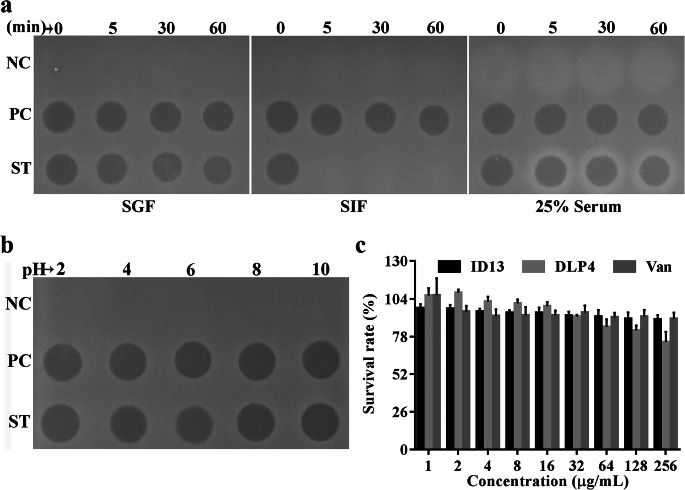
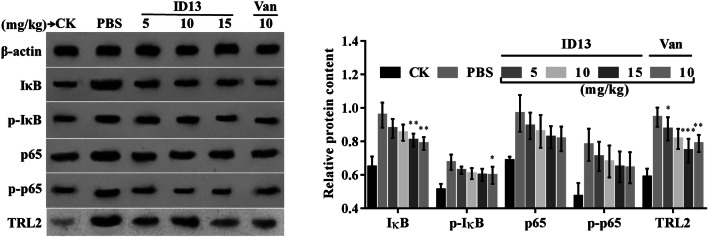
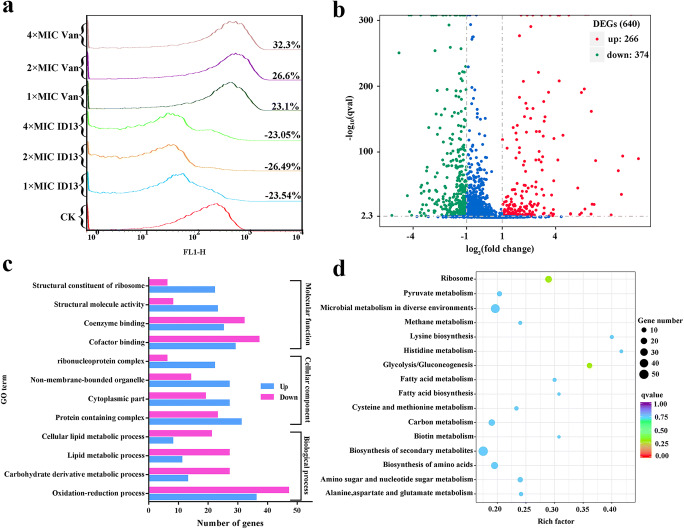
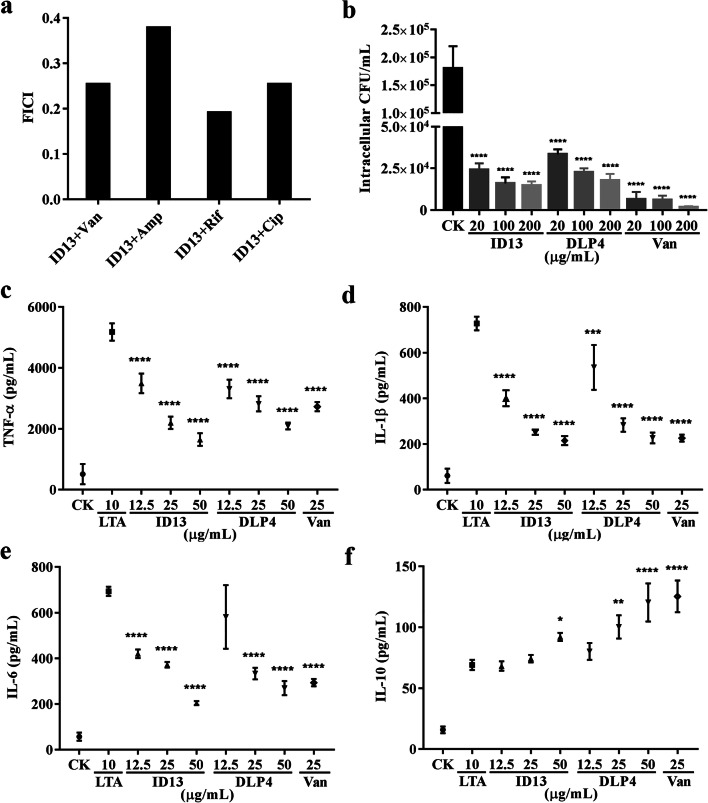
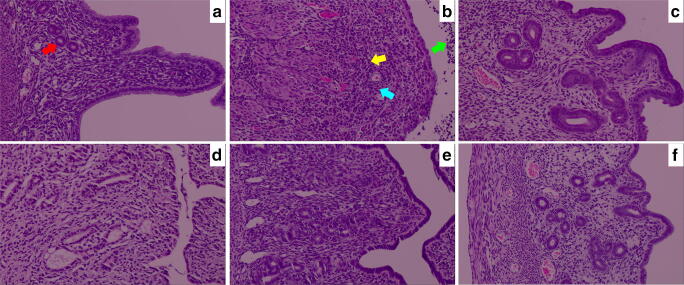
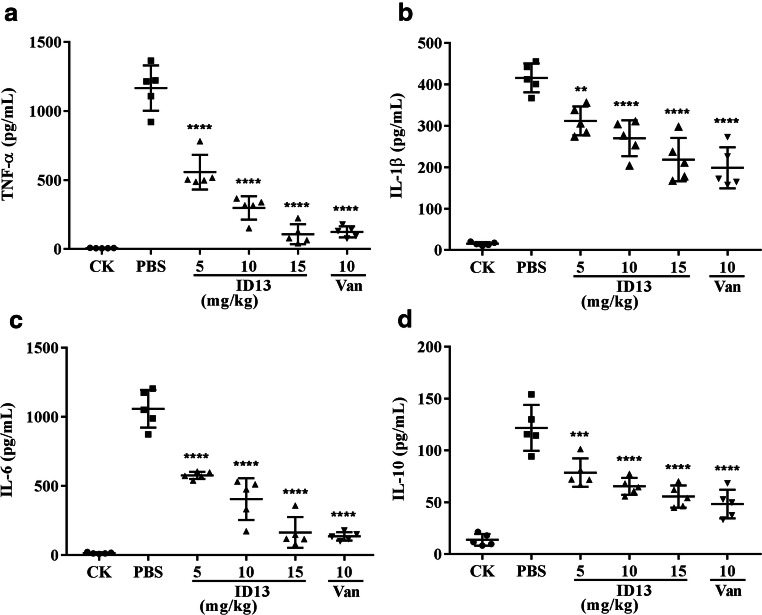
Staphylococcus aureus is a common pathogen that can cause clinical and subclinical endometritis in humans and animals. In this study, a designed CSαβ peptide ID13 from DLP4 exhibited high stable antibacterial activity in simulated gastric fluid (90.79%), serum (99.54%), and different pH buffers (> 99%) against S. aureus CVCC 546 and lower cytotoxicity (89.62% viability) than its parent peptide DLP4 (74.14% viability) toward mouse endometrial epithelial cells (MEECs). ID13 caused a depolarization of bacterial membrane and downregulation of the expression of genes involved in membrane potential maintenance and biofilm formation. The in vitro efficacy analysis of ID13 showed a synergistic effect with vancomycin, ampicillin, rifampin, and ciprofloxacin; intracellular antimicrobial activity against S. aureus CVCC 546 in MEECs; and the ability to inhibit lipoteichoic acid-induced pro-inflammatory cytokines from RAW 264.7. In the S. aureus-induced endometritis of mice, similar to vancomycin, ID13 remarkably alleviated pathological conditions, inhibited the production of cytokines (TNF-α, IL-1ß, IL-6, and IL-10), and suppressed the TLR2-NF-κB signal pathway. Collectively, these results suggest that ID13 could be a potential candidate peptide for therapeutic application in S. aureus-induced endometritis. Key Points •Higher antibacterial activity and lower hemolysis of ID13 than DLP4. •ID13 could downregulate the genes of bacterial survival and infection. •ID13 could alleviate the S. aureus-induced endometritis of mice. •ID13 could regulate the cytokines and suppress the TLR2-NF-κB signal pathway.
金黄色葡萄球菌是一种常见的病原体,可导致人类和动物的临床和亚临床子宫内膜炎。在这项研究中,一种设计的 CSαβ 肽 ID13 从 DLP4 表现出高稳定的抗菌活性在模拟胃液(90.79%),血清(99.54%)和不同的 pH 缓冲液(> 99%)对金黄色葡萄球菌 CVCC 546 和较低的细胞毒性(89.62%活力)比其母体肽 DLP4(74.14%活力)对小鼠子宫内膜上皮细胞(MEECs)。ID13 导致细菌膜去极化和下调参与膜电位维持和生物膜形成的基因的表达。ID13 的体外疗效分析显示与万古霉素、氨苄西林、利福平、环丙沙星协同作用;在 MEECs 中对金黄色葡萄球菌 CVCC 546 的细胞内抗菌活性;并抑制脂磷壁酸诱导的 RAW 264.7 促炎细胞因子。在金黄色葡萄球菌诱导的小鼠子宫内膜炎中,与万古霉素相似,ID13 显著缓解了病理状况,抑制了细胞因子(TNF-α、IL-1β、IL-6 和 IL-10)的产生,并抑制了 TLR2-NF-κB 信号通路。综上所述,这些结果表明 ID13 可能是治疗金黄色葡萄球菌诱导的子宫内膜炎的潜在候选肽。 要点 •ID13 比 DLP4 具有更高的抗菌活性和更低的溶血活性。 •ID13 可以下调细菌生存和感染的基因。 •ID13 可以缓解金黄色葡萄球菌诱导的小鼠子宫内膜炎。 •ID13 可以调节细胞因子并抑制 TLR2-NF-κB 信号通路。