Scheiner Stefan, Ukaj Niketa, Hellmich Christian
Institute for Mechanics of Materials and Structures, Vienna University of Technology (TU Wien), Karlsplatz 13/202, Vienna 1040, Austria.
Chaos Solitons Fractals. 2020 Jul;136:109891. doi: 10.1016/j.chaos.2020.109891. Epub 2020 May 30.
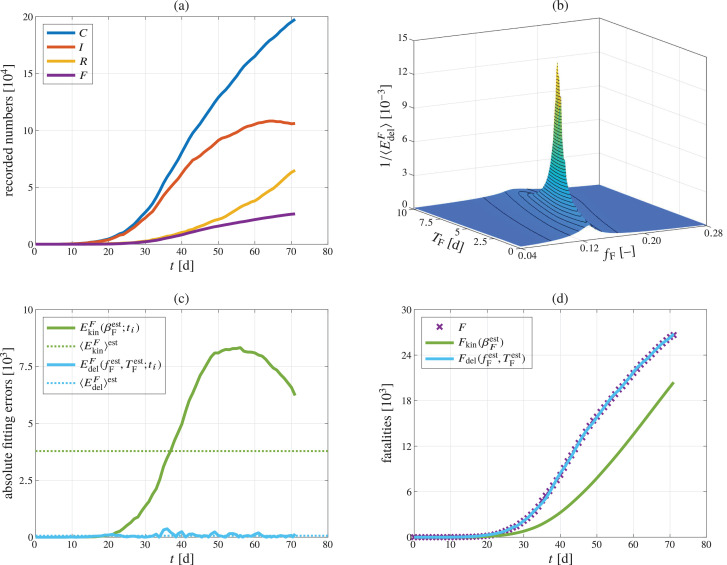
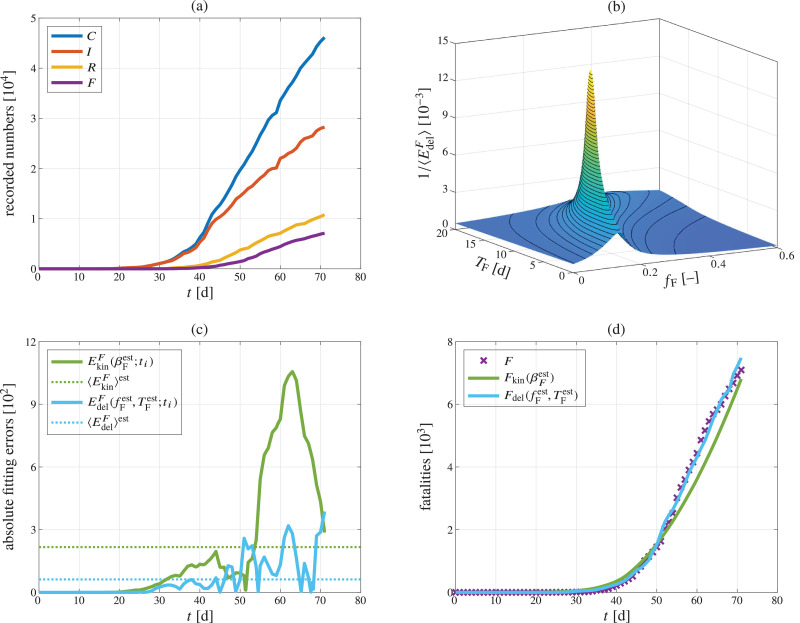
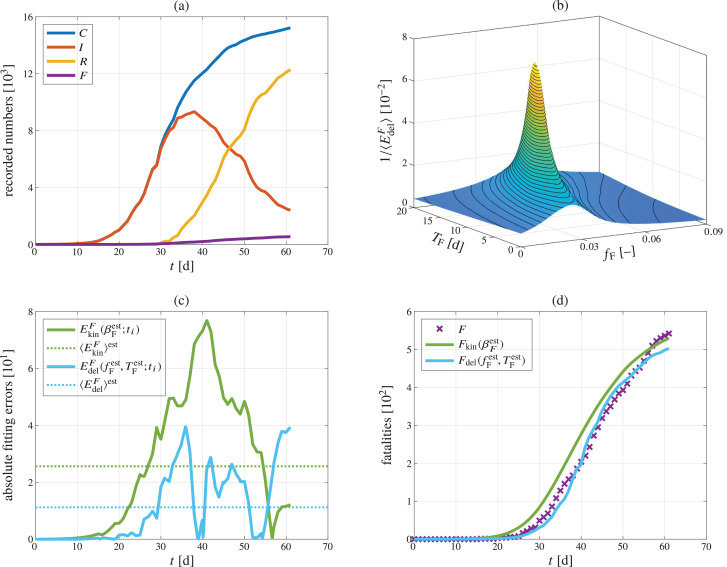
The COVID-19 pandemic has world-widely motivated numerous attempts to properly adjust classical epidemiological models, namely those of the SEIR-type, to the spreading characteristics of the novel Corona virus. In this context, the fundamental structure of the differential equations making up the SEIR models has remained largely unaltered-presuming that COVID-19 may be just "another epidemic". We here take an alternative approach, by investigating the relevance of one key ingredient of the SEIR models, namely the death kinetics law. The latter is compared to an alternative approach, which we call infection-to-death delay rule. For that purpose, we check how well these two mathematical formulations are able to represent the publicly available country-specific data on recorded fatalities, across a selection of 57 different nations. Thereby, we consider that the model-governing parameters-namely, the death transmission coefficient for the death kinetics model, as well as the apparent fatality-to-case fraction and the characteristic fatal illness period for the infection-to-death delay rule-are time-invariant. For 55 out of the 57 countries, the infection-to-death delay rule turns out to represent the actual situation significantly more precisely than the classical death kinetics rule. We regard this as an important step towards making SEIR-approaches more fit for the COVID-19 spreading prediction challenge.
新冠疫情在全球范围内促使人们进行了大量尝试,以适当调整经典的流行病学模型,即那些SEIR类型的模型,使其适应新型冠状病毒的传播特征。在这种情况下,构成SEIR模型的微分方程的基本结构在很大程度上保持不变——前提是新冠疫情可能只是“另一场流行病”。我们在此采用一种替代方法,研究SEIR模型的一个关键要素,即死亡动力学定律的相关性。将其与一种替代方法进行比较,我们称之为感染到死亡延迟规则。为此,我们检验这两种数学公式在57个不同国家的样本中,能够多好地代表公开可得的特定国家的死亡记录数据。在此过程中,我们认为模型控制参数,即死亡动力学模型的死亡传播系数,以及感染到死亡延迟规则的表观病死率和特征性致命疾病期是时间不变的。在57个国家中的55个国家,感染到死亡延迟规则比经典的死亡动力学规则更能精确地代表实际情况。我们认为这是使SEIR方法更适合新冠疫情传播预测挑战的重要一步。