Wang Xuan, Wang Zheng, Pan Junjie, Lu Zhou-Yi, Xu Dong, Zhang Hui-Jun, Wang Shao-Hua, Huang Da-Yu, Chen Xiao-Feng
Department of Thoracic Surgery, Huashan Hospital, Fudan University, Shanghai, China.
Comprehensive Breast Health Center, Ruijin Hospital, Shanghai Jiao Tong University School of Medicine, Shanghai, China.
Front Oncol. 2020 May 19;10:715. doi: 10.3389/fonc.2020.00715. eCollection 2020.
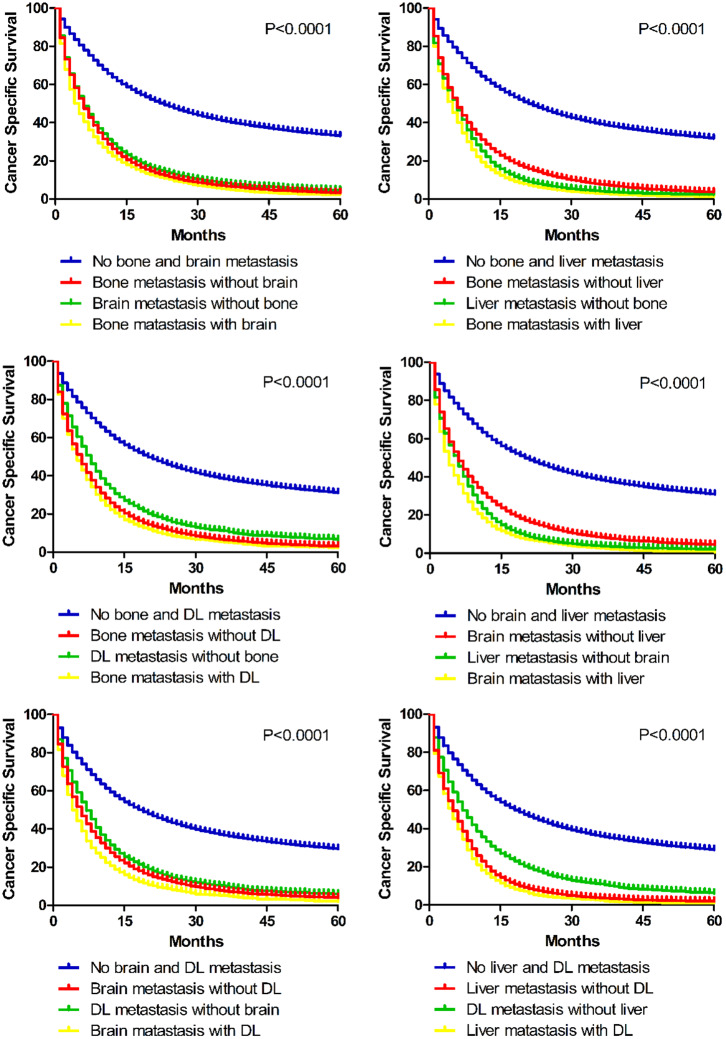
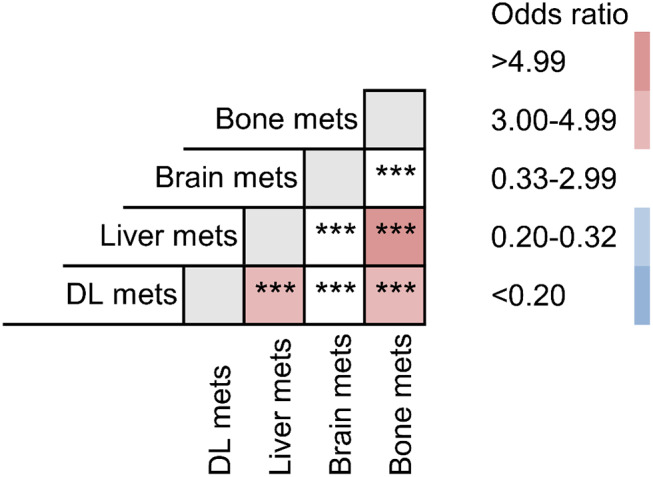
Lung cancer is the leading cause of cancer-related deaths mainly attributable to metastasis, especially extrathoracic metastasis. This large-cohort research is aimed to explore metastatic profiles in different histological types of lung cancer, as well as to assess clinicopathological and survival significance of diverse metastatic lesions. Lung cancer cases were extracted and enrolled from the Surveillance, Epidemiology, and End Results (SEER) database. χ-tests were conducted to make comparisons of metastatic distribution among different histological types and odds ratios were calculated to analyze co-occurrence relationships between different metastatic lesions. Kaplan-Meier methods were performed to analyze survival outcomes according to different metastatic sites and Cox regression models were conducted to identify independent prognostic factors. In total, we included 159,241 lung cancer cases with detailed metastatic status and complete follow-up information. In order to understand their metastatic patterns, we elucidated the following points in this research: (1) Comparing the frequencies of different metastatic lesions in different histological types. The frequency of bone metastasis was highest in adenocarcinoma, squamous cell carcinoma, LCLC and NSCLC/NOS, while liver was the most common metastatic site in SCLC. (2) Elaborating the tendency of combined metastases. Bi-site metastases occurred more common than tri-site and tetra-site metastases. And several metastatic sites, such as bone and liver, intended to co-metastasize preferentially. (3) Clarifying the prognostic significance of single-site and bi-site metastases. All single-site metastases were independent prognostic factors and co-metastases ended up with even worse survival outcomes. Thus, our findings would be beneficial for research design and clinical practice.
肺癌是癌症相关死亡的主要原因,主要归因于转移,尤其是胸外转移。这项大型队列研究旨在探索不同组织学类型肺癌的转移特征,以及评估不同转移病灶的临床病理和生存意义。从监测、流行病学和最终结果(SEER)数据库中提取并纳入肺癌病例。进行χ检验以比较不同组织学类型之间的转移分布,并计算比值比以分析不同转移病灶之间的共现关系。采用Kaplan-Meier方法根据不同转移部位分析生存结果,并进行Cox回归模型以确定独立的预后因素。我们总共纳入了159,241例具有详细转移状态和完整随访信息的肺癌病例。为了了解它们的转移模式,我们在本研究中阐明了以下几点:(1)比较不同组织学类型中不同转移病灶的频率。腺癌、鳞状细胞癌、大细胞肺癌和非小细胞肺癌/未特指型中骨转移的频率最高,而肝是小细胞肺癌最常见的转移部位。(2)阐述联合转移的趋势。双部位转移比三部位和四部位转移更常见。并且一些转移部位,如骨和肝,倾向于优先共同转移。(3)明确单部位和双部位转移的预后意义。所有单部位转移都是独立的预后因素,联合转移最终导致更差的生存结果。因此,我们的研究结果将有助于研究设计和临床实践。