Department of Psychiatry, University of Pittsburgh, Pittsburgh, PA, 15213, USA.
Department of Psychiatry, University of Pittsburgh, Pittsburgh, PA, 15213, USA; Department of Psychology, University of Pittsburgh, Pittsburgh, PA, 15260, USA.
Dev Cogn Neurosci. 2020 Jun;43:100779. doi: 10.1016/j.dcn.2020.100779. Epub 2020 Apr 1.
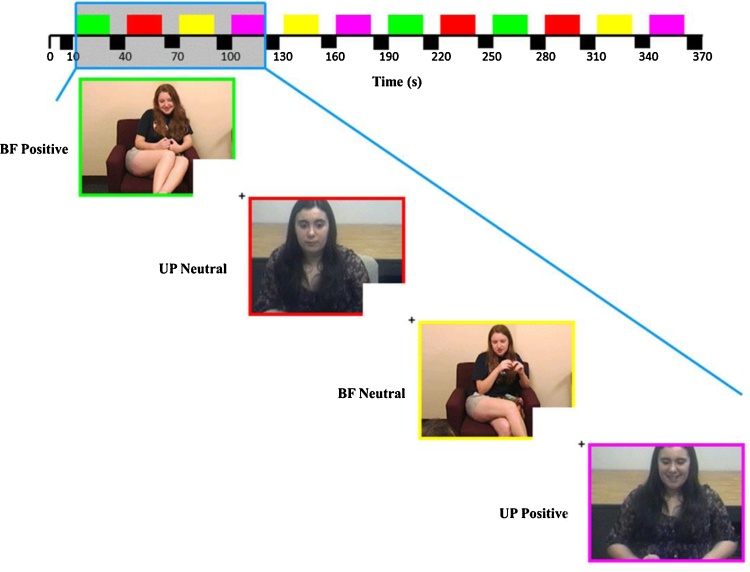
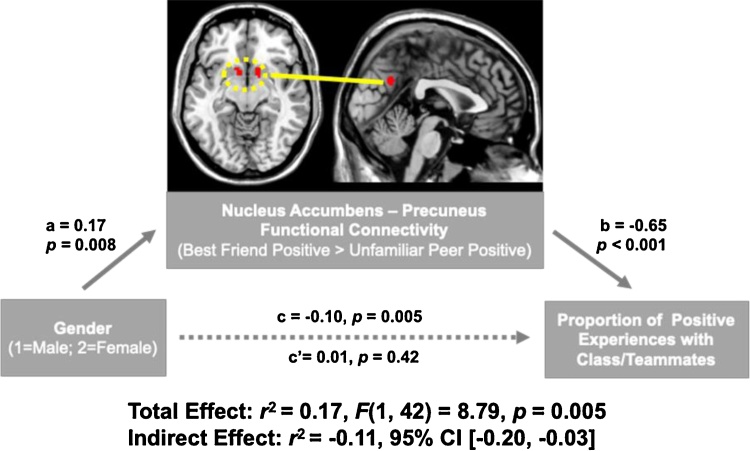
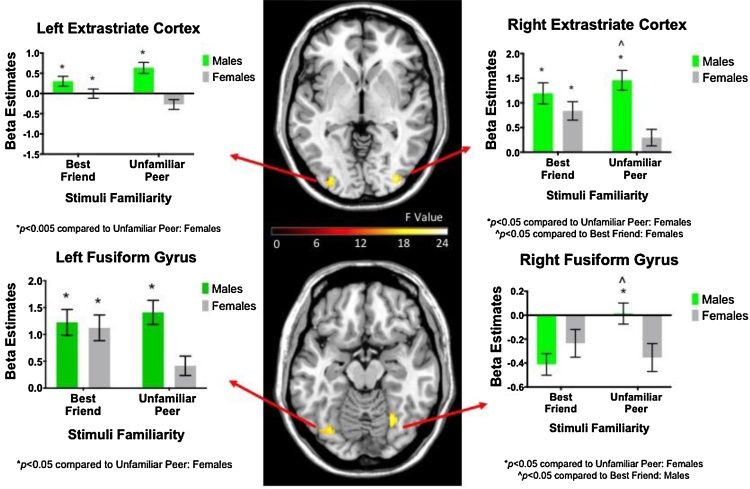
Peers become increasingly important during adolescence, with emerging gender differences in peer relationships associated with distinct behavioral and emotional outcomes. Males tend to socialize in larger peer groups with competitive interactions, whereas females engage in longer bouts of dyadic interaction with more intimacy. To examine gender differences in neural response to ecologically valid displays of positive affect and future social interactions, 52 adolescents (14-18 years old; female = 30) completed a social reward functional magnetic resonance imaging (fMRI) task with videos of a same-gender best friend (BF) or unfamiliar peer (UP) expressing positive (versus neutral) affect. Participants completed ecological momentary assessment of social experiences for two 5-day intervals. Compared with females, males more often reported that their happiest experience in the past hour occurred with class/teammates. Females and males displayed greater fusiform gyrus (FG) activation during BF and UP conditions, respectively (p<0.0001, p<0.05, family-wise error). Compared with males, females exhibited greater nucleus accumbens (NAcc)-precuneus functional connectivity to BF Positive> UP Positive. An exploratory analysis indicated that the association of male gender with a greater proportion of positive experiences with class/teammates was statistically mediated by greater NAcc-precuneus functional connectivity. Gender differences in positive social experiences may be associated with reward and social cognition networks.
在青少年时期,同伴变得越来越重要,同伴关系中出现的性别差异与不同的行为和情绪结果有关。男性倾向于在具有竞争互动的更大同伴群体中社交,而女性则进行更亲密的长时间二元互动。为了研究神经对积极情感和未来社交互动的生态有效展示的性别差异,52 名青少年(14-18 岁;女性=30)完成了一项社交奖励功能磁共振成像(fMRI)任务,其中包含同性别最好的朋友(BF)或不熟悉的同伴(UP)表达积极(相对于中性)情感的视频。参与者在两个 5 天的间隔内完成了社交经历的生态瞬间评估。与女性相比,男性更常报告说他们过去一小时最快乐的经历是与同班/队友一起度过的。与男性相比,女性在 BF 和 UP 条件下显示出更大的梭状回(FG)激活(p<0.0001,p<0.05,全脑错误)。与男性相比,女性的伏隔核-楔前叶功能连接对 BF 阳性> UP 阳性的反应更大。一项探索性分析表明,男性与与同班/队友一起经历更多积极体验的比例较高的关联,统计学上是由伏隔核-楔前叶功能连接较大介导的。积极社交体验的性别差异可能与奖励和社会认知网络有关。