Dhum Matthias, Herwig Uwe, Opialla Sarah, Siegrist Michael, Brühl Annette B
Department of Consumer Behavior, Institute of Environmental Decisions, ETHZurich, Switzerland.
Department of Psychiatry, Psychotherapy and Psychosomatics, University Hospital of Psychiatry, University of ZurichZurich, Switzerland.
Front Hum Neurosci. 2017 Aug 23;11:415. doi: 10.3389/fnhum.2017.00415. eCollection 2017.
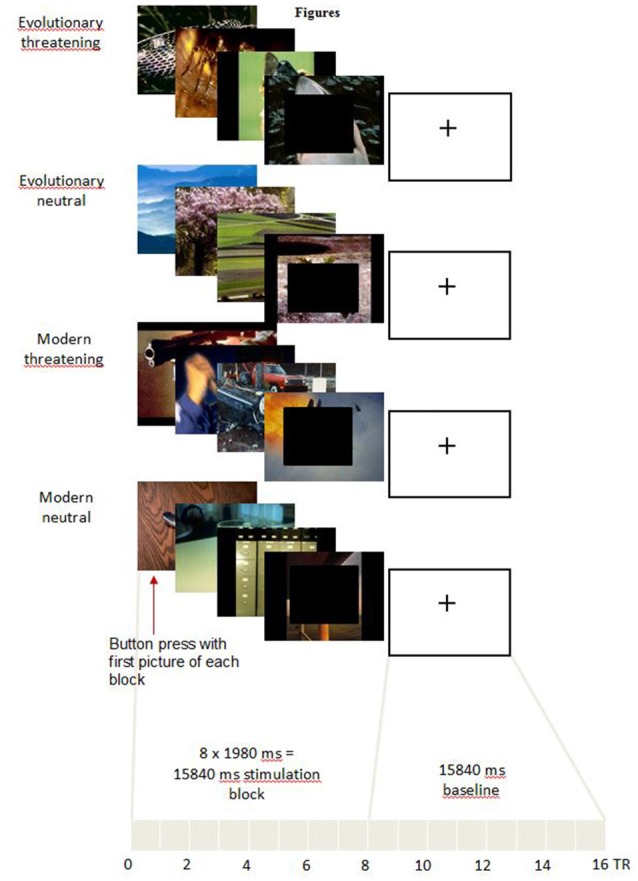
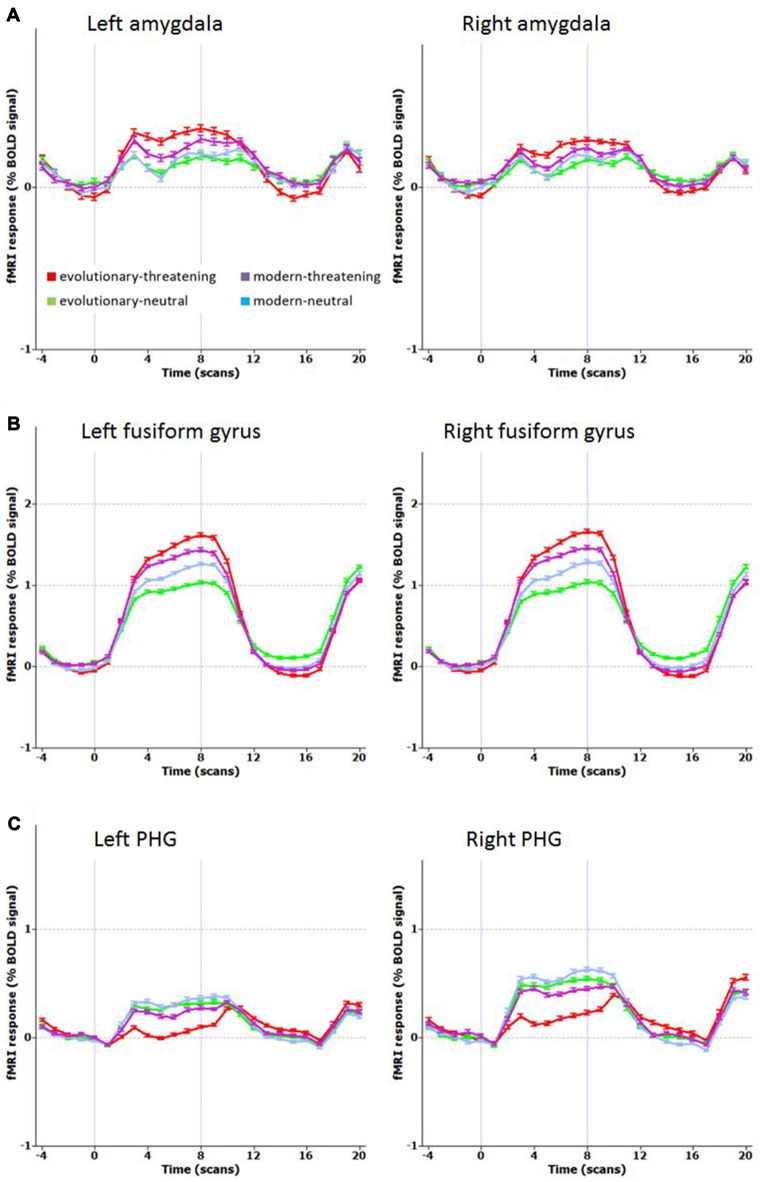
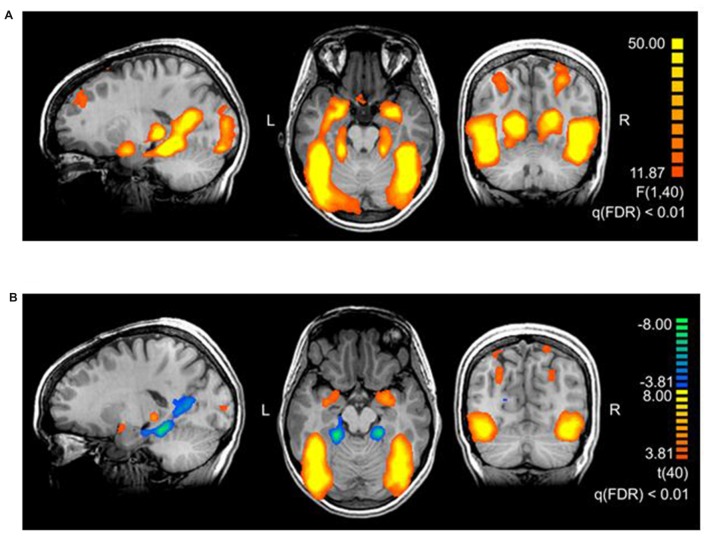
From an evolutionary perspective, environmental threats relevant for survival constantly challenged human beings. Current research suggests the evolution of a fear processing module in the brain to cope with these threats. Recently, humans increasingly encountered modern threats (e.g., guns or car accidents) in addition to evolutionary threats (e.g., snakes or predators) which presumably required an adaptation of perception and behavior. However, the neural processes underlying the perception of these different threats remain to be elucidated. We investigated the effect of image content (i.e., evolutionary vs. modern threats) on the activation of neural networks of emotion processing. During functional magnetic resonance imaging (fMRI) 41 participants watched affective pictures displaying evolutionary-threatening, modern-threatening, evolutionary-neutral and modern-neutral content. Evolutionary-threatening stimuli evoked stronger activations than modern-threatening stimuli in left inferior frontal gyrus and thalamus, right middle frontal gyrus and parietal regions as well as bilaterally in parietal regions, fusiform gyrus and bilateral amygdala. We observed the opposite effect, i.e., higher activity for modern-threatening than for evolutionary-threatening stimuli, bilaterally in the posterior cingulate and the parahippocampal gyrus. We found no differences in subjective arousal ratings between the two threatening conditions. On the valence scale though, subjects rated modern-threatening pictures significantly more negative than evolutionary-threatening pictures, indicating a higher level of perceived threat. The majority of previous studies show a positive relationship between arousal rating and amygdala activity. However, comparing fMRI results with behavioral findings we provide evidence that neural activity in fear processing areas is not only driven by arousal or valence, but presumably also by the evolutionary content of the stimulus. This has also fundamental methodological implications, in the sense to suggest a more elaborate classification of stimulus content to improve the validity of experimental designs.
从进化的角度来看,与生存相关的环境威胁一直困扰着人类。当前的研究表明,大脑中进化出了一个恐惧处理模块来应对这些威胁。最近,除了进化威胁(如蛇或食肉动物)之外,人类越来越多地遭遇现代威胁(如枪支或车祸),这可能需要对感知和行为进行调整。然而,对这些不同威胁的感知背后的神经过程仍有待阐明。我们研究了图像内容(即进化威胁与现代威胁)对情绪处理神经网络激活的影响。在功能磁共振成像(fMRI)过程中,41名参与者观看了展示进化威胁、现代威胁、进化中性和现代中性内容的情感图片。与现代威胁性刺激相比,进化威胁性刺激在左额下回和丘脑、右额中回和顶叶区域以及双侧顶叶区域、梭状回和双侧杏仁核中引起更强的激活。我们观察到相反的效果,即在双侧扣带回后部和海马旁回中,现代威胁性刺激比进化威胁性刺激具有更高的活性。我们发现两种威胁条件下的主观唤醒评分没有差异。然而,在效价量表上,受试者对现代威胁性图片的评分明显比进化威胁性图片更负面,表明感知到的威胁程度更高。以前的大多数研究表明唤醒评分与杏仁核活动之间存在正相关。然而,将fMRI结果与行为结果进行比较,我们提供了证据表明恐惧处理区域的神经活动不仅由唤醒或效价驱动,还可能由刺激的进化内容驱动。这在某种意义上也具有基本的方法学意义,即建议对刺激内容进行更精细的分类,以提高实验设计的有效性。