Evolutionary Ecology, Institute for Organismic and Molecular Evolution (iomE), Johannes Gutenberg University, Hanns-Dieter-Hüsch-Weg 15, 55128, Mainz, Germany.
Plant Evolutionary Ecology, Institute of Evolution and Ecology, University of Tübingen, Auf der Morgenstelle 5, 72076, Tübingen, Germany.
Nat Commun. 2020 Jun 11;11(1):2964. doi: 10.1038/s41467-020-16687-7.
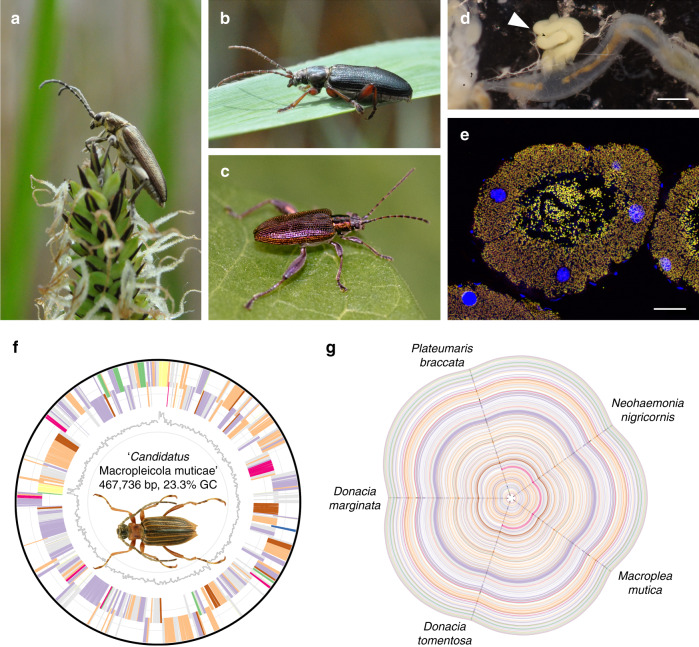
Symbiotic microbes can enable their host to access untapped nutritional resources but may also constrain niche space by promoting specialization. Here, we reconstruct functional changes in the evolutionary history of the symbiosis between a group of (semi-)aquatic herbivorous insects and mutualistic bacteria. Sequencing the symbiont genomes across 26 species of reed beetles (Chrysomelidae, Donaciinae) spanning four genera indicates that the genome-eroded mutualists provide life stage-specific benefits to larvae and adults, respectively. In the plant sap-feeding larvae, the symbionts are inferred to synthesize most of the essential amino acids as well as the B vitamin riboflavin. The adult reed beetles' folivory is likely supported by symbiont-encoded pectinases that complement the host-encoded set of cellulases, as revealed by transcriptome sequencing. However, mapping the occurrence of the symbionts' pectinase genes and the hosts' food plant preferences onto the beetles' phylogeny reveals multiple independent losses of pectinase genes in lineages that switched to feeding on pectin-poor plants, presumably constraining their hosts' subsequent adaptive potential.
共生微生物可以使宿主利用未开发的营养资源,但也可以通过促进专业化来限制生态位空间。在这里,我们重建了一组(半)水生草食性昆虫与其共生细菌之间共生关系的进化历史中的功能变化。对跨越四个属的 26 种芦苇甲虫(Chrysomelidae,Donaciinae)的共生体基因组进行测序表明,基因组侵蚀的共生体分别为幼虫和成虫提供了特定生命阶段的益处。在植物汁液取食的幼虫中,共生体被推断合成了大部分必需氨基酸以及维生素 B 族中的核黄素。成年芦苇甲虫的食叶行为可能得到了共生体编码的果胶酶的支持,这些酶补充了宿主编码的纤维素酶,这一点通过转录组测序得到了揭示。然而,将共生体的果胶酶基因的出现和宿主对食物植物的偏好映射到甲虫的系统发育树上,揭示了在转向以果胶含量低的植物为食的谱系中,果胶酶基因多次独立丢失,这可能限制了它们宿主随后的适应潜力。