Konno Masamitsu, Asai Ayumu, Kitagawa Toru, Yabumoto Masami, Ofusa Ken, Arai Takahiro, Hirotsu Takaaki, Doki Yuichiro, Eguchi Hidetoshi, Ishii Hideshi
Center of Medical Innovation and Translational Research, Osaka University Graduate School of Medicine, Suita, Yamadaoka 2-2, Osaka 565-0871, Japan.
Artificial Intelligence Research Center, The Institute of Scientific and Industrial Research, Osaka University, 8-1 Mihogaoka, Ibaraki, Osaka 567-0047, Japan.
Diagnostics (Basel). 2020 Jun 10;10(6):392. doi: 10.3390/diagnostics10060392.
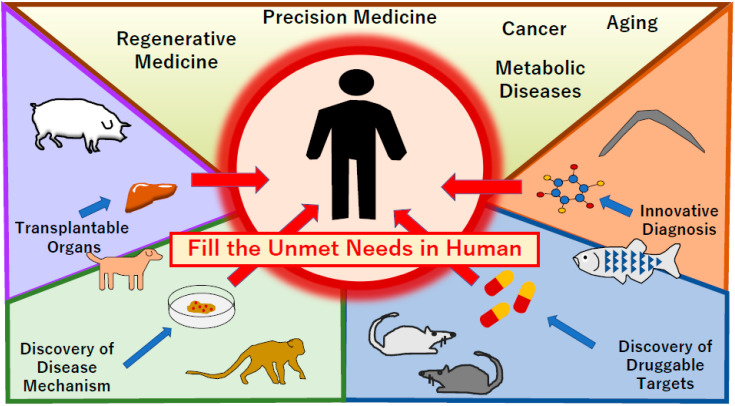
Since the 1980s, molecular biology has been used to investigate medical field mechanisms that still require the use of crude biological materials in order to achieve their necessary goals. Transcription factor-induced pluripotent stem cells are used in regenerative medicine to screen drugs and to support lost tissues. However, these cells insufficiently reconstruct whole organs and require various intact cells, such as damaged livers and diabetic pancreases. For efficient gene transfer in medical use, virally mediated gene transfers are used, although immunogenic issues are investigated. To obtain efficient detective and diagnostic power in intractable diseases, biological tools such as roundworms and zebrafish have been found to be useful for high-throughput screening (HST) and diagnosis. Taken together, this biological approach will help to fill the gaps between medical needs and novel innovations in the field of medicine.
自20世纪80年代以来,分子生物学一直被用于研究医学领域的机制,这些机制仍需要使用粗制生物材料来实现其必要目标。转录因子诱导的多能干细胞被用于再生医学中筛选药物和支持受损组织。然而,这些细胞无法充分重建整个器官,并且需要各种完整细胞,如受损肝脏和糖尿病胰腺。为了在医学应用中实现高效的基因转移,人们使用了病毒介导的基因转移,尽管免疫原性问题仍在研究中。为了在难治性疾病中获得高效的检测和诊断能力,人们发现诸如线虫和斑马鱼等生物工具可用于高通量筛选(HST)和诊断。综上所述,这种生物学方法将有助于填补医学需求与医学领域新创新之间的差距。