Department of Otorhinolaryngology-Head and Neck Surgery, Soonchunhyang University College of Medicine, Cheonan, Republic of Korea.
Hallym Data Science Laboratory, Hallym University College of Medicine, Anyang, Republic of Korea.
Sci Rep. 2020 Jun 12;10(1):9589. doi: 10.1038/s41598-020-66479-8.
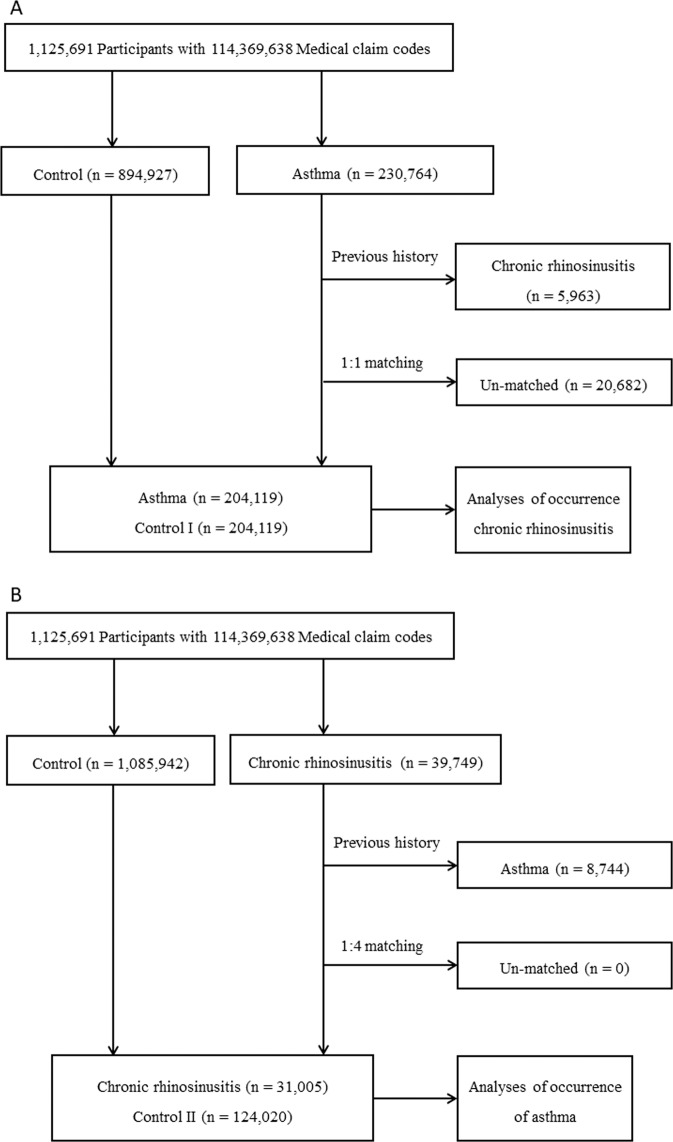
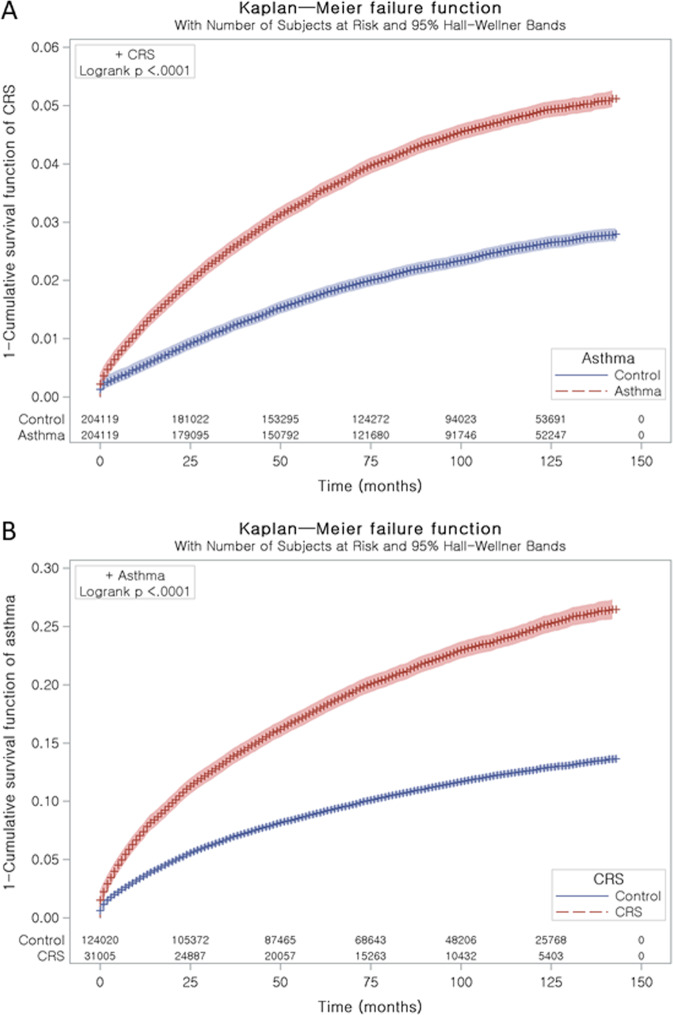
The aim of this study was to evaluate an epidemiologic association of asthma and chronic rhinosinusitis (CRS) using a national sample cohort of the Korean population. We collected data from the Korean Health Insurance Review and Assessment Service-National Sample Cohort between 2002 and 2013, and two different case-control cohorts were designed (1st: asthmatic patients matched in a 1:1 ratio with 204,119 non-asthmatics as control I, 2nd: CRS patients matched in a 1:4 ratio with 124,020 non-CRS patients as control II). Bidirectional association was examined using Cox proportional hazard models stratified by age, sex, income, and region of residence. Patients with asthma had an increased risk of developing CRS [adjusted hazard ratio (95% confidence interval) = 1.74 (1.67-1.80)], both with nasal polyps [1.55 (1.36-1.78)], without nasal polyps [1.74 (1.67-1.81)]. In the second cohort, patients with CRS had increased risk of developing asthma [1.85 (1.80-1.91)] with similar results for those with and without nasal polyps. The strongest association for risk of CRS was in 20-39 years old men with asthma [2.41 (1.97-2.96)], while the strongest association for increased risk of asthma in those with CRS group was also seen in this same subgroup [2.40 (2.18-2.63)]. CRS and asthma had a bidirectional influence on each other. CRS increased the risk of asthma, and asthma increased the risk of CRS, especially in young men.
本研究旨在使用韩国人群的国家样本队列评估哮喘和慢性鼻-鼻窦炎(CRS)的流行病学关联。我们从 2002 年至 2013 年期间收集了韩国健康保险审查和评估服务-国家样本队列的数据,并设计了两个不同的病例对照队列(第 1 组:哮喘患者与 204119 名非哮喘患者 1:1 匹配作为对照 I,第 2 组:CRS 患者与 124020 名非 CRS 患者 1:4 匹配作为对照 II)。使用 Cox 比例风险模型分层分析年龄、性别、收入和居住地区域,检验双向关联。哮喘患者发生 CRS 的风险增加[调整后的危险比(95%置信区间)=1.74(1.67-1.80)],伴或不伴鼻息肉均如此[1.55(1.36-1.78)]。在第二队列中,CRS 患者发生哮喘的风险增加[1.85(1.80-1.91)],伴或不伴鼻息肉的结果相似。哮喘男性 20-39 岁者发生 CRS 的风险最高[2.41(1.97-2.96)],而 CRS 患者组中哮喘风险增加的最强关联也出现在这一亚组中[2.40(2.18-2.63)]。CRS 和哮喘之间存在双向影响。CRS 增加哮喘的风险,哮喘增加 CRS 的风险,尤其是在年轻男性中。