• 文献检索
  • 文档翻译
  • 深度研究
  • 学术资讯
  • Suppr Zotero 插件Zotero 插件
  • 邀请有礼
  • 套餐&价格
  • 历史记录
应用&插件
Suppr Zotero 插件Zotero 插件浏览器插件Mac 客户端Windows 客户端微信小程序
定价
高级版会员购买积分包购买API积分包
服务
文献检索文档翻译深度研究API 文档MCP 服务
关于我们
关于 Suppr公司介绍联系我们用户协议隐私条款
关注我们

Suppr 超能文献

核心技术专利:CN118964589B侵权必究
粤ICP备2023148730 号-1Suppr @ 2026

文献检索

告别复杂PubMed语法,用中文像聊天一样搜索,搜遍4000万医学文献。AI智能推荐,让科研检索更轻松。

立即免费搜索

文件翻译

保留排版,准确专业,支持PDF/Word/PPT等文件格式,支持 12+语言互译。

免费翻译文档

深度研究

AI帮你快速写综述,25分钟生成高质量综述,智能提取关键信息,辅助科研写作。

立即免费体验

基因编辑技术推动脑肿瘤模型研究。

Genome Engineering Evolves Brain Tumor Modeling.

机构信息

Department of Neurosurgery, University of Minnesota Medical School.

Ludwig Institute for Cancer Research, University of California San Diego.

出版信息

Neurol Med Chir (Tokyo). 2020 Jul 15;60(7):329-336. doi: 10.2176/nmc.ra.2020-0091. Epub 2020 Jun 15.

DOI:10.2176/nmc.ra.2020-0091
PMID:32536682
原文链接:https://pmc.ncbi.nlm.nih.gov/articles/PMC7358782/
Abstract

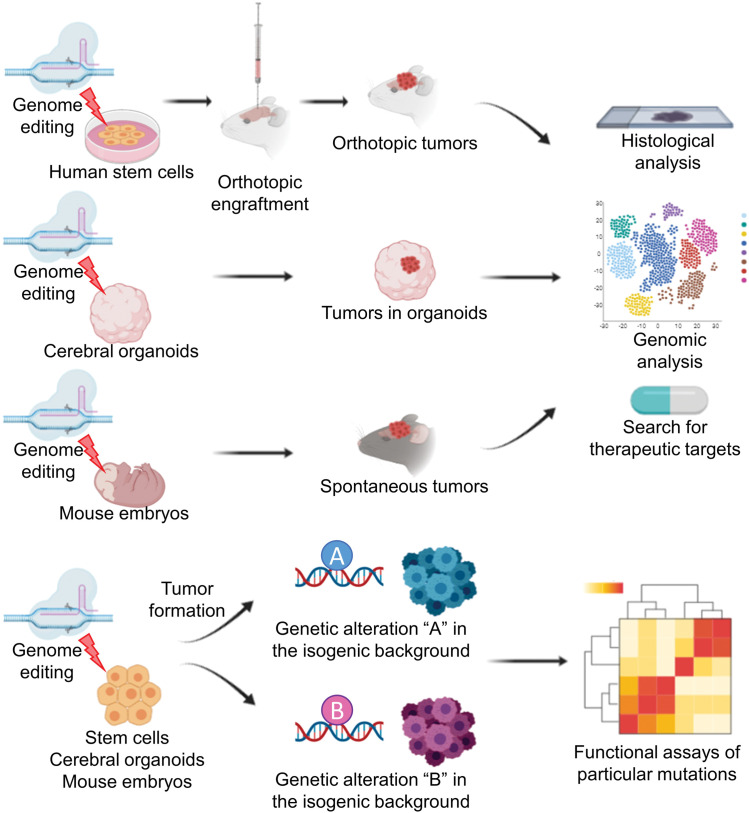
Genome engineering using programmable nucleases such as transcription activator-like effector nuclease (TALEN), and clustered regularly interspaced short palindromic repeat-associated protein nine facilitated the introduction of genetic alterations at specific genomic sites in various cell types. These tools have been applied to cancer modeling to understand the pathogenic effects of the growing catalog of mutations found in human cancers. Pertaining to brain tumors, neural progenitor cells derived from human induced pluripotent stem cells (iPSCs) engineered with different combinations of genetic driver mutations observed in distinct molecular subtypes of glioblastomas, the most common form of primary brain cancer in adults, give rise to brain tumors when engrafted orthotopically in mice. These glioblastoma models recapitulate the transcriptomic signature of each molecular subtype and authentically resemble pathobiology of glioblastoma, including inter- and intra-tumor heterogeneity, chromosomal aberrations, and extrachromosomal DNA amplifications. Similar engineering with genetic mutations found in medulloblastoma and atypical teratoid rhabdoid tumors in iPSCs have led to genetically trackable models that bear clinical relevance to these pediatric brain tumors. These models have contributed to improved comprehension of the genetic causation of tumorigenesis and offered a novel platform for therapeutic discovery. Studied in the context of three-dimensional cerebral organoids, these models have aided in the study of tumor invasion as well as therapeutic responses. In summary, modeling brain tumors through genome engineering enables not only the establishment of authentic tumor avatars driven by bona fide genetic mutations observed in patient samples but also facilitates functional investigations of particular genetic alterations in an otherwise isogenic background.

摘要

使用可编程核酸酶(如转录激活因子样效应核酸酶(TALEN))进行基因组工程,以及聚类规则间隔短回文重复相关蛋白 9(CRISPR/Cas9),可以在各种细胞类型的特定基因组位点引入遗传改变。这些工具已被应用于癌症建模,以了解在人类癌症中发现的不断增加的突变目录的致病效应。在脑肿瘤方面,源自人类诱导多能干细胞(iPSC)的神经祖细胞,经过不同组合的遗传驱动突变工程改造,这些突变在胶质母细胞瘤的不同分子亚型中观察到,是成人中最常见的原发性脑癌形式,当在小鼠中原位移植时会引发脑瘤。这些胶质母细胞瘤模型再现了每个分子亚型的转录组特征,并真实地类似于胶质母细胞瘤的病理生物学,包括肿瘤内和肿瘤间异质性、染色体异常和染色体外 DNA 扩增。在 iPSC 中发现的与髓母细胞瘤和非典型畸胎样横纹肌样瘤相关的遗传突变的类似工程导致了可遗传追踪的模型,这些模型与这些儿科脑肿瘤具有临床相关性。这些模型有助于提高对肿瘤发生的遗传原因的理解,并为治疗发现提供了新的平台。在三维大脑类器官的背景下研究这些模型,有助于研究肿瘤侵袭以及治疗反应。总之,通过基因组工程对脑肿瘤进行建模不仅可以建立由患者样本中观察到的真正遗传突变驱动的真实肿瘤模拟体,还可以在其他同基因背景下对特定遗传改变进行功能研究。
https://cdn.ncbi.nlm.nih.gov/pmc/blobs/f6b5/7358782/c9f00d9a38b1/nmc-60-329-g1.jpg

相似文献

1
Genome Engineering Evolves Brain Tumor Modeling.基因编辑技术推动脑肿瘤模型研究。
Neurol Med Chir (Tokyo). 2020 Jul 15;60(7):329-336. doi: 10.2176/nmc.ra.2020-0091. Epub 2020 Jun 15.
2
Longitudinal assessment of tumor development using cancer avatars derived from genetically engineered pluripotent stem cells.利用源于基因工程多能干细胞的癌症化身进行肿瘤发展的纵向评估。
Nat Commun. 2020 Jan 28;11(1):550. doi: 10.1038/s41467-020-14312-1.
3
Genetically engineered cerebral organoids model brain tumor formation.基因工程脑类器官模型模拟脑肿瘤形成。
Nat Methods. 2018 Aug;15(8):631-639. doi: 10.1038/s41592-018-0070-7. Epub 2018 Jul 23.
4
CRISPR therapeutic tools for complex genetic disorders and cancer (Review).CRISPR 治疗工具治疗复杂遗传疾病和癌症(综述)。
Int J Oncol. 2018 Aug;53(2):443-468. doi: 10.3892/ijo.2018.4434. Epub 2018 Jun 6.
5
Site-Specific Genome Engineering in Human Pluripotent Stem Cells.人类多能干细胞中的位点特异性基因组工程
Int J Mol Sci. 2016 Jun 24;17(7):1000. doi: 10.3390/ijms17071000.
6
Pioneering models of pediatric brain tumors.儿科脑瘤的开拓性模型。
Neoplasia. 2023 Feb;36:100859. doi: 10.1016/j.neo.2022.100859. Epub 2023 Jan 3.
7
Efficient CRISPR/Cas9-Based Genome Engineering in Human Pluripotent Stem Cells.基于CRISPR/Cas9的人类多能干细胞高效基因组工程
Curr Protoc Hum Genet. 2016 Jan 1;88:21.4.1-21.4.23. doi: 10.1002/0471142905.hg2104s88.
8
Studying Kidney Disease Using Tissue and Genome Engineering in Human Pluripotent Stem Cells.利用人类多能干细胞中的组织和基因组工程研究肾脏疾病。
Nephron. 2018;138(1):48-59. doi: 10.1159/000480710. Epub 2017 Oct 7.
9
Genomic editing tools to model human diseases with isogenic pluripotent stem cells.利用同基因多能干细胞模拟人类疾病的基因组编辑工具。
Stem Cells Dev. 2014 Nov 15;23(22):2673-86. doi: 10.1089/scd.2014.0167. Epub 2014 Oct 7.
10
Developmental origins and oncogenic pathways in malignant brain tumors.恶性脑肿瘤的发育起源与致癌途径
Wiley Interdiscip Rev Dev Biol. 2019 Jul;8(4):e342. doi: 10.1002/wdev.342. Epub 2019 Apr 3.

引用本文的文献

1
Modeling Human Brain Tumors and the Microenvironment Using Induced Pluripotent Stem Cells.利用诱导多能干细胞对人脑肿瘤及微环境进行建模
Cancers (Basel). 2023 Feb 16;15(4):1253. doi: 10.3390/cancers15041253.
2
Developing Bottom-Up Induced Pluripotent Stem Cell Derived Solid Tumor Models Using Precision Genome Editing Technologies.利用精确基因组编辑技术开发基于底部的诱导多能干细胞衍生的实体瘤模型。
CRISPR J. 2022 Aug;5(4):517-535. doi: 10.1089/crispr.2022.0032.
3
Friends with Benefits: Chemokines, Glioblastoma-Associated Microglia/Macrophages, and Tumor Microenvironment.

本文引用的文献

1
PIK3CA variants selectively initiate brain hyperactivity during gliomagenesis.PIK3CA 变异体在胶质瘤发生过程中选择性地引发大脑过度活跃。
Nature. 2020 Feb;578(7793):166-171. doi: 10.1038/s41586-020-1952-2. Epub 2020 Jan 29.
2
Longitudinal assessment of tumor development using cancer avatars derived from genetically engineered pluripotent stem cells.利用源于基因工程多能干细胞的癌症化身进行肿瘤发展的纵向评估。
Nat Commun. 2020 Jan 28;11(1):550. doi: 10.1038/s41467-020-14312-1.
3
Circular ecDNA promotes accessible chromatin and high oncogene expression.
有共同利益的朋友:趋化因子、胶质母细胞瘤相关的小胶质细胞/巨噬细胞和肿瘤微环境。
Int J Mol Sci. 2022 Feb 24;23(5):2509. doi: 10.3390/ijms23052509.
4
Applications of CRISPR-Cas9 Technology to Genome Editing in Glioblastoma Multiforme.CRISPR-Cas9 技术在多形性胶质母细胞瘤基因组编辑中的应用。
Cells. 2021 Sep 7;10(9):2342. doi: 10.3390/cells10092342.
5
The Organoid Era Permits the Development of New Applications to Study Glioblastoma.类器官时代推动了用于研究胶质母细胞瘤的新应用的发展。
Cancers (Basel). 2020 Nov 9;12(11):3303. doi: 10.3390/cancers12113303.
环状 ecDNA 促进染色质可及性和高致癌基因表达。
Nature. 2019 Nov;575(7784):699-703. doi: 10.1038/s41586-019-1763-5. Epub 2019 Nov 20.
4
An Integrative Model of Cellular States, Plasticity, and Genetics for Glioblastoma.胶质母细胞瘤的细胞状态、可塑性和遗传学综合模型
Cell. 2019 Aug 8;178(4):835-849.e21. doi: 10.1016/j.cell.2019.06.024. Epub 2019 Jul 18.
5
Engineering Genetic Predisposition in Human Neuroepithelial Stem Cells Recapitulates Medulloblastoma Tumorigenesis.工程化遗传易感性在人神经上皮干细胞中重现髓母细胞瘤的肿瘤发生。
Cell Stem Cell. 2019 Sep 5;25(3):433-446.e7. doi: 10.1016/j.stem.2019.05.013. Epub 2019 Jun 13.
6
Cancer modeling meets human organoid technology.癌症建模与人类类器官技术相遇。
Science. 2019 Jun 7;364(6444):952-955. doi: 10.1126/science.aaw6985.
7
Modeling Patient-Derived Glioblastoma with Cerebral Organoids.利用脑类器官对患者来源的脑胶质瘤进行建模。
Cell Rep. 2019 Mar 19;26(12):3203-3211.e5. doi: 10.1016/j.celrep.2019.02.063.
8
Gboxin is an oxidative phosphorylation inhibitor that targets glioblastoma.Gboxin 是一种靶向神经胶质瘤的氧化磷酸化抑制剂。
Nature. 2019 Mar;567(7748):341-346. doi: 10.1038/s41586-019-0993-x. Epub 2019 Mar 6.
9
Human Pluripotent Stem Cell-Derived Tumor Model Uncovers the Embryonic Stem Cell Signature as a Key Driver in Atypical Teratoid/Rhabdoid Tumor.人多能干细胞源性肿瘤模型揭示胚胎干细胞特征为胚胎性肿瘤/横纹肌样瘤的关键驱动因素。
Cell Rep. 2019 Mar 5;26(10):2608-2621.e6. doi: 10.1016/j.celrep.2019.02.009.
10
Responsiveness to anti-PD-1 and anti-CTLA-4 immune checkpoint blockade in SB28 and GL261 mouse glioma models.SB28和GL261小鼠胶质瘤模型对抗PD-1和抗CTLA-4免疫检查点阻断的反应性。
Oncoimmunology. 2018 Sep 5;7(12):e1501137. doi: 10.1080/2162402X.2018.1501137. eCollection 2018.