Armson Bryony, Gubbins Simon, Mioulet Valérie, Qasim Ibrahim A, King Donald P, Lyons Nicholas A
Vesicular Disease Reference Laboratory, The Pirbright Institute, Surrey, United Kingdom.
Boyd Orr Centre for Population and Ecosystem Health, Institute of Biodiversity, Animal Health and Comparative Medicine, College of Medical, Veterinary and Life Sciences, University of Glasgow, Glasgow, United Kingdom.
Front Vet Sci. 2020 May 27;7:264. doi: 10.3389/fvets.2020.00264. eCollection 2020.
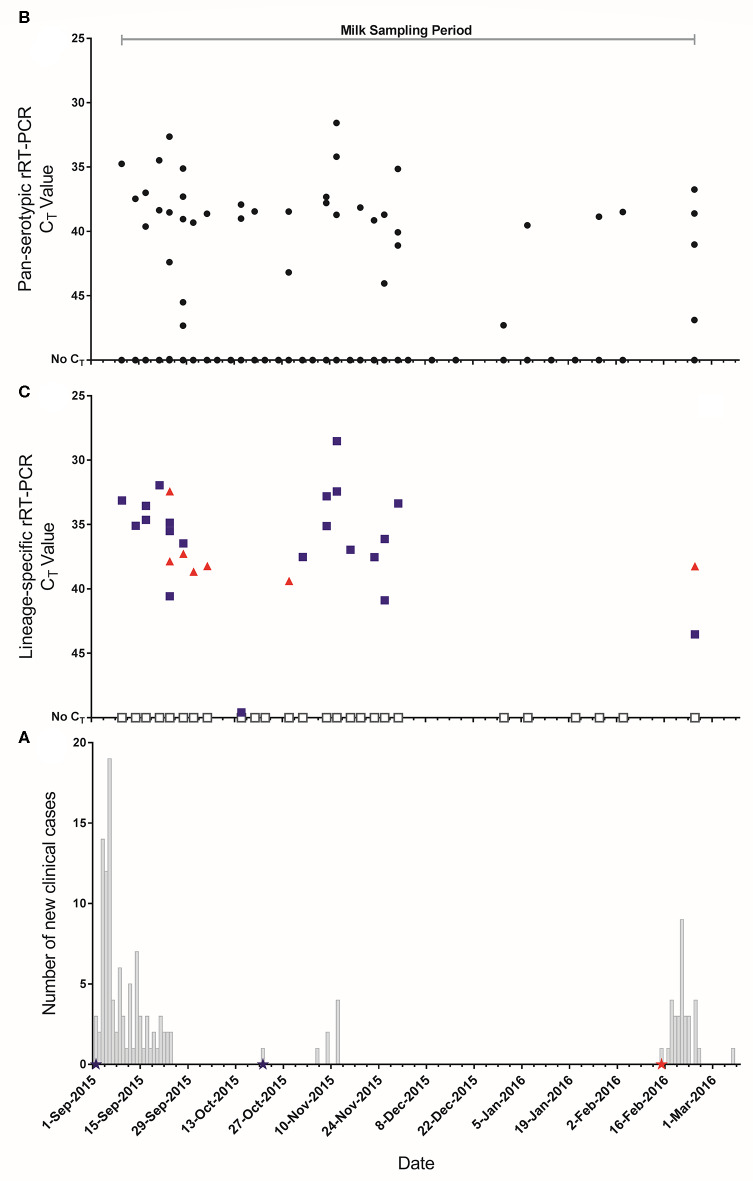
Pooled milk is used for the surveillance of several diseases of livestock. Previous studies demonstrated the detection of foot-and-mouth disease virus (FMDV) in the milk of infected animals at high dilutions, and consequently, the collection of pooled milk samples could be used to enhance FMD surveillance. This study evaluated pooled milk for FMDV surveillance on a large-scale dairy farm that experienced two FMD outbreaks caused by the A/ASIA/G-VII and O/ME-SA/Ind-2001d lineages, despite regular vaccination and strict biosecurity practices. FMDV RNA was detected in 42 (5.7%) of the 732 pooled milk samples, and typing information was concordant with diagnostic reports of clinical disease. The FMDV positive milk samples were temporally clustered around reports of new clinical cases, but with a wider distribution. For further investigation, a model was established to predict real-time RT-PCR (rRT-PCR) C values using individual cattle movement data, clinical disease records and virus excretion data from previous experimental studies. The model explained some of the instances where there were positive results by rRT-PCR, but no new clinical cases and suggested that subclinical infection occurred during the study period. Further studies are required to investigate the effect of vaccination on FMDV excretion in milk, and to evaluate more representative sampling methods. However, the results from this pilot study indicate that testing pooled milk by rRT-PCR may be valuable for FMD surveillance and has provided evidence of subclinical virus infection in vaccinated herds that could be important in the epidemiology of FMD in endemic countries where vaccination is used.
混合乳用于监测家畜的多种疾病。先前的研究表明,在感染动物的乳汁中能检测到高稀释度的口蹄疫病毒(FMDV),因此,采集混合乳样本可用于加强口蹄疫监测。本研究在一个大型奶牛场评估了混合乳对口蹄疫病毒的监测情况,该奶牛场尽管定期接种疫苗并采取了严格的生物安全措施,但仍经历了由A/ASIA/G-VII和O/ME-SA/Ind-2001d谱系引起的两次口蹄疫疫情。在732份混合乳样本中,有42份(5.7%)检测到FMDV RNA,分型信息与临床疾病诊断报告一致。FMDV阳性乳样本在时间上聚集在新临床病例报告周围,但分布范围更广。为了进一步调查,建立了一个模型,使用个体牛只移动数据、临床疾病记录和先前实验研究中的病毒排泄数据来预测实时逆转录聚合酶链反应(rRT-PCR)的C值。该模型解释了一些rRT-PCR呈阳性结果但无新临床病例的情况,并表明在研究期间发生了亚临床感染。需要进一步研究来调查疫苗接种对口蹄疫病毒在乳汁中排泄的影响,并评估更具代表性的采样方法。然而,这项初步研究的结果表明,通过rRT-PCR检测混合乳可能对口蹄疫监测有价值,并提供了在使用疫苗接种的流行国家中,接种牛群中亚临床病毒感染的证据,这在口蹄疫流行病学中可能很重要。