Kastan Jonathan P, Dobrikova Elena Y, Bryant Jeffrey D, Gromeier Matthias
Department of Neurosurgery, Duke University Medical Center, NC 27710, USA.
Sci Adv. 2020 Jun 3;6(23):eaba0745. doi: 10.1126/sciadv.aba0745. eCollection 2020 Jun.
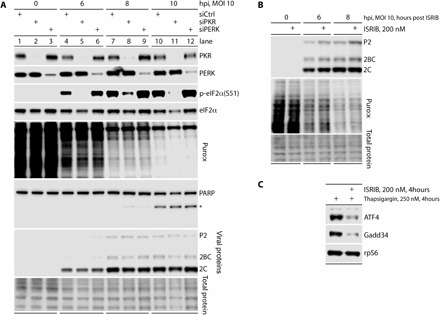
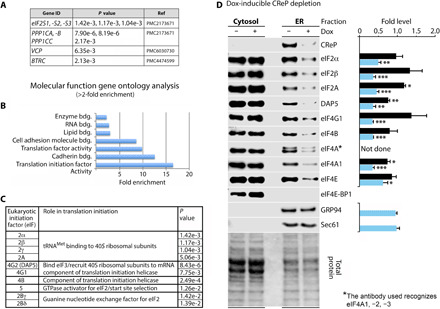
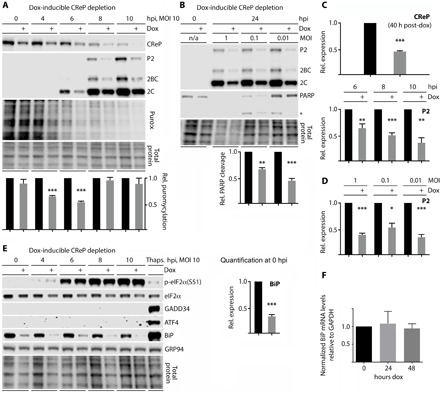
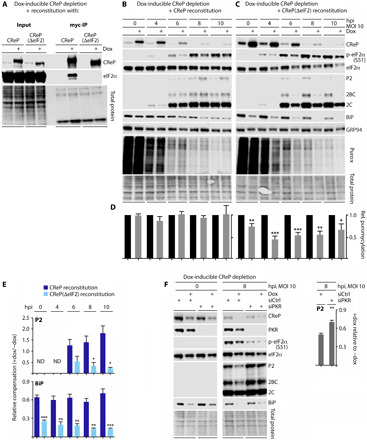
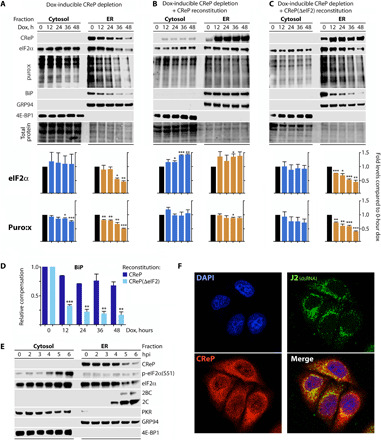
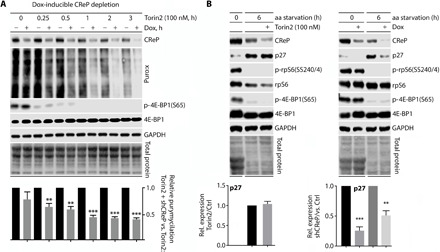
Eukaryotic protein synthesis control at multiple levels allows for dynamic, selective responses to diverse conditions, but spatial organization of translation initiation machinery as a regulatory principle has remained largely unexplored. Here we report on a role of constitutive repressor of eIF2α phosphorylation (CReP) in translation of poliovirus and the endoplasmic reticulum (ER)-resident chaperone binding immunoglobulin protein (BiP) at the ER. Functional, proximity-dependent labeling and cell fractionation studies revealed that CReP, through binding eIF2α, anchors translation initiation machinery at the ER and enables local protein synthesis in this compartment. This ER site was protected from the suppression of cytoplasmic protein synthesis by acute stress responses, e.g., phosphorylation of eIF2α(S51) or mTOR blockade. We propose that partitioning of translation initiation machinery at the ER enables cells to maintain active translation during stress conditions associated with global protein synthesis suppression.
真核生物蛋白质合成在多个水平上的调控允许对各种条件做出动态、选择性的反应,但翻译起始机制的空间组织作为一种调控原则在很大程度上仍未被探索。在这里,我们报道了真核翻译起始因子2α磷酸化的组成型阻遏物(CReP)在脊髓灰质炎病毒翻译以及内质网(ER)驻留伴侣结合免疫球蛋白蛋白(BiP)在内质网的翻译中的作用。功能、邻近依赖性标记和细胞分级分离研究表明,CReP通过结合真核翻译起始因子2α,将翻译起始机制锚定在内质网,并使该区域能够进行局部蛋白质合成。这个内质网位点受到保护,免受急性应激反应(例如真核翻译起始因子2α(S51)的磷酸化或mTOR阻断)对细胞质蛋白质合成的抑制。我们提出,内质网上翻译起始机制的分区使细胞能够在与整体蛋白质合成抑制相关的应激条件下维持活跃的翻译。