Lashkevich Kseniya A, Dmitriev Sergey E
Belozersky Institute of Physico-Chemical Biology, Moscow State University, 119234 Moscow, Russia.
Faculty of Bioengineering and Bioinformatics, Moscow State University, 119234 Moscow, Russia.
Mol Biol. 2021;55(4):507-537. doi: 10.1134/S0026893321030080. Epub 2021 May 30.
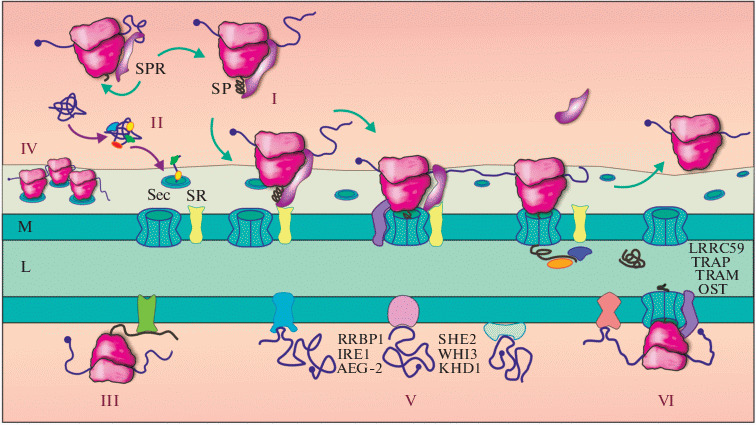
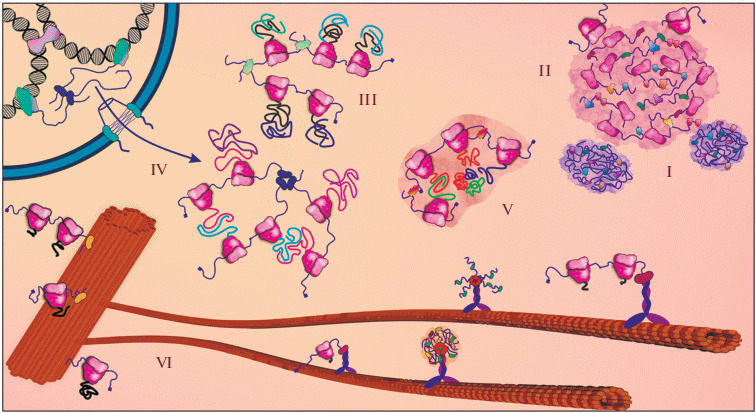
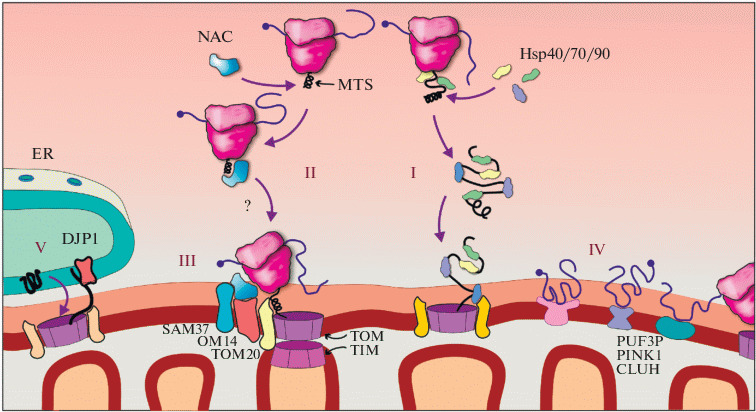
Spatial organization of protein biosynthesis in the eukaryotic cell has been studied for more than fifty years, thus many facts have already been included in textbooks. According to the classical view, mRNA transcripts encoding secreted and transmembrane proteins are translated by ribosomes associated with endoplasmic reticulum membranes, while soluble cytoplasmic proteins are synthesized on free polysomes. However, in the last few years, new data has emerged, revealing selective translation of mRNA on mitochondria and plastids, in proximity to peroxisomes and endosomes, in various granules and at the cytoskeleton (actin network, vimentin intermediate filaments, microtubules and centrosomes). There are also long-standing debates about the possibility of protein synthesis in the nucleus. Localized translation can be determined by targeting signals in the synthesized protein, nucleotide sequences in the mRNA itself, or both. With RNA-binding proteins, many transcripts can be assembled into specific RNA condensates and form RNP particles, which may be transported by molecular motors to the sites of active translation, form granules and provoke liquid-liquid phase separation in the cytoplasm, both under normal conditions and during cell stress. The translation of some mRNAs occurs in specialized "translation factories," assemblysomes, transperons and other structures necessary for the correct folding of proteins, interaction with functional partners and formation of oligomeric complexes. Intracellular localization of mRNA has a significant impact on the efficiency of its translation and presumably determines its response to cellular stress. Compartmentalization of mRNAs and the translation machinery also plays an important role in viral infections. Many viruses provoke the formation of specific intracellular structures, virus factories, for the production of their proteins. Here we review the current concepts of the molecular mechanisms of transport, selective localization and local translation of cellular and viral mRNAs, their effects on protein targeting and topogenesis, and on the regulation of protein biosynthesis in different compartments of the eukaryotic cell. Special attention is paid to new systems biology approaches, providing new cues to the study of localized translation.
真核细胞中蛋白质生物合成的空间组织已经研究了五十多年,因此许多事实已被纳入教科书。根据经典观点,编码分泌蛋白和跨膜蛋白的mRNA转录本由与内质网膜相关的核糖体翻译,而可溶性细胞质蛋白则在游离多聚核糖体上合成。然而,在过去几年中,出现了新的数据,揭示了mRNA在线粒体和质体上、靠近过氧化物酶体和内体处、在各种颗粒中以及在细胞骨架(肌动蛋白网络、波形蛋白中间丝、微管和中心体)上的选择性翻译。关于细胞核中蛋白质合成的可能性也存在长期争论。局部翻译可以由合成蛋白质中的靶向信号、mRNA本身的核苷酸序列或两者共同决定。通过RNA结合蛋白,许多转录本可以组装成特定RNA凝聚物并形成RNP颗粒,这些颗粒可以被分子马达运输到活跃翻译位点,形成颗粒并在正常条件下和细胞应激期间在细胞质中引发液-液相分离。一些mRNA的翻译发生在专门的“翻译工厂”、组装体、转座子和其他蛋白质正确折叠、与功能伙伴相互作用以及形成寡聚复合物所必需的结构中。mRNA的细胞内定位对其翻译效率有重大影响,并可能决定其对细胞应激的反应。mRNA和翻译机制的区室化在病毒感染中也起着重要作用。许多病毒会引发特定细胞内结构即病毒工厂的形成,用于生产它们的蛋白质。在这里,我们综述了关于细胞和病毒mRNA运输、选择性定位和局部翻译的分子机制的当前概念,它们对蛋白质靶向和拓扑结构的影响,以及对真核细胞不同区室中蛋白质生物合成调控的影响。特别关注新的系统生物学方法,为局部翻译的研究提供了新线索。