Wellman Center for Photomedicine, Massachusetts General Hospital, Boston, MA, USA.
Harvard Medical School, Boston, MA, USA.
Sci Rep. 2020 Jun 15;10(1):9611. doi: 10.1038/s41598-020-66158-8.
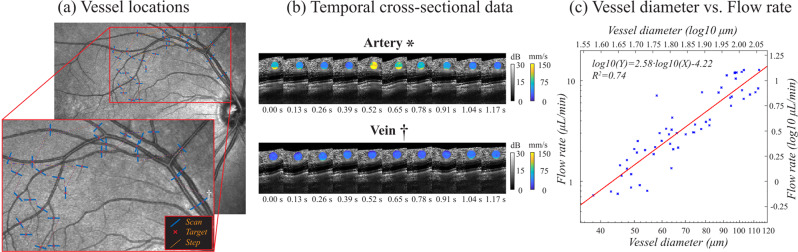
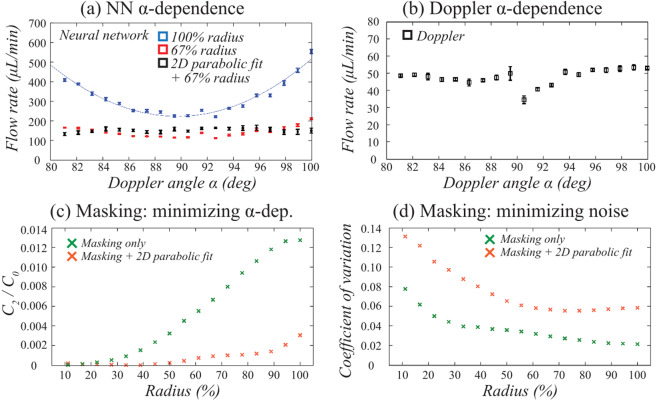
Many diseases of the eye are associated with alterations in the retinal vasculature that are possibly preceded by undetected changes in blood flow. In this work, a robust blood flow quantification framework is presented based on optical coherence tomography (OCT) angiography imaging and deep learning. The analysis used a forward signal model to simulate OCT blood flow data for training of a neural network (NN). The NN was combined with pre- and post-processing steps to create an analysis framework for measuring flow rates from individual blood vessels. The framework's accuracy was validated using both blood flow phantoms and human subject imaging, and across flow speed, vessel angle, hematocrit levels, and signal-to-noise ratio. The reported flow rate of the calibrated NN framework was measured to be largely independent of vessel angle, hematocrit levels, and measurement signal-to-noise ratio. In vivo retinal flow rate measurements were self-consistent across vascular branch points, and approximately followed a predicted power-law dependence on the vessel diameter. The presented OCT-based NN flow rate estimation framework addresses the need for a robust, deployable, and label-free quantitative retinal blood flow mapping technique.
许多眼部疾病都与视网膜血管的改变有关,而这些改变可能是在血流未被检测到的变化之前发生的。在这项工作中,提出了一种基于光学相干断层扫描(OCT)血管造影成像和深度学习的稳健血流量化框架。该分析使用正向信号模型来模拟 OCT 血流数据,以训练神经网络(NN)。将神经网络与预处理和后处理步骤相结合,创建了一个用于测量单个血管内血流速度的分析框架。该框架的准确性通过血流体模和人体成像进行了验证,涵盖了血流速度、血管角度、血细胞比容水平和信号噪声比等多个方面。报告的校准神经网络框架的血流速度测量结果在很大程度上独立于血管角度、血细胞比容水平和测量信号噪声比。在体内视网膜血流速度测量结果在血管分支点处是一致的,并且大致遵循了与血管直径的预测幂律关系。所提出的基于 OCT 的 NN 血流速度估计框架满足了对稳健、可部署和无标记的定量视网膜血流映射技术的需求。